place

Stade Canac

Baseball in Quebec CityBaseball venues in QuebecFrontier League ballparksMinor league baseball venuesSports venues in Quebec City
Use mdy dates from January 2017
StadeCanac1
StadeCanac1

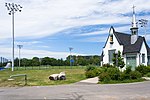
Stade Canac is a stadium in Quebec City, Quebec. It is used primarily for baseball and is currently the home stadium for the Quebec Capitales of the independent Frontier League. Originally opened in 1939, it has a capacity of 4,300 and is located within the boundaries of Parc Victoria, a municipal park and recreation area located between the St-Roch district of Quebec City and the south shore of the Saint-Charles River. The ballpark is often informally referred to as simply "Parc Victoria" by local residents even though the field only occupies about a quarter of the park's total area. Modest in capacity relative to the size of the city's population, it has been well-attended during Capitales home games.

Excerpt from the Wikipedia article Stade Canac (License: CC BY-SA 3.0, Authors, Images).

Stade Canac
Rue du Cardinal-Maurice-Roy, Quebec Saint-Roch (La Cité-Limoilou)

Geographical coordinates (GPS) Address Nearby Places
placeShow on map

Wikipedia: Stade CanacContinue reading on Wikipedia

Geographical coordinates (GPS)

Latitude Longitude
N 46.818611111111 ° E -71.233497222222 °
placeShow on map

Address

Stade Canac

Rue du Cardinal-Maurice-Roy
G1K 5Y3 Quebec, Saint-Roch (La Cité-Limoilou)
Quebec, Canada
mapOpen on Google Maps

StadeCanac1
StadeCanac1
Share experience

Nearby Places

Cartier-Brébeuf National Historic Site

Cartier-Brébeuf National Historic Site is a National Historic Site of Canada and so designated by the Historic Sites and Monuments board of Canada in 1958 under the recommendation of John Diefenbaker, the Prime Minister of Canada at the time. It is administered by Parks Canada and located at the confluence of Saint-Charles and Lairet rivers, in Quebec City, Quebec, Canada, more precisely in La Cité-Limoilou borough. On the site you can find an interpretation centre and a 6,8 hectares inner-city park characterised by an uneven landscape and divided into two sectors "East" and "West" separated by the Lairet river. Several commemorative monuments and elements are also present. The site commemorates the second voyage of Jacques Cartier; more precisely in 1535-1536 when he and his shipmates wintered near the Iroquoian village of Stadacona (Quebec City). It also recalls the establishment of the first residence of the Jesuit missionaries in Quebec, in 1625-1626. Moreover, by the end of the 17th century up to the opening of the national historic site in 1972, it hosted numerous hand-crafted and industrial activities such as a tannery, a pottery, a brickyard, a shipyard, a sawmill, a junkyard and a snow-dumping lot. Today, the site offers a museum exhibition, animations for elementary and high school groups, thematic events, and a natural habitat in an inner-city park. A cycleway and the linear park of Saint-Charles river also cross the park's ground.