place

La Cité-Limoilou

2009 establishments in QuebecBoroughs of Quebec CityGentrification in CanadaUse Canadian English from July 2022
Lacite limoilou
Lacite limoilou

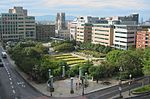
La Cité-Limoilou is the central borough of Quebec City, the oldest (in terms of architecture), and the most populous, comprising 21.85% of the city's total population. As an administrative division, it is very new, having only been formed on November 1, 2009, from the former boroughs of La Cité and Limoilou.

Excerpt from the Wikipedia article La Cité-Limoilou (License: CC BY-SA 3.0, Authors, Images).

La Cité-Limoilou
Rue de la Pointe-aux-Lièvres, Quebec Saint-Roch (La Cité-Limoilou)

Geographical coordinates (GPS) Address Nearby Places
placeShow on map

Wikipedia: La Cité-LimoilouContinue reading on Wikipedia

Geographical coordinates (GPS)

Latitude Longitude
N 46.8219 ° E -71.2372 °
placeShow on map

Address

BRCC - Ville de Québec - Pointe-aux-Lièvres

Rue de la Pointe-aux-Lièvres
G1K 5Y3 Quebec, Saint-Roch (La Cité-Limoilou, Village de l'Anse)
Quebec, Canada
mapOpen on Google Maps

Lacite limoilou
Lacite limoilou
Share experience

Nearby Places

Cartier-Brébeuf National Historic Site

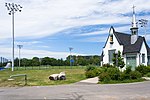
Cartier-Brébeuf National Historic Site is a National Historic Site of Canada and so designated by the Historic Sites and Monuments board of Canada in 1958 under the recommendation of John Diefenbaker, the Prime Minister of Canada at the time. It is administered by Parks Canada and located at the confluence of Saint-Charles and Lairet rivers, in Quebec City, Quebec, Canada, more precisely in La Cité-Limoilou borough. On the site you can find an interpretation centre and a 6,8 hectares inner-city park characterised by an uneven landscape and divided into two sectors "East" and "West" separated by the Lairet river. Several commemorative monuments and elements are also present. The site commemorates the second voyage of Jacques Cartier; more precisely in 1535-1536 when he and his shipmates wintered near the Iroquoian village of Stadacona (Quebec City). It also recalls the establishment of the first residence of the Jesuit missionaries in Quebec, in 1625-1626. Moreover, by the end of the 17th century up to the opening of the national historic site in 1972, it hosted numerous hand-crafted and industrial activities such as a tannery, a pottery, a brickyard, a shipyard, a sawmill, a junkyard and a snow-dumping lot. Today, the site offers a museum exhibition, animations for elementary and high school groups, thematic events, and a natural habitat in an inner-city park. A cycleway and the linear park of Saint-Charles river also cross the park's ground.