place

Burnside, Dunedin

Suburbs of DunedinUse New Zealand English from January 2022

Burnside is a mainly industrial suburb of the New Zealand city of Dunedin. It is located at the mouth of a long valley, the Kaikorai Valley, through which flows the Kaikorai Stream. This valley stretches to the northeast for 3.5 kilometres (2.2 mi). Burnside is 5.5 kilometres (3.4 mi) to the southwest of the city centre, close to eastern end of the much larger suburb, Green Island. Other suburbs located nearby include Concord, immediately to the southeast and Kenmure further up Kaikorai Valley. Burnside is separated from the central urban area of Dunedin by the large ridge which surrounds the city's heart. This ridge is part of the crater wall of the long-extinct Dunedin Volcano. The ridge lies immediately to the east of Burnside, with the main pass over it, the saddle of Lookout Point, lying 0.8 kilometres (0.50 mi) to the east.

Excerpt from the Wikipedia article Burnside, Dunedin (License: CC BY-SA 3.0, Authors).

Burnside, Dunedin
Kaikorai Valley Road, Dunedin Burnside

Geographical coordinates (GPS) Address Nearby Places
placeShow on map

Wikipedia: Burnside, DunedinContinue reading on Wikipedia

Geographical coordinates (GPS)

Latitude Longitude
N -45.898 ° E 170.455 °
placeShow on map

Address

Kaikorai Valley Road
9018 Dunedin, Burnside
Otago, New Zealand
mapOpen on Google Maps

Share experience

Nearby Places

Calton Hill, New Zealand

Calton Hill is an elevated southern residential suburb of the City of Dunedin in New Zealand's South Island. The suburb is named after Calton Hill in Edinburgh, Scotland, and some of its street names carry similar etymological roots. The suburb was established in the 1900s, as part of the second wave of suburban development in Dunedin. The parent suburb is Caversham, one of Dunedin's (and New Zealand's) oldest suburbs, established two generations prior as part of the first wave of settlement of the area. During the first wave of settlement before Calton Hill was established, it is unclear what modern day Calton Hill was called; possibilities include Caversham Hills or, more informally, John Sidey's farm. Calton Hill is the geographical area bounded by the Dunedin Southern Motorway to the north and the Caversham Valley Forest Reserve beyond; farmland in the south and west that borders Concord and the Burnside industrial area; and an arbitrary eastern border of Corstorphine Road, Sidey Street, Cole Street and South Road (where it terminates near the Dunedin Southern Motorway). The South Island Main Trunk railway and the motorway (part of State Highway 1) further distinguish its northern border. For many of those on the northern and eastern slopes, Calton Hill has views to Mt Cargill (Kapukataumahaka) and Flagstaff (Te Whanaupaki) in the north and the Pacific Ocean in the south-east. To the east, Calton Hill looks over the central plains of Dunedin city with Signal Hill (Te Pahuri o te Rangipohika), the Otago Harbour and Otago Peninsula in the distance. For those on the western slopes, the Kaikorai Valley and Green Island are in immediate view with Saddle Hill and the Taieri Plains beyond.

Maryhill, New Zealand

Maryhill is a residential suburb of the New Zealand city of Dunedin. It is located on a ridge to the southwest of the central city between the suburbs of Mornington, Kenmure, and Caversham. The smaller suburb of Balaclava lies immediately to its west. Maryhill is believed to take its name from a district in the city of Glasgow in Scotland, where many of the early settlers of the suburb originated. In this regard it is unusual among Dunedin suburbs, many of which are named for suburbs of Edinburgh - Maryhill and the nearby Little Paisley are the only suburbs named for Glaswegian locations, and the latter is an old name rarely used today. A second theory is that Maryhill was named in honour of Mary, the wife of early Dunedin settler John Bathgate.The main road in Maryhill is Glenpark Avenue, which runs south from a series of small streets which connect it with Mailer Street Mornington. At its southern end, it links with a tortuous zig-zag road, Lancefield Street, which leads to the suburb of Caversham. Several roads cross Glenpark Avenue; notable among them are Maryhill Terrace and Glen Road. These connect with Caversham at The Glen, in Maryhill's southwestern corner. Elgin Road, which runs parallel with Glenpark Avenue and lies at roughly the border of Maryhill, Mornington, and Kenmure, forms a major access road at Maryhill's western edge. This route links with Mailer Street and Kenmure Road at its northernmost point, and with Mornington Road at its southern end. Little Paisley is an old name for an area close to the boundary of Maryhill and Mornington, between the top of Glen Road and Eglinton Road close to Dunedin Southern Cemetery. It gained this name in the early years of Dunedin's settlement, was settled by weavers from Paisley. The name is rarely used today. Maryhill was connected from 1855 to 1955 to the Dunedin cable tramway system via the Maryhill Extension. The line, which followed Glenpark Avenue from Mornington, was perfectly straight, and was sometimes referred to as The Big Dipper because of its undulating course. Maryhill's notable residents have included writer and publisher Sir Alfred Hamish Reed.

Anglican Diocese of Dunedin

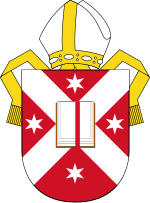
The Diocese of Dunedin is one of the thirteen dioceses and hui amorangi (Māori bishoprics) of the Anglican Church in Aotearoa, New Zealand and Polynesia. The diocese covers the same area as the provinces of Otago and Southland in the South Island of New Zealand. Area 65,990 km2, population 272,541 (2001). Anglicans are traditionally the third largest religious group in Otago and Southland after Presbyterians and Roman Catholics. Description of arms: Gules between a cross saltire argent, four starts argent on the fess point a Bible. In 1814 the Gospel first preached in Aotearoa at Oihi, Northland by Anglican missionary Samuel Marsden, in 1841George Selwyn consecrated and appointed Bishop of New Zealand (including Polynesia and Melanesia). In 1843 the first Anglican missionaries to come to Southland and Otago were Tamihana Te Rauparaha and Matene Te Whiwhi. In 1852 Rev. John Fenton arrives in Dunedin; he was the first Anglican priest to settle south of Lyttleton. In 1856 when the Diocese of New Zealand was subdivided, Southland and Otago were included in the Diocese of Christchurch. In 1866 Henry Lascelles Jenner selected and ordained by the Archbishop of Canterbury “into the office of a Bishop of the United Church of England and Ireland in the colony of New Zealand”, with the intention that he be Bishop of Dunedin. In 1869 the Diocese of Dunedin formed from the Diocese of Christchurch. The first meeting of Dunedin's synod rejected Jenner's claim to the See 1871 Samuel Nevill enthroned as 1st bishop of Dunedin. The Bishop of Dunedin's cathedra is at St. Paul's Cathedral, Dunedin. The diocese has a total of 33 parishes. The adaption of "Local Shared Ministry" has been a strategy by which local people are ordained to serve in a parish which cannot afford to support full-time professional clergy. The diocese includes Anglo-Catholic, broad and Evangelical parishes.

Mornington, Dunedin
Mornington, Dunedin

Mornington is a suburb of the city of Dunedin, in the South Island of New Zealand. It is situated on hilly slopes 2 kilometres (1.2 mi) to the west of the city centre, the slopes forming part of a ridge which surrounds the heart of the city. According to the 2013 New Zealand census, Mornington has a population of 3,267, a decrease of 126 people since the 2006 census. There were 1,518 males and 1,749 females.The use of the name Mornington for the area was first recorded in 1862. There seems to be some conjecture about the origin of the name – some sources record it as being purely descriptive, with the suburb receiving the first rays of the sunrise. There is some likelihood, however, that it was named by early landholder David Mailer after Mornington, Victoria. Mornington was a separate borough until amalgamation with Dunedin city in 1916Mornington's main streets are Mailer Street, Elgin Road, Glenpark Avenue, Eglinton Road, and Kenmure Road. It is a mainly residential suburb, with a retail area on Mailer Street. The suburb is surrounded by the suburbs of Kenmure to the west, Roslyn to the north, Maryhill to the southwest, Belleknowes to the northeast, and The Glen – divided roughly between Mornington and Caversham in the southeast. To the east lies the City Rise, an area that includes some old grand houses which surround the southern end of the city centre. The Town Belt, a bush-clad green belt dating to the early years of Dunedin's settlement, follows the slopes of the ridge, and lies immediately below Mornington, most prominently to the northeast. Mornington is the home to several sports grounds and teams, and was the site of New Zealand's first golf course, opened in 1872. The Zingari-Richmond Rugby Club is based at Montecillo ground in Eglinton Road. Montecillo, the city's home for war veterans, was moved from Eglinton Road to South Dunedin in the 1990s. Immediately above Montecillo ground is Unity Park, which is a venue for Mornington Football (soccer) club. Unity Park affords panoramic views across the central city, and is the site of a statue of Antarctic explorer Admiral Richard Byrd, commemorating the 1928 departure for the southern continent from Dunedin by Byrd's 1928 expeditionLandmarks within Mornington include the suburb's former post office in Mailer Street, a distinctive building completed in 1905 with small a mock-Byzantine domed tower above the entrance.