place

Estádio Municipal Antônio Fernandes

Brazilian sports venue stubsFootball venues in São Paulo (state)Sports venues in São Paulo (state)Use mdy dates from May 2011

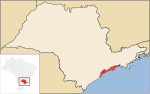
Estádio Municipal Antônio Fernandes, is a football stadium located in Guarujá, São Paulo, Brazil. It has a maximum capacity of 8,000 people. The stadium is owned by the Guarujá City Hall. Associação Desportiva Guarujá play their home games at this stadium. It is one of the two hosts of the 2009 Copa Libertadores de Fútbol Femenino.

Excerpt from the Wikipedia article Estádio Municipal Antônio Fernandes (License: CC BY-SA 3.0, Authors).

Estádio Municipal Antônio Fernandes
Rua Brasilina Desidério, Guarujá Jardim Primavera (Guarujá)

Geographical coordinates (GPS) Address Phone number External links Nearby Places
placeShow on map

Wikipedia: Estádio Municipal Antônio FernandesContinue reading on Wikipedia

Geographical coordinates (GPS)

Latitude Longitude
N -23.997222222222 ° E -46.271111111111 °
placeShow on map

Address

Estádio Municipal Antonio Fernandes (Associação Depos)

Rua Brasilina Desidério 430
11431-260 Guarujá, Jardim Primavera (Guarujá)
São Paulo, Brazil
mapOpen on Google Maps

Phone number
Prefeitura de Guarujá

call(13)33877189

linkWikiData (Q3033337)
linkOpenStreetMap (51035783)

Share experience

Nearby Places

Port of Santos
Port of Santos

The Port of Santos (in Portuguese: Porto de Santos) is located in the city of Santos, state of São Paulo, Brazil. As of 2006, it is the busiest container port in Latin America. In 2016, it was considered the 39th largest port in the world for container handling, and the 35th per ton, according to the AAPA - American Association of Port Authorities ranking, being the busiest in Latin America.It possesses a wide variety of cargo handling terminals—solid and liquid bulk, containers, and general loads. It is Brazil's leading port in container traffic. The terrestrial access system to the port is made up by the Anchieta and Imigrantes highways and by the railroads operated by Ferroban and MRS. It was once considered the "port of death" in the 19th century due to yellow fever, and ships often avoided docking at the wood plank port. The floods in the city's area provoked illnesses.Today it is Latin America's largest port. Its structure is considered Brazil's most modern. In the early 20th century, major overhauling and urbanization created the port's modern structure seen today, eliminating the risk of diseases and providing the port with modern, industrial-age infrastructure. The location of the city of Santos was chosen at a convenient point for crossing the Serra do Mar mountain range, which is the main obstacle to access the interior. The first railway link from the port to the state capital São Paulo City, 79 km away, and the state's interior, was completed in 1864. This allowed for an easier transportation of the vast masses of migrant workers who headed to São Paulo and the state's numerous coffee farms. The main product exported by Santos until World War II was São Paulo state's huge coffee production, Brazil's largest. Today, coffee has become a smaller component of Brazil's exports and cars, machinery, orange juice, soybeans are now some of the port's main exports. Millions of immigrants reached Brazil via the Port of Santos in the late 19th and early 20th centuries, proceeding to the country's interior by railway.