place

Moscow Orphanage

1763 establishments in the Russian Empire18th century in Moscow1917 disestablishments in RussiaBuildings and structures in MoscowCultural heritage monuments of federal significance in Moscow
Education in RussiaNeoclassical architecture in RussiaOrphanages in RussiaResidential buildings completed in 1781Russian EmpireTheatre in Russia
Moscow Orphanage asv2018 01

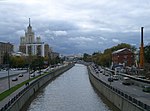
The Moscow Orphanage or Foundling Home (Russian: Воспитательный дом в Москве) was an ambitious project conceived by Catherine the Great and Ivan Betskoy, in the early 1760s. This idealistic experiment of the Age of Enlightenment was intended to manufacture "ideal citizens" for the Russian state by bringing up thousands of abandoned children to a very high standard of refinement, cultivation, and professional qualifications. Despite more than adequate staffing and financing, the Orphanage was plagued by high infant mortality and ultimately failed as a social institution. The main building, one of the earliest and largest Neoclassical structures in the city, occupies a large portion of Moskvoretskaya Embankment between the Kremlin and Yauza River, boasting a 379-metre frontage on Moskva River. The complex was built in three stages over two centuries, from Karl Blank's master plan (1767) to its complete implementation in the 1940s. Today, the ensemble of the Orphanage houses the Academy of Missile Forces and Russian Academy of Medicine.

Excerpt from the Wikipedia article Moscow Orphanage (License: CC BY-SA 3.0, Authors, Images).

Moscow Orphanage
Китайгородский проезд, Moscow Tagansky District

Geographical coordinates (GPS) Address Nearby Places
placeShow on map

Wikipedia: Moscow OrphanageContinue reading on Wikipedia

Geographical coordinates (GPS)

Latitude Longitude
N 55.749722222222 ° E 37.636666666667 °
placeShow on map

Address

Китайгородский проезд 9 с4
109074 Moscow, Tagansky District
Moscow, Russia
mapOpen on Google Maps

Moscow Orphanage asv2018 01
Share experience

Nearby Places

Battle of Moscow
Battle of Moscow

The Battle of Moscow was a military campaign that consisted of two periods of strategically significant fighting on a 600 km (370 mi) sector of the Eastern Front during World War II. It took place between September 1941 and January 1942. The Soviet defensive effort frustrated Hitler's attack on Moscow, the capital and largest city of the Soviet Union. Moscow was one of the primary military and political objectives for Axis forces in their invasion of the Soviet Union. The German Strategic Offensive, named Operation Typhoon, called for two pincer offensives, one to the north of Moscow against the Kalinin Front by the 3rd and 4th Panzer Armies, simultaneously severing the Moscow–Leningrad railway, and another to the south of Moscow Oblast against the Western Front south of Tula, by the 2nd Panzer Army, while the 4th Army advanced directly towards Moscow from the west. Initially, the Soviet forces conducted a strategic defence of the Moscow Oblast by constructing three defensive belts, deploying newly raised reserve armies, and bringing troops from the Siberian and Far Eastern Military Districts. As the German offensives were halted, a Soviet strategic counter-offensive and smaller-scale offensive operations forced the German armies back to the positions around the cities of Oryol, Vyazma and Vitebsk, and nearly surrounded three German armies. It was a major setback for the Germans, and the end of their belief in a swift German victory over the USSR. As a result of the failed offensive, Field Marshal Walther von Brauchitsch was dismissed as supreme commander of the German Army, with Hitler replacing him in the position.

Yauza (river)
Yauza (river)

The Yauza (Russian: Я́уза) is a river in Moscow and Mytishchi, Russia, a tributary of the Moskva. It originates in the Losiny Ostrov National Park northeast of Moscow, flows through Mytishchi, enters Moscow in the Medvedkovo District and flows through the city in an irregular, meandering, generally north-south direction. The Yauza joins the Moskva River in Tagansky District just west of Tagansky Hill, now marked by the Kotelnicheskaya Embankment tower. Valleys of the Yauza, from the MKAD beltway in the north to the Moscow-Yaroslavl railway west of Sokolniki Park, are protected as natural reserves.The Yauza has been mentioned in Russian chronicles since 1156; the exact origin of the name is unknown. Moscow crossed its former natural eastern boundary (marked by the Yauza) in the beginning of the 16th century. The banks of the Yauza within the Garden Ring were densely urbanized by the middle of the 17th century; upstream valleys housed suburban residences of the House of Romanov, from Mikhail to Catherine II. Settlements along the Yauza (German Quarter, Lefortovo, Preobrazhenskoye) played a significant role in the history of Russia in the 17th and 18th centuries. Industrialization in the 19th and 20th centuries made the Yauza "the biggest gutter for waste in Moscow". In the 2000s the ecology improved, with the closing or conversion of old factories and cleanup efforts by the city government. In 2007 the Yauza waters were reclassified from "dirty" to "polluted" status, but in 2008 the trend reversed and pollution in the Yauza exceeded its 2006 levels. As of 2008, Yauza water passing the Moscow city boundary is rated as "polluted", and reaches a "very dirty" level at its inlet. Untreated surface runoff in the Central Administrative District remains the main source of pollution.