place

Slavyanskaya Square

Squares in Moscow
Славянская площадь (сентябрь 2017)

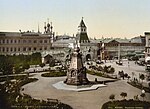
Slavyanskaya Square (Russian: Славянская площадь) is a square in central Moscow, also known in 1924-1991 as northern side of Nogina Square (Площадь Ногина); the southern side of former Nogina Square is now called Varvarka Gates Square (Площадь Варварских Ворот). These two square separates central Kitai-gorod from eastward Tagansky District. They connect to Varvarka Street (west), Solyanka Street (east), Kitaigorodsky Lane (south), Staraya Square and Lubyansky Lane (north), completing the half-circle of Central Squares of Moscow around Moscow Kremlin and Kitai-gorod.

Excerpt from the Wikipedia article Slavyanskaya Square (License: CC BY-SA 3.0, Authors, Images).

Slavyanskaya Square
Staraya Sq, Moscow Tverskoy District

Geographical coordinates (GPS) Address Nearby Places
placeShow on map

Wikipedia: Slavyanskaya SquareContinue reading on Wikipedia

Geographical coordinates (GPS)

Latitude Longitude
N 55.75389 ° E 37.63304 °
placeShow on map

Address

Старая площадь

Staraya Sq
109074 Moscow, Tverskoy District
Moscow, Russia
mapOpen on Google Maps

Славянская площадь (сентябрь 2017)
Share experience

Nearby Places

Battle of Moscow
Battle of Moscow

The Battle of Moscow was a military campaign that consisted of two periods of strategically significant fighting on a 600 km (370 mi) sector of the Eastern Front during World War II. It took place between September 1941 and January 1942. The Soviet defensive effort frustrated Hitler's attack on Moscow, the capital and largest city of the Soviet Union. Moscow was one of the primary military and political objectives for Axis forces in their invasion of the Soviet Union. The German Strategic Offensive, named Operation Typhoon, called for two pincer offensives, one to the north of Moscow against the Kalinin Front by the 3rd and 4th Panzer Armies, simultaneously severing the Moscow–Leningrad railway, and another to the south of Moscow Oblast against the Western Front south of Tula, by the 2nd Panzer Army, while the 4th Army advanced directly towards Moscow from the west. Initially, the Soviet forces conducted a strategic defence of the Moscow Oblast by constructing three defensive belts, deploying newly raised reserve armies, and bringing troops from the Siberian and Far Eastern Military Districts. As the German offensives were halted, a Soviet strategic counter-offensive and smaller-scale offensive operations forced the German armies back to the positions around the cities of Oryol, Vyazma and Vitebsk, and nearly surrounded three German armies. It was a major setback for the Germans, and the end of their belief in a swift German victory over the USSR. As a result of the failed offensive, Field Marshal Walther von Brauchitsch was dismissed as supreme commander of the German Army, with Hitler replacing him in the position.