place

Bolshoy Ustinsky Bridge

Bridges completed in 1927Bridges completed in 1938Bridges completed in 1940Bridges in MoscowConcrete bridges
Deck arch bridgesPlate girder bridges

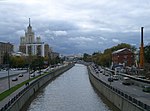
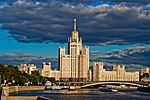
Bolshoy Ustinsky Bridge (Russian: Большой Устьинский мост) is a steel arch bridge that spans Moskva River near the mouth of Yauza River, connecting the Boulevard Ring with Zamoskvorechye district in Moscow, Russia. It was completed in May 1938 by V.M.Vakhurkin (structural engineering), G.P.Golts and D.M.Sobolev (architectural design).It is surrounded by three lesser bridges, two across Yauza and one across Vodootvodny Canal: Maly Ustinsky Bridge, Astakhovsky (Yauzsky) Bridge, Komissariatsky Bridge, also described on this page.

Excerpt from the Wikipedia article Bolshoy Ustinsky Bridge (License: CC BY-SA 3.0, Authors).

Bolshoy Ustinsky Bridge
Космодамианская набережная, Moscow Zamoskvorechye District

Geographical coordinates (GPS) Address External links Nearby Places
placeShow on map

Wikipedia: Bolshoy Ustinsky BridgeContinue reading on Wikipedia

Geographical coordinates (GPS)

Latitude Longitude
N 55.746944444444 ° E 37.638611111111 °
placeShow on map

Address

Большой Устьинский мост

Космодамианская набережная
115035 Moscow, Zamoskvorechye District
Moscow, Russia
mapOpen on Google Maps

linkWikiData (Q4092908)
linkOpenStreetMap (3571210)

Share experience

Nearby Places

Yauza (river)
Yauza (river)

The Yauza (Russian: Я́уза) is a river in Moscow and Mytishchi, Russia, a tributary of the Moskva. It originates in the Losiny Ostrov National Park northeast of Moscow, flows through Mytishchi, enters Moscow in the Medvedkovo District and flows through the city in an irregular, meandering, generally north-south direction. The Yauza joins the Moskva River in Tagansky District just west of Tagansky Hill, now marked by the Kotelnicheskaya Embankment tower. Valleys of the Yauza, from the MKAD beltway in the north to the Moscow-Yaroslavl railway west of Sokolniki Park, are protected as natural reserves.The Yauza has been mentioned in Russian chronicles since 1156; the exact origin of the name is unknown. Moscow crossed its former natural eastern boundary (marked by the Yauza) in the beginning of the 16th century. The banks of the Yauza within the Garden Ring were densely urbanized by the middle of the 17th century; upstream valleys housed suburban residences of the House of Romanov, from Mikhail to Catherine II. Settlements along the Yauza (German Quarter, Lefortovo, Preobrazhenskoye) played a significant role in the history of Russia in the 17th and 18th centuries. Industrialization in the 19th and 20th centuries made the Yauza "the biggest gutter for waste in Moscow". In the 2000s the ecology improved, with the closing or conversion of old factories and cleanup efforts by the city government. In 2007 the Yauza waters were reclassified from "dirty" to "polluted" status, but in 2008 the trend reversed and pollution in the Yauza exceeded its 2006 levels. As of 2008, Yauza water passing the Moscow city boundary is rated as "polluted", and reaches a "very dirty" level at its inlet. Untreated surface runoff in the Central Administrative District remains the main source of pollution.

Kotelnicheskaya Embankment Building

Kotelnicheskaya Embankment Building is one of seven Stalinist skyscrapers laid down in September 1947 and completed in 1952, designed by Dmitry Chechulin (then Chief Architect of Moscow) and Andrei Rostkovsky. The main tower has 32 levels (including mechanical floors) and is 176 metres (577 ft) tall. At the time of construction it was the tallest building in Europe.The building also incorporates a 9-story apartment block facing Moskva River, designed by the same architects in 1938 and completed in 1940. Initially built in stern early Stalinist style, with wet stucco wall finishes, it was re-finished in terracotta panels in line with the central tower and acquired ornate pseudo-Gothic crowns over its 12-story raised corners and center tower. By the end of World War II, the side wing was converted to multi-family kommunalka housing, in contrast to the planned elite status of the central tower. The central tower, of a conventional steel frame structural type, has a hexagonal cross-section with three side wings (18 stories, including two mechanical floors). While it is not exceptionally tall or massive, the "upward surge" of five stepped-up layers, from a flat 9-story side wing to the spire, gives the impression of a more massive structure. The structure hides behind itself a so-called "Shvivaya Gorka," a hill with historical architecture and a maze of steeply inclined streets. Chechulin was initially criticized for complete disregard of this area, but his bureaucratic influence brushed off any criticisms.

Battle of Moscow
Battle of Moscow

The Battle of Moscow was a military campaign that consisted of two periods of strategically significant fighting on a 600 km (370 mi) sector of the Eastern Front during World War II. It took place between September 1941 and January 1942. The Soviet defensive effort frustrated Hitler's attack on Moscow, the capital and largest city of the Soviet Union. Moscow was one of the primary military and political objectives for Axis forces in their invasion of the Soviet Union. The German Strategic Offensive, named Operation Typhoon, called for two pincer offensives, one to the north of Moscow against the Kalinin Front by the 3rd and 4th Panzer Armies, simultaneously severing the Moscow–Leningrad railway, and another to the south of Moscow Oblast against the Western Front south of Tula, by the 2nd Panzer Army, while the 4th Army advanced directly towards Moscow from the west. Initially, the Soviet forces conducted a strategic defence of the Moscow Oblast by constructing three defensive belts, deploying newly raised reserve armies, and bringing troops from the Siberian and Far Eastern Military Districts. As the German offensives were halted, a Soviet strategic counter-offensive and smaller-scale offensive operations forced the German armies back to the positions around the cities of Oryol, Vyazma and Vitebsk, and nearly surrounded three German armies. It was a major setback for the Germans, and the end of their belief in a swift German victory over the USSR. As a result of the failed offensive, Field Marshal Walther von Brauchitsch was dismissed as supreme commander of the German Army, with Hitler replacing him in the position.