place

Church of Saints Cyril and Methodius, Sarajevo

19th-century Roman Catholic church buildings in Bosnia and HerzegovinaArchitecture in Bosnia and HerzegovinaChurches completed in 1896Roman Catholic churches in Sarajevo
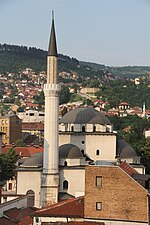
Sarajevo – Cyril and Methodius Church 1

The Church of Saints Cyril and Methodius (Bosnian: Crkva svetih Ćirila i Metoda; Serbo-Croatian Cyrillic: Црква светих Ћирила и Метода) is a neo-Renaissance Roman Catholic church located in Sarajevo, Bosnia and Herzegovina. It is part of the Roman Catholic Archdiocese of Vrhbosna Theological Seminary complex and serves both religious and educational purposes.

Excerpt from the Wikipedia article Church of Saints Cyril and Methodius, Sarajevo (License: CC BY-SA 3.0, Authors, Images).

Church of Saints Cyril and Methodius, Sarajevo
Na varoši, Sarajevo Baščaršija

Geographical coordinates (GPS) Address Nearby Places
placeShow on map

Wikipedia: Church of Saints Cyril and Methodius, SarajevoContinue reading on Wikipedia

Geographical coordinates (GPS)

Latitude Longitude
N 43.8605 ° E 18.4291 °
placeShow on map

Address

Na varoši

Na varoši
71200 Sarajevo, Baščaršija
Federation of Bosnia and Herzegovina, Bosnia and Herzegovina
mapOpen on Google Maps

Sarajevo – Cyril and Methodius Church 1
Share experience

Nearby Places

Morića Han
Morića Han

Morića Han is a han (a roadside inn) originally built in 1551 in Sarajevo, Ottoman Empire (now Bosnia and Herzegovina). After a fire in 1697 it was reconstructed in its current form. Morića Han is one of the buildings which were financed by and belonged to Gazi Husrev-Beg's endowment (Vakuf). It is the only surviving han in Sarajevo. It is located in Baščaršija, Sarači street, in Stari Grad. Morića Han (also spelled "khan" when translated to English) is considered a true caravanserai because, when operational, it could accommodate about 300 passengers and 70 horses. Evliya Çelebi, an Ottoman traveller, wrote about his visit to Sarajevo in 1659 and described Morića Han as Hadži-Bešir's han, because Hadži-Bešir was landlord of the han then. The modern name probably comes from the surname of the han's tenants at the beginning of the 19th century, Mustafa-aga Morić and his son Ibrahim-aga Morić. However, some sources connect the name of this han with the Morić brothers who participated in rebellions against the Ottoman Empire from 1747 to 1757.The citizens of Sarajevo gathered in Morića Han on 29 July 1878, established Narodni Odbor (English: Peoples Council) and protested against the occupation of Bosnia and Herzegovina by Austria-Hungary. The han has survived several fires, most recently in December 1957 when the entire building was destroyed. It was reconstructed from 1971 to 1974 and decorated with Persian calligraphy inscriptions from poems written by Omar Khayyám. Stari Grad returned ownership of Morića Han to Gazi Husrev-Beg's endowment in 1998. Management of the endowment rents the han for business purposes that match the historical context, including a national restaurant, a Persian carpet shop, and religious societies.Morića Han is mentioned in the sevdalinka song "Vila kliče sa vrh Trebevića" used in the film When Father Was Away on Business, directed by Emir Kusturica.

War Childhood Museum

The War Childhood Museum (Bosnian: Muzej ratnog djetinjstva) is a historical museum in Sarajevo, Bosnia-Herzegovina that opened in January 2017. The museum presents the experiences of children who lived through the war in Bosnia, told through objects, video testimonies, and excerpts from oral histories. The 2018 Council of Europe Museum Prize, one of the most prestigious awards in the museum industry, was awarded to the War Childhood Museum as part of the 2018 European Museum of the Year Award.The project began in 2010 when Jasminko Halilovic, a Sarajevan entrepreneur, activist, and "war child," used an online platform to collect short recollections of young adults who had been children during the Bosnian war. Over 1,000 young adults submitted their memories. Halilovic assembled these recollections into a book which was published in 2013. The book has subsequently been translated into German and Japanese.As Halilovic began corresponding with the young adults who submitted memories, he realized that many of the former "war children" still had specific objects that they connected with their memories. He began working with a team of other young professionals to develop a museum collection, eventually collecting over 3,000 objects and over 60 oral history testimonies.In May 2016, the War Childhood Museum held its first, temporary exhibition at the Historical Museum of Bosnia and Herzegovina. Further exhibitions followed in the cities of Zenica and Visoko. In January 2017, the museum’s permanent exhibition opened on Logavina Street in Sarajevo. The museum’s collections feature diaries, toys, photographs, items of clothing, and a variety of other objects donated by war survivors. All the items are presented alongside first-person recollections from the individual who donated them. In addition to the items, visitors can listen to testimonies and read snippets from oral history interviews.