place

Brusa bezistan

Architecture stubsBuildings and structures in SarajevoMuseums in SarajevoNational Monuments of Bosnia and HerzegovinaStari Grad, Sarajevo
Bascarsija
Bascarsija

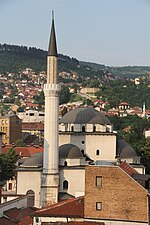
Brusa bezistan with its 6 roof domes it is one of the historic buildings in Sarajevo's Baščaršija from the time of the Ottoman period in the history of Bosnia and Herzegovina. It has a rectangular base and has four entrances on all four sides, and connects the craft streets Kundurdžiluk, Veliki and Mali Čurčiluk with Abadžiluk and the Baščaršija. It was built by order of the Grand Vizier Rustem-pasha Opuković in 1551. Bezistan was named after the Turkish city of Bursa, from which silk was brought to Bezistan and sold. Unlike Gazi Husrev-beg's bezistan, where groceries were originally sold, Brusa bezistan sold household items and small furniture in addition to silk. Today it is one of the museums in the city, designated as the National monument of Bosnia and Herzegovina by the Commission to preserve national monuments of Bosnia and Herzegovina, and houses one of the departments of Museum of Sarajevo.

Excerpt from the Wikipedia article Brusa bezistan (License: CC BY-SA 3.0, Authors, Images).

Brusa bezistan
Čurčiluk veliki, Sarajevo Baščaršija

Geographical coordinates (GPS) Address External links Nearby Places
placeShow on map

Wikipedia: Brusa bezistanContinue reading on Wikipedia

Geographical coordinates (GPS)

Latitude Longitude
N 43.8589 ° E 18.4304 °
placeShow on map

Address

Brusa Bezistan

Čurčiluk veliki
71200 Sarajevo, Baščaršija
Federation of Bosnia and Herzegovina, Bosnia and Herzegovina
mapOpen on Google Maps

linkWikiData (Q1564450)
linkOpenStreetMap (169760856)

Bascarsija
Bascarsija
Share experience

Nearby Places

Morića Han
Morića Han

Morića Han is a han (a roadside inn) originally built in 1551 in Sarajevo, Ottoman Empire (now Bosnia and Herzegovina). After a fire in 1697 it was reconstructed in its current form. Morića Han is one of the buildings which were financed by and belonged to Gazi Husrev-Beg's endowment (Vakuf). It is the only surviving han in Sarajevo. It is located in Baščaršija, Sarači street, in Stari Grad. Morića Han (also spelled "khan" when translated to English) is considered a true caravanserai because, when operational, it could accommodate about 300 passengers and 70 horses. Evliya Çelebi, an Ottoman traveller, wrote about his visit to Sarajevo in 1659 and described Morića Han as Hadži-Bešir's han, because Hadži-Bešir was landlord of the han then. The modern name probably comes from the surname of the han's tenants at the beginning of the 19th century, Mustafa-aga Morić and his son Ibrahim-aga Morić. However, some sources connect the name of this han with the Morić brothers who participated in rebellions against the Ottoman Empire from 1747 to 1757.The citizens of Sarajevo gathered in Morića Han on 29 July 1878, established Narodni Odbor (English: Peoples Council) and protested against the occupation of Bosnia and Herzegovina by Austria-Hungary. The han has survived several fires, most recently in December 1957 when the entire building was destroyed. It was reconstructed from 1971 to 1974 and decorated with Persian calligraphy inscriptions from poems written by Omar Khayyám. Stari Grad returned ownership of Morića Han to Gazi Husrev-Beg's endowment in 1998. Management of the endowment rents the han for business purposes that match the historical context, including a national restaurant, a Persian carpet shop, and religious societies.Morića Han is mentioned in the sevdalinka song "Vila kliče sa vrh Trebevića" used in the film When Father Was Away on Business, directed by Emir Kusturica.

Assassination of Archduke Franz Ferdinand

The assassination of Archduke Franz Ferdinand was one of the key events that led to World War I. Archduke Franz Ferdinand of Austria, heir presumptive to the Austro-Hungarian throne, and his wife, Sophie, Duchess of Hohenberg, were assassinated on 28 June 1914 by Bosnian Serb student Gavrilo Princip. They were shot at close range while being driven through Sarajevo, the provincial capital of Bosnia-Herzegovina, formally annexed by Austria-Hungary in 1908. Princip was part of a group of six Bosnian assassins together with Muhamed Mehmedbašić, Vaso Čubrilović, Nedeljko Čabrinović, Cvjetko Popović and Trifko Grabež coordinated by Danilo Ilić; all but one were Bosnian Serbs and members of a student revolutionary group that later became known as Young Bosnia. The political objective of the assassination was to free Bosnia and Herzegovina of Austria-Hungarian rule and establish a common South Slav ("Yugoslav") state. The assassination precipitated the July Crisis which led to Austria-Hungary declaring war on Serbia and the start of World War I. The assassination team was helped by the Black Hand, a Serbian secret nationalist group; support came from Dragutin Dimitrijević, chief of the military intelligence section of the Serbian general staff, as well as from Major Vojislav Tankosić and Rade Malobabić, a Serbian intelligence agent. Tankosić provided bombs and pistols to the assassins and trained them in their use. The assassins were given access to the same clandestine network of safe-houses and agents that Malobabić used for the infiltration of weapons and operatives into Austria-Hungary. The assassins and key members of the clandestine network were tried in Sarajevo in October 1914. In total twenty-five people were indicted. All six assassins, except Mehmedbašić, were under twenty at the time of the assassination; while the group was dominated by Bosnian Serbs, four of the indictees were Bosnian Croats, and all of them were Austro-Hungarian citizens, none from Serbia. Princip was found guilty of murder and high treason; too young to be executed, he was sentenced to twenty years in jail, while the four other attackers also received jail terms. Five of the older prisoners were sentenced to be hanged. Black Hand members were arrested and tried before a Serbian court in Salonika in 1917 on fabricated charges of high treason; the Black Hand was disbanded and three of its leaders were executed. Much of what is known about the assassinations comes from these two trials and related records. Princip's legacy was re-evaluated following the breakup of Yugoslavia, and public opinion of him in the successor states is largely divided along ethnic lines.