place

Sarajevo Clock Tower

BaščaršijaBuildings and structures in SarajevoClock towersGazi Husrev-beg's endowmentNational Monuments of Bosnia and Herzegovina
Stari Grad, SarajevoTourist attractions in Bosnia and Herzegovina
Sahat kula in Sarajevo

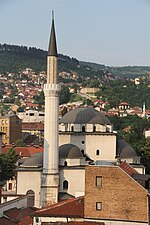
The Sarajevo Clock Tower (Bosnian: Sarajevska sahat-kula) is a clock tower in Sarajevo, the capital of Bosnia and Herzegovina. It is located beside Gazi Husrev-beg Mosque and is the tallest of the 21 clock towers erected throughout the country, reaching a height of 30 meters. The tower was declared a National Monument of Bosnia and Herzegovina in 2006. The clock shows lunar time, in which the hands indicate 12 o'clock at the moment of sunset, the time of the Muslim Maghrib prayer. A caretaker sets the clock's time manually once a week.

Excerpt from the Wikipedia article Sarajevo Clock Tower (License: CC BY-SA 3.0, Authors, Images).

Sarajevo Clock Tower
Mudželiti veliki, Sarajevo MZ "Baščaršija" (Stari Grad Municipality)

Geographical coordinates (GPS) Address Phone number Nearby Places
placeShow on map

Wikipedia: Sarajevo Clock TowerContinue reading on Wikipedia

Geographical coordinates (GPS)

Latitude Longitude
N 43.85917 ° E 18.42857 °
placeShow on map

Address

Hookah Lounge Grace

Mudželiti veliki 5
71000 Sarajevo, MZ "Baščaršija" (Stari Grad Municipality)
Federation of Bosnia and Herzegovina, Bosnia and Herzegovina
mapOpen on Google Maps

Phone number

call+38762574574

Sahat kula in Sarajevo
Share experience

Nearby Places

Assassination of Archduke Franz Ferdinand

The assassination of Archduke Franz Ferdinand was one of the key events that led to World War I. Archduke Franz Ferdinand of Austria, heir presumptive to the Austro-Hungarian throne, and his wife, Sophie, Duchess of Hohenberg, were assassinated on 28 June 1914 by Bosnian Serb student Gavrilo Princip. They were shot at close range while being driven through Sarajevo, the provincial capital of Bosnia-Herzegovina, formally annexed by Austria-Hungary in 1908. Princip was part of a group of six Bosnian assassins together with Muhamed Mehmedbašić, Vaso Čubrilović, Nedeljko Čabrinović, Cvjetko Popović and Trifko Grabež coordinated by Danilo Ilić; all but one were Bosnian Serbs and members of a student revolutionary group that later became known as Young Bosnia. The political objective of the assassination was to free Bosnia and Herzegovina of Austria-Hungarian rule and establish a common South Slav ("Yugoslav") state. The assassination precipitated the July Crisis which led to Austria-Hungary declaring war on Serbia and the start of World War I. The assassination team was helped by the Black Hand, a Serbian secret nationalist group; support came from Dragutin Dimitrijević, chief of the military intelligence section of the Serbian general staff, as well as from Major Vojislav Tankosić and Rade Malobabić, a Serbian intelligence agent. Tankosić provided bombs and pistols to the assassins and trained them in their use. The assassins were given access to the same clandestine network of safe-houses and agents that Malobabić used for the infiltration of weapons and operatives into Austria-Hungary. The assassins and key members of the clandestine network were tried in Sarajevo in October 1914. In total twenty-five people were indicted. All six assassins, except Mehmedbašić, were under twenty at the time of the assassination; while the group was dominated by Bosnian Serbs, four of the indictees were Bosnian Croats, and all of them were Austro-Hungarian citizens, none from Serbia. Princip was found guilty of murder and high treason; too young to be executed, he was sentenced to twenty years in jail, while the four other attackers also received jail terms. Five of the older prisoners were sentenced to be hanged. Black Hand members were arrested and tried before a Serbian court in Salonika in 1917 on fabricated charges of high treason; the Black Hand was disbanded and three of its leaders were executed. Much of what is known about the assassinations comes from these two trials and related records. Princip's legacy was re-evaluated following the breakup of Yugoslavia, and public opinion of him in the successor states is largely divided along ethnic lines.