place

Gazi Husrev Bey's Madrasa

1537 establishments in the Ottoman EmpireBuildings and structures in SarajevoEducation in SarajevoGazi Husrev-beg's endowmentIslam in Bosnia and Herzegovina
Medieval Bosnia and Herzegovina architectureNational Monuments of Bosnia and HerzegovinaOttoman period in the history of Bosnia and HerzegovinaRebuilt buildings and structures in Bosnia and Herzegovina
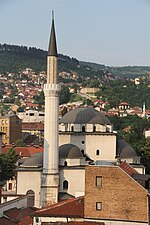
Gazi Husrey Bey Complex panoramio

JU Gazi Husrev-begova medresa, Sarajevo (Javna ustanova Gazi Husrev-begova medresa u Sarajevu; transl. Public Institution Gazi Husrev-beg Madrasa in Sarajevo) is a high school and college, a madrasa in Arabic, founded on 8 January 1537 CE and built in Sarajevo as Gazi Husrev-beg's second endowment. It was built in the style of the Istanbul madrasas, and was called Kuršumlija because it was covered with a lead roof (lead in Turkish: kurşun).

Excerpt from the Wikipedia article Gazi Husrev Bey's Madrasa (License: CC BY-SA 3.0, Authors, Images).

Gazi Husrev Bey's Madrasa
Gazi Husrev-begova, Sarajevo MZ "Baščaršija" (Stari Grad Municipality)

Geographical coordinates (GPS) Address Nearby Places
placeShow on map

Wikipedia: Gazi Husrev Bey's MadrasaContinue reading on Wikipedia

Geographical coordinates (GPS)

Latitude Longitude
N 43.859611111111 ° E 18.428333333333 °
placeShow on map

Address

Gazi Husrev-begova biblioteka

Gazi Husrev-begova
71200 Sarajevo, MZ "Baščaršija" (Stari Grad Municipality)
Federation of Bosnia and Herzegovina, Bosnia and Herzegovina
mapOpen on Google Maps

Gazi Husrey Bey Complex panoramio
Share experience

Nearby Places

Ferhat Pasha Mosque (Sarajevo)

Ferhadija Mosque (Bosnian: Ferhat-pašina džamija, Turkish: Ferhad Paşa Camii), also known as Ferhat Pasha Mosque, is a central building in the city of Sarajevo built by Bosnian Sanjak-bey (governor) Ferhad-beg Vuković, a descendant of the famous mediaeval Vuković family. This mosque has one dome above the prayer area and three small domes at the cloister and is one of the greatest achievements of Bosnia and Herzegovina’s 16th century Ottoman and Islamic architecture. The Ferhadija mosque reflects the full maturity of the classical Ottoman style-domed mosque, portico with small domes, and beautiful built-on minaret. Research works on the painted decoration inside the mosque carried out in 1964–1965 revealed five painted layers dating from various periods. The oldest and extremely valuable decorations of the first layer date from the 16th century (in the dome, on the cornice and pendentives, the base of the corner calottes, the mihrab and the lunettes of the lower row of windows), belonging to the group known as Rumi ornament, which were also to be seen in the Aladža Mosque in Foča. The next layers (on the calottes, central part of the mihrab, and surface of the dome) consists of purely floral decorations with the features of 18th-century style. The third and fourth layers date from the late 19th century (1878), and the first quarter of the 20th. The mosque was damaged during the Bosnian War in 1992–1995.

Morića Han
Morića Han

Morića Han is a han (a roadside inn) originally built in 1551 in Sarajevo, Ottoman Empire (now Bosnia and Herzegovina). After a fire in 1697 it was reconstructed in its current form. Morića Han is one of the buildings which were financed by and belonged to Gazi Husrev-Beg's endowment (Vakuf). It is the only surviving han in Sarajevo. It is located in Baščaršija, Sarači street, in Stari Grad. Morića Han (also spelled "khan" when translated to English) is considered a true caravanserai because, when operational, it could accommodate about 300 passengers and 70 horses. Evliya Çelebi, an Ottoman traveller, wrote about his visit to Sarajevo in 1659 and described Morića Han as Hadži-Bešir's han, because Hadži-Bešir was landlord of the han then. The modern name probably comes from the surname of the han's tenants at the beginning of the 19th century, Mustafa-aga Morić and his son Ibrahim-aga Morić. However, some sources connect the name of this han with the Morić brothers who participated in rebellions against the Ottoman Empire from 1747 to 1757.The citizens of Sarajevo gathered in Morića Han on 29 July 1878, established Narodni Odbor (English: Peoples Council) and protested against the occupation of Bosnia and Herzegovina by Austria-Hungary. The han has survived several fires, most recently in December 1957 when the entire building was destroyed. It was reconstructed from 1971 to 1974 and decorated with Persian calligraphy inscriptions from poems written by Omar Khayyám. Stari Grad returned ownership of Morića Han to Gazi Husrev-Beg's endowment in 1998. Management of the endowment rents the han for business purposes that match the historical context, including a national restaurant, a Persian carpet shop, and religious societies.Morića Han is mentioned in the sevdalinka song "Vila kliče sa vrh Trebevića" used in the film When Father Was Away on Business, directed by Emir Kusturica.