place

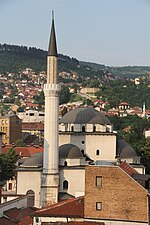
Gazi Husrev-begov bezistan

BaščaršijaBuildings and structures in SarajevoGazi Husrev-beg's endowmentNational Monuments of Bosnia and HerzegovinaOttoman architecture in Bosnia and Herzegovina
Sarajevo Gazi Husrev Beg Basar01

Gazi Husrev-beg's bezistan is one of the preserved bezistan in Sarajevo, Bosnia and Herzegovina, from the Ottoman period in the history of the country. Built in 1555 in Baščaršija, bezistan still serves its purpose - trade.

Excerpt from the Wikipedia article Gazi Husrev-begov bezistan (License: CC BY-SA 3.0, Authors, Images).

Gazi Husrev-begov bezistan
Zelenih beretki, Sarajevo MZ "Baščaršija" (Stari Grad Municipality)

Geographical coordinates (GPS) Address Nearby Places
placeShow on map

Wikipedia: Gazi Husrev-begov bezistanContinue reading on Wikipedia

Geographical coordinates (GPS)

Latitude Longitude
N 43.8586 ° E 18.4279 °
placeShow on map

Address

Tašlihan

Zelenih beretki
71144 Sarajevo, MZ "Baščaršija" (Stari Grad Municipality)
Federation of Bosnia and Herzegovina, Bosnia and Herzegovina
mapOpen on Google Maps

Sarajevo Gazi Husrev Beg Basar01
Share experience

Nearby Places

Ferhat Pasha Mosque (Sarajevo)

Ferhadija Mosque (Bosnian: Ferhat-pašina džamija, Turkish: Ferhad Paşa Camii), also known as Ferhat Pasha Mosque, is a central building in the city of Sarajevo built by Bosnian Sanjak-bey (governor) Ferhad-beg Vuković, a descendant of the famous mediaeval Vuković family. This mosque has one dome above the prayer area and three small domes at the cloister and is one of the greatest achievements of Bosnia and Herzegovina’s 16th century Ottoman and Islamic architecture. The Ferhadija mosque reflects the full maturity of the classical Ottoman style-domed mosque, portico with small domes, and beautiful built-on minaret. Research works on the painted decoration inside the mosque carried out in 1964–1965 revealed five painted layers dating from various periods. The oldest and extremely valuable decorations of the first layer date from the 16th century (in the dome, on the cornice and pendentives, the base of the corner calottes, the mihrab and the lunettes of the lower row of windows), belonging to the group known as Rumi ornament, which were also to be seen in the Aladža Mosque in Foča. The next layers (on the calottes, central part of the mihrab, and surface of the dome) consists of purely floral decorations with the features of 18th-century style. The third and fourth layers date from the late 19th century (1878), and the first quarter of the 20th. The mosque was damaged during the Bosnian War in 1992–1995.

Assassination of Archduke Franz Ferdinand

The assassination of Archduke Franz Ferdinand was one of the key events that led to World War I. Archduke Franz Ferdinand of Austria, heir presumptive to the Austro-Hungarian throne, and his wife, Sophie, Duchess of Hohenberg, were assassinated on 28 June 1914 by Bosnian Serb student Gavrilo Princip. They were shot at close range while being driven through Sarajevo, the provincial capital of Bosnia-Herzegovina, formally annexed by Austria-Hungary in 1908. Princip was part of a group of six Bosnian assassins together with Muhamed Mehmedbašić, Vaso Čubrilović, Nedeljko Čabrinović, Cvjetko Popović and Trifko Grabež coordinated by Danilo Ilić; all but one were Bosnian Serbs and members of a student revolutionary group that later became known as Young Bosnia. The political objective of the assassination was to free Bosnia and Herzegovina of Austria-Hungarian rule and establish a common South Slav ("Yugoslav") state. The assassination precipitated the July Crisis which led to Austria-Hungary declaring war on Serbia and the start of World War I. The assassination team was helped by the Black Hand, a Serbian secret nationalist group; support came from Dragutin Dimitrijević, chief of the military intelligence section of the Serbian general staff, as well as from Major Vojislav Tankosić and Rade Malobabić, a Serbian intelligence agent. Tankosić provided bombs and pistols to the assassins and trained them in their use. The assassins were given access to the same clandestine network of safe-houses and agents that Malobabić used for the infiltration of weapons and operatives into Austria-Hungary. The assassins and key members of the clandestine network were tried in Sarajevo in October 1914. In total twenty-five people were indicted. All six assassins, except Mehmedbašić, were under twenty at the time of the assassination; while the group was dominated by Bosnian Serbs, four of the indictees were Bosnian Croats, and all of them were Austro-Hungarian citizens, none from Serbia. Princip was found guilty of murder and high treason; too young to be executed, he was sentenced to twenty years in jail, while the four other attackers also received jail terms. Five of the older prisoners were sentenced to be hanged. Black Hand members were arrested and tried before a Serbian court in Salonika in 1917 on fabricated charges of high treason; the Black Hand was disbanded and three of its leaders were executed. Much of what is known about the assassinations comes from these two trials and related records. Princip's legacy was re-evaluated following the breakup of Yugoslavia, and public opinion of him in the successor states is largely divided along ethnic lines.

Monument to Franz Ferdinand in Sarajevo

The Atonement Monument was unveiled in the city of Sarajevo on June 28, 1917. The monument commemorated the assassination attempt in Sarajevo on June 28, 1914, in which Gavrilo Princip assassinated the heir to the Austro-Hungarian throne, Franz Ferdinand , and was located in the immediate vicinity of the Latin Bridge . After the war, the monument was dismantled. Parts of the monument were housed in the Sarajevo City Museum until the 1970s. Since 2014, there have been discussions about reconstructing the monument. According to plans by Jenő Bory , the twelve-meter-high structure was made of Silesian granite. The memorial consisted of two columns visible from afar. The base bore a bronze plaque on which a portrait of the murdered heir to the throne and the Austro-Hungarian coat of arms were inscribed. A stone bench was erected opposite. The altar of the memorial was blown up. The bench still exists today. Since 2014, a two-meter-high glass plate depicting the atonement monument has been located at the site of the memorial. The glass plate contains the following inscription: Memorial to the victims of the assassination attempt in Sarajevo, Archduke Franz Ferdinand, heir to the throne of Austria-Hungary and his wife Sophie, Duchess of Hohenberg. Unveiled on June 28, 1917 and removed in 1919. Architect: Jenő Bory. Bory developed further plans for a large cathedral that would seat 4,000 people. The building, consisting of several complexes, was to include a church and a youth center. The plans, drawn up in 1917, could not be realized. Before the construction of the atonement monument, a stone plaque with the inscription in Bosnian was placed at the site: "28.VI.1914 The heir to the throne, Archduke Franz Ferdinand, and his wife, Duchess Sophie Hohenberg, suffered martyrdom at the hands of murderers at this intersection." In 1930, a stone plaque in Serbo-Croatian was installed with the inscription " At this historic place, Gavrilo Princip brought freedom on 15/28 Vidovdan." This stone plaque was presented to Hitler as war booty after the Balkan campaign on his 52nd birthday . After the war, the plaque was handed over to a representative of the Yugoslav Military Commission on 6 November 1946. Since then, the plaque has disappeared.