place

Mother's Monument

1949 establishments in Mexico1949 sculpturesMonuments and memorials in Mexico CityMonuments and memorials to womenOutdoor sculptures in Mexico City
Sculptures of childrenSculptures of men in MexicoSculptures of women in MexicoStatues in Mexico City
Monumento a la Madre

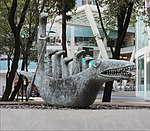
The Mother's Monument, or Monument to the Mother (Spanish: Monumento a la Madre), is a monument commemorating Mexican mothers, installed in Mexico City, inaugurated on May 10, 1949. It was destroyed on September 19, 2017, after an earthquake of magnitude 7.1 on the Richter scale that shook Mexico City, and reopened on November 21, 2018.

Excerpt from the Wikipedia article Mother's Monument (License: CC BY-SA 3.0, Authors, Images).

Mother's Monument
Calle Serapio Rendón, Mexico City

Geographical coordinates (GPS) Address Nearby Places
placeShow on map

Wikipedia: Mother's MonumentContinue reading on Wikipedia

Geographical coordinates (GPS)

Latitude Longitude
N 19.432547222222 ° E -99.160786111111 °
placeShow on map

Address

Monumento a la Madre

Calle Serapio Rendón
Mexico City
Mexico
mapOpen on Google Maps

Monumento a la Madre
Share experience

Nearby Places

Colonia Juárez, Mexico City

Colonia Juárez is one of the better-known neighborhoods or colonias in the Cuauhtémoc borough of Mexico City. The neighborhood is shaped like a long triangle with the boundaries: Paseo de la Reforma on the north, Avenida Chapultepec on the south, and Eje 1 Poniente (Avenida Bucareli) on the east. It is located between the historic center of Mexico City and the Chapultepec Park area, just south of the Paseo de la Reforma, which is one of Mexico's main commercial districts and its financial center. Since it was established in the late 19th century and early 20th as a haven for the wealthy leaving the city center, the colonia has been in near constant change. Most of the mansions built in the early part of its history have either been abandoned, converted into businesses or been taken over by squatters. However, it has had a cosmopolitan and intellectual reputation since its founding, which was reinforced with the influx of artists and intellectuals in the 1960s. The area has suffered deterioration since the 1980s, due to the 1985 Mexico City earthquake and other factors, but there have been efforts to restore the area's former prestige, including tourism promotion, historic conservation efforts and the urbanization of areas close to Paseo de la Reforma. The best known area of the colonia is Zona Rosa (Pink Zone) which is a tourist attraction for its artistic and intellectual reputation and is home to Mexico City's gay community. It is also home to "Little Seoul", center of the city's Korean immigrant population.