place

Glorieta de la Palma

1865 establishments in Mexico2022 in MexicoIndividual trees in MexicoPaseo de la ReformaRoundabouts and traffic circles in Mexico
Use American English from April 2022
Mexico City (2018) 507

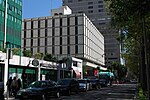
Glorieta de la Palma is a roundabout in Mexico City that connects Paseo de la Reforma with Río Rhin Street and Niza Street. It is known for a tall palm tree that stood in the middle for a century. The roundabout is the only along Reforma that has never had a monument. The building of Bolsa Mexicana de Valores is at the roundabout, opposite the Zona Rosa. The area is serviced by the city's Metrobús system at La Palma station, whose pictogram features the palm tree.

Excerpt from the Wikipedia article Glorieta de la Palma (License: CC BY-SA 3.0, Authors, Images).

Glorieta de la Palma
Mexico City

Geographical coordinates (GPS) Address Nearby Places
placeShow on map

Wikipedia: Glorieta de la PalmaContinue reading on Wikipedia

Geographical coordinates (GPS)

Latitude Longitude
N 19.428830388889 ° E -99.163680388889 °
placeShow on map

Address


06600 Mexico City
Mexico
mapOpen on Google Maps

Mexico City (2018) 507
Share experience

Nearby Places

Zona Rosa, Mexico City

Zona Rosa (English: "Pink Zone") is a neighborhood in Mexico City which is known for its shopping, nightlife, gay community and its recently established Korean community. The neighborhood is officially part of the Colonia Juárez colonia or official neighborhood, located just west of the historic center of Mexico City. The area's history as a community began when it was developed as a residential district for wealthy foreigners and Mexico City residents looking to move from the city center. The development of the area stalled during and after the Mexican Revolution. From the 1950s to 1980s the neighborhood was revitalized by artists, intellectuals and the city's elite who repopulated the area, gave it a bohemian reputation and attracted exclusive restaurants and clubs for visiting politicians and other notables. It was during this time that the area received the name of Zona Rosa, from José Luis Cuevas. The era ended in the 1980s, when many of the upscale businesses moved out and tourism, men's clubs, prostitution and other crime moved in. Although the area declined during the 1980s, it is still a major shopping and entertainment district and has also become a major tourist attraction for the city, one that the city has worked to preserve and rehabilitate since the 2000s, with mixed success. From the 1990s, the area has also become home to Mexico City's gay community, which is prominent around Amberes Street and sponsors an annual pride parade on Paseo de la Reforma.

Colonia Juárez, Mexico City

Colonia Juárez is one of the better-known neighborhoods or colonias in the Cuauhtémoc borough of Mexico City. The neighborhood is shaped like a long triangle with the boundaries: Paseo de la Reforma on the north, Avenida Chapultepec on the south, and Eje 1 Poniente (Avenida Bucareli) on the east. It is located between the historic center of Mexico City and the Chapultepec Park area, just south of the Paseo de la Reforma, which is one of Mexico's main commercial districts and its financial center. Since it was established in the late 19th century and early 20th as a haven for the wealthy leaving the city center, the colonia has been in near constant change. Most of the mansions built in the early part of its history have either been abandoned, converted into businesses or been taken over by squatters. However, it has had a cosmopolitan and intellectual reputation since its founding, which was reinforced with the influx of artists and intellectuals in the 1960s. The area has suffered deterioration since the 1980s, due to the 1985 Mexico City earthquake and other factors, but there have been efforts to restore the area's former prestige, including tourism promotion, historic conservation efforts and the urbanization of areas close to Paseo de la Reforma. The best known area of the colonia is Zona Rosa (Pink Zone) which is a tourist attraction for its artistic and intellectual reputation and is home to Mexico City's gay community. It is also home to "Little Seoul", center of the city's Korean immigrant population.