place

L. I. Geltischeva Mansion

1904 establishmentsArt Nouveau architecture in MoscowArt Nouveau housesCultural heritage monuments of federal significance in Moscow
Средний Овчинниковский переулок, 8, строение 1

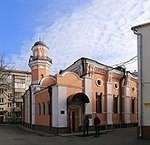
The L. I. Geltischeva Mansion (Russian: Особняк Л. И. Гельтищевой) is a building in the center of Moscow (Average Ovchinnikovsky Lane, Building 8, Building 1). It was built in 1904 by the architect F. F. Voskresensky in the Art Nouveau style. L. I. Geltischeva's mansion has the status of an object of cultural heritage of federal significance.

Excerpt from the Wikipedia article L. I. Geltischeva Mansion (License: CC BY-SA 3.0, Authors, Images).

L. I. Geltischeva Mansion
Sredniy Ovchinnikovskiy Lane, Moscow Zamoskvorechye District

Geographical coordinates (GPS) Address External links Nearby Places
placeShow on map

Wikipedia: L. I. Geltischeva MansionContinue reading on Wikipedia

Geographical coordinates (GPS)

Latitude Longitude
N 55.7448 ° E 37.6304 °
placeShow on map

Address

Sredniy Ovchinnikovskiy Lane 8 с1
115184 Moscow, Zamoskvorechye District
Moscow, Russia
mapOpen on Google Maps

linkWikiData (Q53211544)
linkOpenStreetMap (165736625)

Средний Овчинниковский переулок, 8, строение 1
Share experience

Nearby Places

Tretyakovskaya (Moscow Metro)

Tretyakovskaya (Russian: Третьяко́вская. English: Tretyakov's) is a station complex of Moscow Metro located in the Zamoskvorechye District, Central Administrative Okrug. It offers a cross-platform interchange between Kaluzhsko-Rizhskaya and Kalininsko-Solntsevskaya lines. It is named after the nearby Tretyakov Gallery. Unlike Kitay-gorod which was purpose-built as a cross-platform interchange station, Tretyakovskaya operated as a normal station before the connection with Kalininskaya Line in 1986. At that time a second hall was opened forming a cross-platform interchange. The two halls are joined by a passage located midway along their length and also by the shared vestibule, which opens onto Klimentovsky Lane. The southern hall of Tretyakovskaya opened on 3 January 1971. Designed by V. Polikarpova and A. Marova, it has block pylons faced with white Koyelga marble and joined by a continuous marble cornice. Kaluzhsko-Rizhskaya Line trains stopped at both platforms of this hall until 1986, when the new northern hall opened. Currently the southern hall is served by northbound trains of both lines, terminating at Medvedkovo and Novokosino. The northern hall, served by southbound trains terminating at Tretyakovskaya and Novoyasenevskaya, was designed by R. Pogrebnoy and V. Filippov. It features curved white marble separated by translucent panels which conceal fluorescent light fixtures. The walls are faced with red marble and decorated with a series of plaques by Alexander Bourganov depicting 16 great Russian painters, whose works the Tretyakov Gallery contains.

Embassy of Tanzania, Moscow

The Embassy of the United Republic of Tanzania in Moscow is the diplomatic mission of Tanzania in the Russian Federation. It is located in embassy quarter on Bol'shaya Nikitskaja Str., house #51, that was previously occupied by the embassy of Morocco. Prior to 2013, the Tanzanian embassy was located at 33 Pyatnitskaya Street (Russian: Пятницкая ул., 33) in the Zamoskvorechye District of Moscow.The old Embassy occupied a listed memorial building - Korobkova House - built in two stages in 1890s. The oldest, northern part of the building contains a two-story core, built in 1866 and rebuilt in ornate late eclecticism by Lev Kekushev (1890-1894). In the same decade the owners acquired an adjacent southern lot and hired Sergey Schutzmann to expand the building from Kekushev's 21×23 to 30×23 meters. The annex, completed in 1899, corresponds to the three southernmost windows on the main facade. Instead of expanding Kekushev's original artwork to the south annex, Schutzmann completely redesigned the facade, radically changing its appearance. Public sources frequently, and incorrectly, credit the building to Kekushev alone or present Kekushev's and Schutzmann's work as a joint collaboration. For a short period following relocation of Academy of Sciences from Leningrad to Moscow (1934) the building was a residence of the Academy's Presidents Alexander Karpinsky (1935-1936) and Vladimir Komarov (1936-1945). Korobkova House was most recently renovated in 2000-2001.

Battle of Moscow
Battle of Moscow

The Battle of Moscow was a military campaign that consisted of two periods of strategically significant fighting on a 600 km (370 mi) sector of the Eastern Front during World War II. It took place between September 1941 and January 1942. The Soviet defensive effort frustrated Hitler's attack on Moscow, the capital and largest city of the Soviet Union. Moscow was one of the primary military and political objectives for Axis forces in their invasion of the Soviet Union. The German Strategic Offensive, named Operation Typhoon, called for two pincer offensives, one to the north of Moscow against the Kalinin Front by the 3rd and 4th Panzer Armies, simultaneously severing the Moscow–Leningrad railway, and another to the south of Moscow Oblast against the Western Front south of Tula, by the 2nd Panzer Army, while the 4th Army advanced directly towards Moscow from the west. Initially, the Soviet forces conducted a strategic defence of the Moscow Oblast by constructing three defensive belts, deploying newly raised reserve armies, and bringing troops from the Siberian and Far Eastern Military Districts. As the German offensives were halted, a Soviet strategic counter-offensive and smaller-scale offensive operations forced the German armies back to the positions around the cities of Oryol, Vyazma and Vitebsk, and nearly surrounded three German armies. It was a major setback for the Germans, and the end of their belief in a swift German victory over the USSR. As a result of the failed offensive, Field Marshal Walther von Brauchitsch was dismissed as supreme commander of the German Army, with Hitler replacing him in the position.