place

St Clement's Church, Moscow

Baroque church buildings in RussiaChurch buildings with domesChurches completed in 1769Cultural heritage monuments of federal significance in MoscowHarv and Sfn no-target errors
Russian Orthodox churches in MoscowZamoskvorechye District
Moscow StClementChurch 001 0344

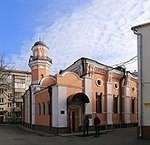
St. Clement's Church (Храм Священномученика Климента, Папы Римского) is one of the two Orthodox churches in Moscow dedicated to a Roman Pope, St. Clement I. The massive five-domed two-storey church used to dominate the skyline of Zamoskvorechye. It was built between 1762 and 1769 on the site of a church erected in 1720.The church is considered a major example of Elizabethan Baroque, but the architect is unknown. It has been often attributed to Pietro Antonio Trezzini, the architect of St Sampson's Cathedral in St. Petersburg. The belfry and refectory were designed by Dmitry Ukhtomsky and built in 1756—1758.The church is renowned for its glittering Baroque interior and iconostasis, as well as a set of gilded 18th-century railings. The parish was disbanded in 1934 and the original free-standing gate was demolished. The Lenin State Library stored its books in the building throughout the Soviet period. It was not until 2008 that the building reverted to the Russian Orthodox Church.

Excerpt from the Wikipedia article St Clement's Church, Moscow (License: CC BY-SA 3.0, Authors, Images).

St Clement's Church, Moscow
Pyatnitskaya Street, Moscow Zamoskvorechye District

Geographical coordinates (GPS) Address Nearby Places
placeShow on map

Wikipedia: St Clement's Church, MoscowContinue reading on Wikipedia

Geographical coordinates (GPS)

Latitude Longitude
N 55.740833333333 ° E 37.628888888889 °
placeShow on map

Address

Pyatnitskaya Street 29
115035 Moscow, Zamoskvorechye District
Moscow, Russia
mapOpen on Google Maps

Moscow StClementChurch 001 0344
Share experience

Nearby Places

Embassy of Tanzania, Moscow

The Embassy of the United Republic of Tanzania in Moscow is the diplomatic mission of Tanzania in the Russian Federation. It is located in embassy quarter on Bol'shaya Nikitskaja Str., house #51, that was previously occupied by the embassy of Morocco. Prior to 2013, the Tanzanian embassy was located at 33 Pyatnitskaya Street (Russian: Пятницкая ул., 33) in the Zamoskvorechye District of Moscow.The old Embassy occupied a listed memorial building - Korobkova House - built in two stages in 1890s. The oldest, northern part of the building contains a two-story core, built in 1866 and rebuilt in ornate late eclecticism by Lev Kekushev (1890-1894). In the same decade the owners acquired an adjacent southern lot and hired Sergey Schutzmann to expand the building from Kekushev's 21×23 to 30×23 meters. The annex, completed in 1899, corresponds to the three southernmost windows on the main facade. Instead of expanding Kekushev's original artwork to the south annex, Schutzmann completely redesigned the facade, radically changing its appearance. Public sources frequently, and incorrectly, credit the building to Kekushev alone or present Kekushev's and Schutzmann's work as a joint collaboration. For a short period following relocation of Academy of Sciences from Leningrad to Moscow (1934) the building was a residence of the Academy's Presidents Alexander Karpinsky (1935-1936) and Vladimir Komarov (1936-1945). Korobkova House was most recently renovated in 2000-2001.

Tretyakovskaya (Moscow Metro)

Tretyakovskaya (Russian: Третьяко́вская. English: Tretyakov's) is a station complex of Moscow Metro located in the Zamoskvorechye District, Central Administrative Okrug. It offers a cross-platform interchange between Kaluzhsko-Rizhskaya and Kalininsko-Solntsevskaya lines. It is named after the nearby Tretyakov Gallery. Unlike Kitay-gorod which was purpose-built as a cross-platform interchange station, Tretyakovskaya operated as a normal station before the connection with Kalininskaya Line in 1986. At that time a second hall was opened forming a cross-platform interchange. The two halls are joined by a passage located midway along their length and also by the shared vestibule, which opens onto Klimentovsky Lane. The southern hall of Tretyakovskaya opened on 3 January 1971. Designed by V. Polikarpova and A. Marova, it has block pylons faced with white Koyelga marble and joined by a continuous marble cornice. Kaluzhsko-Rizhskaya Line trains stopped at both platforms of this hall until 1986, when the new northern hall opened. Currently the southern hall is served by northbound trains of both lines, terminating at Medvedkovo and Novokosino. The northern hall, served by southbound trains terminating at Tretyakovskaya and Novoyasenevskaya, was designed by R. Pogrebnoy and V. Filippov. It features curved white marble separated by translucent panels which conceal fluorescent light fixtures. The walls are faced with red marble and decorated with a series of plaques by Alexander Bourganov depicting 16 great Russian painters, whose works the Tretyakov Gallery contains.

Church of the Savior on Bolvany

Church of Transfiguration of Savior in Bolvanovka (Russian: Храм Спаса Преображения на Болвановке), also abbreviated to Saviour in Bolvanovka (Спас на Болвановке), is an Orthodox church in Zamoskvorechye District of Moscow. The neighborhood, Bolvanovka (rus. Болвановка), derives its name from Russian bolvan (болван), which could mean either a billet or, in obsolete sense, a non-Orthodox cult image. There have different Bolvanovka neighborhoods in medieval Moscow, a sign of wide Tatar presence (e.g. near Taganka Square). A legend says that the church stands on site of a Tatar bolvan, an artifact which symbolized submission of Moscow to Golden Horde. Ivan III of Russia destroyed this symbol (or broke ambassador symbol - basma (басма), that has the same name) and established an Orthodox church at this place in 1465. His refusal to pay tribute to the Horde resulted in the Great stand on the Ugra river of 1480. A wooden church had been mentioned in city records since 1465. The new baroque building was built in the 18th century; completion date is disputed (1722 or later); what is known definitely is that the church was consecrated in 1755. Alternative accounts assert that there was a succession of wooden churches built in 1708 and 1722; extant building that replaced them was built in 1749-1755. The church burnt down in the Fire of Moscow (1812) and was reopened to worshippers in 1815 with subsequent expansion in 1839. It was closed by Bolsheviks in 1922, partially destroyed, and returned to the worshippers in 1991. A temporary, standalone wooden belltower was added in the 1990s.