place

Hadžijska Mosque

1561 establishments in the Ottoman Empire16th-century mosquesAttacks on religious buildings and structures during the Bosnian WarBosnia and Herzegovina building and structure stubsCentar, Sarajevo
European mosque stubsMosques in SarajevoOttoman mosques in Bosnia and HerzegovinaReligious buildings and structures completed in 1561
Sarajevo (8745526396)

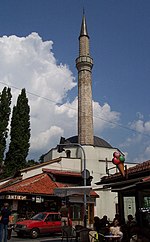
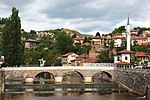
The Vekil-Harrach or Hadžijska mosque (Bosnian: Vekil-Harač ili Hadžijska džamija) is a mosque in the city of Sarajevo, Bosnia and Herzegovina. It is located in Alifakovac, a neighborhood in Babića bašća local community, one of the oldest urban settlements in Sarajevo.

Excerpt from the Wikipedia article Hadžijska Mosque (License: CC BY-SA 3.0, Authors, Images).

Hadžijska Mosque
Veliki Alifakovac, Sarajevo MZ "Babića bašča" (Stari Grad Municipality)

Geographical coordinates (GPS) Address Phone number Nearby Places
placeShow on map

Wikipedia: Hadžijska MosqueContinue reading on Wikipedia

Geographical coordinates (GPS)

Latitude Longitude
N 43.8585 ° E 18.4343 °
placeShow on map

Address

Inat kuća

Veliki Alifakovac 1
71000 Sarajevo, MZ "Babića bašča" (Stari Grad Municipality)
Federation of Bosnia and Herzegovina, Bosnia and Herzegovina
mapOpen on Google Maps

Phone number

call+38733489767

Sarajevo (8745526396)
Share experience

Nearby Places

Vilayet Printing House (Sarajevo)

The Vilayet Printing House (Serbo-Croatian: Вилајетска штампарија, Vilajetska štamparija), originally named Sopron's Printing House (Сопронова печатња, Sopronova pečatnja), was the official printing house of the Ottoman Vilayet of Bosnia from April 1866 until the occupation of the province by Austria-Hungary in August 1878. It was the second printing house that operated in the territory of present-day Bosnia and Herzegovina, founded in Sarajevo almost 350 years after the Goražde printing house ceased its activity. Its founder was Ignjat Sopron, a publisher and printer from Zemun, who sold the establishment to the Government of the Vilayet of Bosnia in October 1866. Its foundation happened in the context of modernising and Europeanising Tanzimat reforms in the Ottoman Empire. Its principal aim was to issue an official gazette of the vilayet and publish textbooks for the elementary schools of Bosnian Serbs and Croats, thus stopping their import from the Principality of Serbia and the Austrian Empire. The first newspaper to be published in Bosnia and Herzegovina was Bosanski vjestnik, a political-informative and educational weekly edited by Sopron and printed in Serbian Cyrillic. It had a pro-Serb inclination, though it generally promoted a unitary Bosnian nation, in accordance with the Ottoman policy in the province. The official gazette, the weekly Bosna, was primarily concerned with publishing and explaining laws, orders, and proclamations. Another weekly issued by the printing house was Sarajevski cvjetnik, which fiercely defended the Ottoman regime and polemicised with Serbian and Austrian newspapers that criticised it. Bosna and Sarajevski cvjetnik were bilingual, printed half in Ottoman Turkish and half in Serbo-Croatian in the Cyrillic script. The printing house produced a number of elementary school textbooks, including the second Serbian alphabet book using the reformed Serbian Cyrillic, following Vuk Karadžić's book published in Vienna in 1827. Other books include a collection of Bosnian Serb lyric folk poetry, an Ottoman Turkish grammar, and several Jewish religious books. The first printed exemplar of Bosnian Aljamiado literature was also published by the Vilayet Printing House. It produced around 50 books and booklets altogether, most of them being concerned with various Ottoman laws and legislation.

Muslihudin Čekrekčija Mosque

Muslihudin Čekrekčija Mosque, also known as Čaršijska, is second oldest domed mosque in Sarajevo. It was constructed in 1526 in the Baščaršija area of the city, at the foot of Kovač (the center of the city's old trading center). It is raised in the mahala of Isa-Bey's turn. From the vakufnam (document bequeathing assets for religious, humanitarian, educational, or other purposes) of the founder of the mosque, Hajji Mustafa, the son of Ishak, is known to the people as Muslihudin Čekrekčija, her builder. This is also the oldest known original document written in Sarajevo. In the vakufnam, in connection with the establishment and construction of the mosque, it is written: "When a man dies, his work comes to an end, except for three things: the knowledge and skills he used, the good child who prays for him, and his enduring sadaqa [good deeds]." – translation by Mehmed HandžićSince 2004, the mosque has been under the protection of the Commission to Preserve National Monuments of Bosnia and Herzegovina. The decision was made by the Commission for the Preservation of National Monuments at the session held from 2 to 8 November 2004 with the following members: Zeynep Ahunbay, Amra Hadžimuhamedović (chair), Dubravko Lovrenović, Ljiljana Ševo and Tina Wik, who declared the mosque the National Monument of Bosnia and Herzegovina. Today its links to its commercial past remain, as it is surrounded by shops.