place

Olivos metro station

2012 establishments in MexicoAccessible Mexico City Metro stationsMexico City Metro Line 12 stationsMexico City Metro stations in TláhuacRailway stations opened in 2012
Use American English from May 2021
Metro Olivos 03
Metro Olivos 03

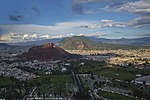
Olivos metro station is a station of the Mexico City Metro in the colonias (neighborhoods) of Ampliación Los Olivos and Granjas San Jerónimo, in Tláhuac, Mexico City. It is an elevated station with two side platforms, served by Line 12 (the Golden Line), between Tezonco and Nopalera stations. The station's pictogram features an olive branch, as it references the area's reputation for olive oil production during the Colonial period. The station was opened on 30 October 2012, on the first day of service between Tláhuac and Mixcoac metro stations. The facilities are accessible for people with disabilities as there are elevators, tactile pavings and braille signage plates and there is a bicycle parking station. In 2019, the station had an average daily ridership of 17,846 passengers, making it the seventh busiest station on the line. The station was closed for 20 months due to structural faults found in the line in 2014. In May 2021, a portion of the station's overhead track collapsed while a train was on it. The track fell onto cars and pedestrians below it, killing 26 and injuring 98.

Excerpt from the Wikipedia article Olivos metro station (License: CC BY-SA 3.0, Authors, Images).

Olivos metro station
Avenida Tláhuac, Mexico City

Geographical coordinates (GPS) Address Nearby Places
placeShow on map

Wikipedia: Olivos metro stationContinue reading on Wikipedia

Geographical coordinates (GPS)

Latitude Longitude
N 19.304275 ° E -99.059385 °
placeShow on map

Address

Olivos

Avenida Tláhuac
Mexico City
Mexico
mapOpen on Google Maps

Metro Olivos 03
Metro Olivos 03
Share experience

Nearby Places

Mexico City Metro overpass collapse

On 3 May 2021, at 22:22 CDT (UTC−5), an overpass in the borough of Tláhuac carrying Line 12 of the Mexico City Metro collapsed beneath a passing train. The overpass and the last two cars of the train fell onto Tláhuac Avenue near Olivos station, killing 26 people and injuring 98 others. It was the Metro's deadliest accident in almost fifty years. The line experienced technical and structural problems that led to a partial closure of the elevated section where the accident occurred between 2014 and 2015. An earthquake in 2017 further damaged the span; although it was repaired within a few months, residents reported problems still existed years later. The line was announced in 2007 as an underground line with the possibility of operating rubber-tired trains because of the instability of the city's soil. The line was scheduled to be opened by 2010 but due to the budget and time constraints, the project was modified to operate both underground and overground with steel-wheeled trains, which researchers have named as one of the causes of track instabilities and damage since the beginning of the line's operations. Empresas ICA, the company that built the system's other lines, constructed it with Alstom Mexicana and Grupo Carso—the latter owned by Carlos Slim. Claudia Sheinbaum, mayor of the city, hired the Norwegian risk management firm Det Norske Veritas (DNV) to investigate the causes of the collapse; preliminary investigations found it was related to deficiencies in the construction of the bridge, and a lack of functional studs and poor-quality welds that led to fatigue in the collapsed beam. Further investigations led them to conclude the bridge was designed and built without quality standards, that the construction and the line's design changes had been inadequately supervised, that there was a lack of fixing and safety elements, and that periodic maintenance checks that would have detected the girder buckling had not been done—the last statement being contested by the city government. Carso, the company responsible for the construction of the collapsed section, denied any wrongdoing but Slim agreed with the government of Mexico to repair the section free of charge. In December 2021, the office of the city's attorney general filed charges against ten former officials—including the project director—who were involved in the construction and supervision of the project in December 2021; as of March 2023, these are awaiting trial for manslaughter, injury, and property damage.