place

Nopalera metro station

2012 establishments in MexicoAccessible Mexico City Metro stationsMexico City Metro Line 12 stationsMexico City Metro stations in TláhuacRailway stations opened in 2012
Use American English from November 2022
Metro Npalera 08
Metro Npalera 08

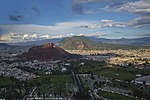
Nopalera metro station is a station of the Mexico City Metro in the colonia (neighborhood) of Miguel Hidalgo and the barrio of Santa Ana Zapotitlán, in Tláhuac, Mexico City. It is an elevated station with two side platforms, served by Line 12 (the Golden Line), between Olivos and Zapotitlán metro stations. The name of the station alludes to the numerous pig and poultry farms that used to occupy the area, and to the nopal cactuses that used to grow on their fields. Similarly, the pictogram for the station depicts the outline of a flowering nopal. The station was opened on 30 October 2012, on the first day of service between Tláhuac and Mixcoac metro stations. The facilities are accessible for people with disabilities as there are elevators, tactile pavings and braille signage plates and there is a bicycle parking station. In 2019, the station had an average daily ridership of 22,491 passengers, making it the 5th busiest station on the line. Since it was opened, Nopalera metro station has had multiple incidents, including a 20-month closure in 2014 due to structural faults found in the elevated section of the line, a closure caused by the 19 September 2017 earthquake that affected the station's track columns, and the subsequent collapse of the track near Olivos station in 2021.

Excerpt from the Wikipedia article Nopalera metro station (License: CC BY-SA 3.0, Authors, Images).

Nopalera metro station
Avenida Tláhuac, Mexico City

Geographical coordinates (GPS) Address Nearby Places
placeShow on map

Wikipedia: Nopalera metro stationContinue reading on Wikipedia

Geographical coordinates (GPS)

Latitude Longitude
N 19.29997 ° E -99.046049 °
placeShow on map

Address

Avenida Tláhuac (Eje 10 Sur;Eje Vial 10 Sur)

Avenida Tláhuac
13300 Mexico City
Mexico
mapOpen on Google Maps

Metro Npalera 08
Metro Npalera 08
Share experience

Nearby Places

Mexico City Metro overpass collapse

On 3 May 2021, at 22:22 CDT (UTC−5), an overpass in the borough of Tláhuac carrying Line 12 of the Mexico City Metro collapsed beneath a passing train. The overpass and the last two cars of the train fell onto Tláhuac Avenue near Olivos station, killing 26 people and injuring 98 others. It was the Metro's deadliest accident in almost fifty years. The line experienced technical and structural problems that led to a partial closure of the elevated section where the accident occurred between 2014 and 2015. An earthquake in 2017 further damaged the span; although it was repaired within a few months, residents reported problems still existed years later. The line was announced in 2007 as an underground line with the possibility of operating rubber-tired trains because of the instability of the city's soil. The line was scheduled to be opened by 2010 but due to the budget and time constraints, the project was modified to operate both underground and overground with steel-wheeled trains, which researchers have named as one of the causes of track instabilities and damage since the beginning of the line's operations. Empresas ICA, the company that built the system's other lines, constructed it with Alstom Mexicana and Grupo Carso—the latter owned by Carlos Slim. Claudia Sheinbaum, mayor of the city, hired the Norwegian risk management firm Det Norske Veritas (DNV) to investigate the causes of the collapse; preliminary investigations found it was related to deficiencies in the construction of the bridge, and a lack of functional studs and poor-quality welds that led to fatigue in the collapsed beam. Further investigations led them to conclude the bridge was designed and built without quality standards, that the construction and the line's design changes had been inadequately supervised, that there was a lack of fixing and safety elements, and that periodic maintenance checks that would have detected the girder buckling had not been done—the last statement being contested by the city government. Carso, the company responsible for the construction of the collapsed section, denied any wrongdoing but Slim agreed with the government of Mexico to repair the section free of charge. In December 2021, the office of the city's attorney general filed charges against ten former officials—including the project director—who were involved in the construction and supervision of the project in December 2021; as of March 2023, these are awaiting trial for manslaughter, injury, and property damage.

Chinampa
Chinampa

Chinampa (Nahuatl languages: chināmitl [tʃiˈnaːmitɬ]) is a technique used in Mesoamerican agriculture which relies on small, rectangular areas of fertile arable land to grow crops on the shallow lake beds in the Valley of Mexico. They are built up on wetlands of a lake or freshwater swamp for agricultural purposes, and their proportions ensure optimal moisture retention. The United Nations designated it a Globally Important Agricultural Heritage System in 2018. The Aztecs created the very first Chinampa. Although different technologies existed during the Post-classic and Colonial periods in the basin, chinampas have raised many questions on agricultural production and political development. After the Aztec Triple Alliance formed, the conquest of southern basin city-states, such as Xochimilco, was one of the first strategies of imperial expansion. Before this time, farmers maintained small-scale chinampas adjacent to their households and communities in the freshwater lakes of Xochimilco and Chalco. Chinampas were invented by the Aztec civilization. Sometimes referred to as "floating gardens," chinampas are artificial islands that were created by interweaving reeds with stakes beneath the lake's surface, creating underwater fences. A buildup of soil and aquatic vegetation would be piled into these "fences" until the top layer of soil was visible on the water's surface.When creating chinampas, in addition to building up masses of land, a drainage system was developed. This drainage system was multi-purposed. A ditch was created to allow for the flow of water and sediments (likely including night soil). Over time, the ditch would slowly accumulate piles of mud. This mud would then be dug up and placed on top of the chinampas, clearing the blockage. The soil from the bottom of the lake was also rich in nutrients, thus acting as an efficient and effective way of fertilizing the chinampas. Replenishing the topsoil with lost nutrients provided for bountiful harvests. Embarcadero-Jiménez and colleagues tested the correlation between environmental parameters and bacterial diversity in the soil. It is speculated that a diverse array of bacteria can affect the nutrients in the soil. The results found that bacterial diversity was more abundant in cultivated soils than non-cultivated soils. Also, "the structure of the bacterial communities showed that the chinampas are a transition system between sediment and soil and revealed an interesting association of the S-cycle and iron-oxidizing bacteria with the rhizosphere of plants grown in the chinampa soil".Evidence from Nahuatl wills from late seventeenth-century Pueblo Culhuacán suggests chinampas were measured in matl (one matl = 1.67 meters), often listed in groups of seven. One scholar has calculated the size of chinampas using Codex Vergara as a source, finding that they usually measured roughly 30 m × 2.5 m (100 ft × 10 ft). In Tenochtitlan, the chinampas ranged from 90 m × 5 m (300 ft × 20 ft) to 90 m × 10 m (300 ft × 30 ft) They were created by staking out the shallow lake bed and then fencing in the rectangle with wattle. The fenced-off area was then layered with mud, lake sediment, and decaying vegetation, eventually bringing it above the level of the lake. Often trees such as āhuexōtl [aːˈweːʃoːt͡ɬ] (Salix bonplandiana) (a willow) and āhuēhuētl [aːˈweːweːt͡ɬ] (Taxodium mucronatum) (a cypress) were planted at the corners to secure the chinampa. In some places, the long raised beds had ditches in between them, giving plants continuous access to water and making crops grown there independent of rainfall. Chinampas were separated by channels wide enough for a canoe to pass. These raised, well-watered beds had very high crop yields with up to 7 harvests a year. Chinampas were commonly used in pre-colonial Mexico and Central America. There is evidence that the Nahua settlement of Culhuacan, on the south side of the Ixtapalapa peninsula that divided Lake Texcoco from Lake Xochimilco, constructed the first chinampas in C.E. 1100.