place

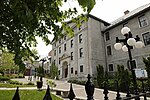
Chalmers-Wesley United Church

1853 establishments in Canada19th-century Presbyterian churches19th-century United Church of Canada church buildingsChurches completed in 1853Churches in Quebec City
Gothic Revival architecture in Quebec CityGothic Revival church buildings in CanadaJohn Wells (architect) buildingsUnited Church of Canada churches in Quebec
Chalmers Wesley United Church, Quebec City

Chalmers-Wesley United Church is a Protestant church located within the walls of Old Quebec at 78, rue Sainte-Ursule in Quebec City, Quebec, Canada. Designed by architect John Wells for the Free Presbyterian Church of Canada, the church was built from 1851-1853 and opened for worship on March 6, 1853. It is particularly admired for its Gothic Revival design. In 1925, the church became part of the newly formed United Church of Canada. Composer William Reed was notably the church's organist from 1900-1913. In 1931, the congregation of the nearby Wesleyan Methodist Church, which had also become part of The United Church of Canada, merged with Chalmers United Church and was renamed Chalmers-Wesley United Church.

Excerpt from the Wikipedia article Chalmers-Wesley United Church (License: CC BY-SA 3.0, Authors, Images).

Chalmers-Wesley United Church
Rue Sainte-Ursule, Quebec

Geographical coordinates (GPS) Address Nearby Places
placeShow on map

Wikipedia: Chalmers-Wesley United ChurchContinue reading on Wikipedia

Geographical coordinates (GPS)

Latitude Longitude
N 46.81006 ° E -71.20901 °
placeShow on map

Address

Chalmers-Wesley United Church

Rue Sainte-Ursule 78
G1R 4E8 Quebec (La Cité-Limoilou)
Quebec, Canada
mapOpen on Google Maps

Chalmers Wesley United Church, Quebec City
Share experience

Nearby Places

Ramparts of Quebec City

The ramparts of Quebec City is a city wall that surrounds the western end of Old Quebec's Upper Town in Quebec City, Quebec, Canada. The ramparts date back to the 17th century, with the ramparts having undergone a succession of modifications and improvements throughout its history. The city walls extends 4.6 kilometres (2.9 mi), with the southern portions of the ramparts forming a part of the Citadelle of Quebec. The ramparts were first built in 1690 in order to defend the Upper Town of Quebec City. In 1745, the walls were rebuilt further west, modelled after designs created by Gaspard-Joseph Chaussegros de Léry. The ramparts withstood several sieges during the mid-18th century, with British forces holding out in the walled city during the French siege of Quebec in 1760, and the American siege of Quebec in 1775. From the 1820s to 1830s, the British expanded and improved the ramparts and the rest of the city's defensive network. However, by the late-19th century, several deteriorating facilities associated with Quebec City's fortifications were demolished, although the primary defences remained. In 1948, the ramparts were designated as a part of the larger Fortifications of Québec National Historic Site. The fortifications, alongside the rest of Old Quebec, were designated as a UNESCO World Heritage Site in 1985; with the area serving as the only intact example of a fortified colonial settlement in North America north of Mexico.

Clarendon Hotel
Clarendon Hotel

The Clarendon Hotel, or Clarendon House (French: Hôtel Clarendon), is a high-end hotel in the historic neighbourhood of Old Quebec in Quebec City, Quebec, Canada. It is the oldest continuously operating hotel in the city. The original building, on the corner of Rue Sainte-Anne and des Jardins, was a house built in 1858 and designed by Charles Baillairgé. It was built as a four-storey house, and was almost immediately sold to Queen's Printers George-Édouard Desbarats and Stewart Derbishire. The building hosted the printers (and various smaller businesses) until 1870, when it became the Russel House hotel, which was sold in 1894, and renamed the Clarendon Hotel. The hotel changed hands again several times until it became part of the Dufour Group hotels. Important extensions and modifications were made to the building during the 20th century: two extra floors with mansard roof and a six-floor Art Deco extension at 57 Rue Sainte-Anne where the main entrance, originally on des Jardins, was relocated. Soon after, another extension was built to enlarge the hotel. The hotel boasts a fine French restaurant, Le Charles Baillairgé, and a bar, L'Emprise, were renowned live jazz shows used to be held until 2006. The main architectural interest of the building is its brick Art Deco façade, completed in 1927 and designed by Raoul Chênevert. It also has Art nouveau cast iron grilles and canopy, giving it a unique combination of styles. Built a few years before neighbouring Édifice Price, its decoration is more geometric than figurative. The building still keeps its wicket entrance. The hotel serves as a backdrop to Nicole Brossard's novel Yesterday, at the Hotel Clarendon (French: Hier).