place

Vieux-Québec–Cap-Blanc–Colline Parlementaire

AC with 0 elementsNeighbourhoods in Quebec CityOld Quebec
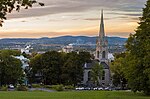
Séminaire de Quebec
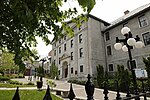
Séminaire de Quebec

Vieux-Québec–Cap-Blanc–Colline Parlementaire is one of the 35 districts of the City of Quebec, and one of six that are located in the borough of La Cité-Limoilou. The district is the most visited and toured location in the city. It is in this partly fortified area where the Château Frontenac is found, with its large terrace overlooking the city of Lévis, across the Saint Lawrence River. A large concentration of cafes, tourist shops, restaurants, hotels and inns are situated in the district. In its most recent census count in 2016, Statistics Canada reported that the district had a population of 5,770 residents, whom comprise 1.1% of the city's total population.

Excerpt from the Wikipedia article Vieux-Québec–Cap-Blanc–Colline Parlementaire (License: CC BY-SA 3.0, Authors, Images).

Vieux-Québec–Cap-Blanc–Colline Parlementaire
Rue D'Auteuil, Quebec

Geographical coordinates (GPS) Address Nearby Places
placeShow on map

Wikipedia: Vieux-Québec–Cap-Blanc–Colline ParlementaireContinue reading on Wikipedia

Geographical coordinates (GPS)

Latitude Longitude
N 46.81 ° E -71.21 °
placeShow on map

Address

Rue D'Auteuil 85
G1R 4E8 Quebec (La Cité-Limoilou)
Quebec, Canada
mapOpen on Google Maps

Séminaire de Quebec
Séminaire de Quebec
Share experience

Nearby Places

Ramparts of Quebec City

The ramparts of Quebec City is a city wall that surrounds the western end of Old Quebec's Upper Town in Quebec City, Quebec, Canada. The ramparts date back to the 17th century, with the ramparts having undergone a succession of modifications and improvements throughout its history. The city walls extends 4.6 kilometres (2.9 mi), with the southern portions of the ramparts forming a part of the Citadelle of Quebec. The ramparts were first built in 1690 in order to defend the Upper Town of Quebec City. In 1745, the walls were rebuilt further west, modelled after designs created by Gaspard-Joseph Chaussegros de Léry. The ramparts withstood several sieges during the mid-18th century, with British forces holding out in the walled city during the French siege of Quebec in 1760, and the American siege of Quebec in 1775. From the 1820s to 1830s, the British expanded and improved the ramparts and the rest of the city's defensive network. However, by the late-19th century, several deteriorating facilities associated with Quebec City's fortifications were demolished, although the primary defences remained. In 1948, the ramparts were designated as a part of the larger Fortifications of Québec National Historic Site. The fortifications, alongside the rest of Old Quebec, were designated as a UNESCO World Heritage Site in 1985; with the area serving as the only intact example of a fortified colonial settlement in North America north of Mexico.