place

Morrin Centre

1868 establishments in CanadaBuildings and structures completed in 1712Education museumsHeritage buildings of QuebecHistory museums in Quebec
Museums in Quebec CityNational Historic Sites in QuebecOld QuebecPrison museums in CanadaQuebec Anglophone culture in Quebec City
Morrin Centre
Morrin Centre

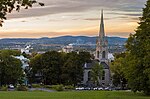
The Morrin Centre is a cultural centre in the Old Quebec neighbourhood of Quebec City, Quebec, Canada. It is designed to educate the public about the historic contribution and present-day culture of local English-speakers. The centre contains the private English-language library of the Literary and Historical Society of Quebec, heritage spaces for events, and interpretation services. The English-language library has been located in the Morrin Centre since 1868. The Library is the repository of the LHSQ's collection of historical documents, including copies of the society's journal, Transactions. These documents include original, scientific, historical, and literary articles from the nineteenth century, as well as reprints of older historical primary sources found in archives around the world. In order to access these materials, one must be a member of the library.

Excerpt from the Wikipedia article Morrin Centre (License: CC BY-SA 3.0, Authors, Images).

Morrin Centre
Chaussée des Écossais, Quebec

Geographical coordinates (GPS) Address External links Nearby Places
placeShow on map

Wikipedia: Morrin CentreContinue reading on Wikipedia

Geographical coordinates (GPS)

Latitude Longitude
N 46.812909 ° E -71.210557 °
placeShow on map

Address

Morrin Centre

Chaussée des Écossais
G1R 4H2 Quebec (La Cité-Limoilou)
Quebec, Canada
mapOpen on Google Maps

linkWikiData (Q3324394)
linkOpenStreetMap (27073750)

Morrin Centre
Morrin Centre
Share experience

Nearby Places

Quebec City
Quebec City

Quebec City ( (listen) or ; French: Ville de Québec), officially Québec ([kebɛk] (listen)), is the capital city of the Canadian province of Quebec. As of July 2021, the city had a population of 549,459, and the metropolitan area had a population of 839,311. It is the eleventh-largest city and the seventh-largest metropolitan area in Canada. It is also the second-largest city in the province after Montreal. It has a humid continental climate with warm summers coupled with cold and snowy winters. The Algonquian people had originally named the area Kébec, an Algonquin word meaning "where the river narrows", because the Saint Lawrence River narrows proximate to the promontory of Quebec and its Cape Diamant. Explorer Samuel de Champlain founded a French settlement here in 1608, and adopted the Algonquin name. Quebec City is one of the oldest European cities in North America. The ramparts surrounding Old Quebec (Vieux-Québec) are the only fortified city walls remaining in the Americas north of Mexico. This area was declared a World Heritage Site by UNESCO in 1985 as the "Historic District of Old Québec".The city's landmarks include the Château Frontenac hotel that dominates the skyline and the Citadelle of Quebec, an intact fortress that forms the centrepiece of the ramparts surrounding the old city and includes a secondary royal residence. The National Assembly of Quebec (provincial legislature), the Musée national des beaux-arts du Québec (National Museum of Fine Arts of Quebec), and the Musée de la civilisation (Museum of Civilization) are found within or near Vieux-Québec.

Clarendon Hotel
Clarendon Hotel

The Clarendon Hotel, or Clarendon House (French: Hôtel Clarendon), is a high-end hotel in the historic neighbourhood of Old Quebec in Quebec City, Quebec, Canada. It is the oldest continuously operating hotel in the city. The original building, on the corner of Rue Sainte-Anne and des Jardins, was a house built in 1858 and designed by Charles Baillairgé. It was built as a four-storey house, and was almost immediately sold to Queen's Printers George-Édouard Desbarats and Stewart Derbishire. The building hosted the printers (and various smaller businesses) until 1870, when it became the Russel House hotel, which was sold in 1894, and renamed the Clarendon Hotel. The hotel changed hands again several times until it became part of the Dufour Group hotels. Important extensions and modifications were made to the building during the 20th century: two extra floors with mansard roof and a six-floor Art Deco extension at 57 Rue Sainte-Anne where the main entrance, originally on des Jardins, was relocated. Soon after, another extension was built to enlarge the hotel. The hotel boasts a fine French restaurant, Le Charles Baillairgé, and a bar, L'Emprise, were renowned live jazz shows used to be held until 2006. The main architectural interest of the building is its brick Art Deco façade, completed in 1927 and designed by Raoul Chênevert. It also has Art nouveau cast iron grilles and canopy, giving it a unique combination of styles. Built a few years before neighbouring Édifice Price, its decoration is more geometric than figurative. The building still keeps its wicket entrance. The hotel serves as a backdrop to Nicole Brossard's novel Yesterday, at the Hotel Clarendon (French: Hier).

Ramparts of Quebec City

The ramparts of Quebec City is a city wall that surrounds the western end of Old Quebec's Upper Town in Quebec City, Quebec, Canada. The ramparts date back to the 17th century, with the ramparts having undergone a succession of modifications and improvements throughout its history. The city walls extends 4.6 kilometres (2.9 mi), with the southern portions of the ramparts forming a part of the Citadelle of Quebec. The ramparts were first built in 1690 in order to defend the Upper Town of Quebec City. In 1745, the walls were rebuilt further west, modelled after designs created by Gaspard-Joseph Chaussegros de Léry. The ramparts withstood several sieges during the mid-18th century, with British forces holding out in the walled city during the French siege of Quebec in 1760, and the American siege of Quebec in 1775. From the 1820s to 1830s, the British expanded and improved the ramparts and the rest of the city's defensive network. However, by the late-19th century, several deteriorating facilities associated with Quebec City's fortifications were demolished, although the primary defences remained. In 1948, the ramparts were designated as a part of the larger Fortifications of Québec National Historic Site. The fortifications, alongside the rest of Old Quebec, were designated as a UNESCO World Heritage Site in 1985; with the area serving as the only intact example of a fortified colonial settlement in North America north of Mexico.