place

Church of the Savior on Bolvany

Church buildings with domesChurches completed in 1755Churches in MoscowCultural heritage monuments of federal significance in MoscowHistory of Moscow
Russian Orthodox church buildings in RussiaZamoskvorechye District
Moscow, Spas na Bolvanovke

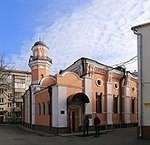
Church of Transfiguration of Savior in Bolvanovka (Russian: Храм Спаса Преображения на Болвановке), also abbreviated to Saviour in Bolvanovka (Спас на Болвановке), is an Orthodox church in Zamoskvorechye District of Moscow. The neighborhood, Bolvanovka (rus. Болвановка), derives its name from Russian bolvan (болван), which could mean either a billet or, in obsolete sense, a non-Orthodox cult image. There have different Bolvanovka neighborhoods in medieval Moscow, a sign of wide Tatar presence (e.g. near Taganka Square). A legend says that the church stands on site of a Tatar bolvan, an artifact which symbolized submission of Moscow to Golden Horde. Ivan III of Russia destroyed this symbol (or broke ambassador symbol - basma (басма), that has the same name) and established an Orthodox church at this place in 1465. His refusal to pay tribute to the Horde resulted in the Great stand on the Ugra river of 1480. A wooden church had been mentioned in city records since 1465. The new baroque building was built in the 18th century; completion date is disputed (1722 or later); what is known definitely is that the church was consecrated in 1755. Alternative accounts assert that there was a succession of wooden churches built in 1708 and 1722; extant building that replaced them was built in 1749-1755. The church burnt down in the Fire of Moscow (1812) and was reopened to worshippers in 1815 with subsequent expansion in 1839. It was closed by Bolsheviks in 1922, partially destroyed, and returned to the worshippers in 1991. A temporary, standalone wooden belltower was added in the 1990s.

Excerpt from the Wikipedia article Church of the Savior on Bolvany (License: CC BY-SA 3.0, Authors, Images).

Church of the Savior on Bolvany
2nd Novokuznetskiy Lane, Moscow Zamoskvorechye District

Geographical coordinates (GPS) Address Nearby Places
placeShow on map

Wikipedia: Church of the Savior on BolvanyContinue reading on Wikipedia

Geographical coordinates (GPS)

Latitude Longitude
N 55.734444444444 ° E 37.631388888889 °
placeShow on map

Address

Детский сад "В гостях у сказки"

2nd Novokuznetskiy Lane
115184 Moscow, Zamoskvorechye District
Moscow, Russia
mapOpen on Google Maps

Moscow, Spas na Bolvanovke
Share experience

Nearby Places

Embassy of Tanzania, Moscow

The Embassy of the United Republic of Tanzania in Moscow is the diplomatic mission of Tanzania in the Russian Federation. It is located in embassy quarter on Bol'shaya Nikitskaja Str., house #51, that was previously occupied by the embassy of Morocco. Prior to 2013, the Tanzanian embassy was located at 33 Pyatnitskaya Street (Russian: Пятницкая ул., 33) in the Zamoskvorechye District of Moscow.The old Embassy occupied a listed memorial building - Korobkova House - built in two stages in 1890s. The oldest, northern part of the building contains a two-story core, built in 1866 and rebuilt in ornate late eclecticism by Lev Kekushev (1890-1894). In the same decade the owners acquired an adjacent southern lot and hired Sergey Schutzmann to expand the building from Kekushev's 21×23 to 30×23 meters. The annex, completed in 1899, corresponds to the three southernmost windows on the main facade. Instead of expanding Kekushev's original artwork to the south annex, Schutzmann completely redesigned the facade, radically changing its appearance. Public sources frequently, and incorrectly, credit the building to Kekushev alone or present Kekushev's and Schutzmann's work as a joint collaboration. For a short period following relocation of Academy of Sciences from Leningrad to Moscow (1934) the building was a residence of the Academy's Presidents Alexander Karpinsky (1935-1936) and Vladimir Komarov (1936-1945). Korobkova House was most recently renovated in 2000-2001.

Paveletskaya (Koltsevaya line)

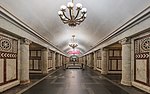
Paveletskaya (Russian: Павеле́цкая) is a station on the Koltsevaya line and Zamotskvoretskaya line of the Moscow Metro. Opened on 1 January 1950 as part of the first segment of the fourth stage, the station is a pylon-trivault built in the style of the late 1940/early 1950s Stalinist architecture to a design by architects Nikolai Kolli and I. Kasetl. The station's theme comes from the Paveletsky railway terminal from which trains depart towards the Volga Region. Thus agricultural influences are clearly seen, these include the square white koyelga marble columns decorated with red marble strips, flanked by marble columns with modern Ionic capitals. Bright bronze chandeliers provide lighting. The walls repeat the two tone marble, white on top, red on bottom, and the floor is laid with grey and white granite. The station's vestibule is built into the corner of the Garden Ring and Zemlyannoy Val, and occupies the ground floor of the building there. Inside above the escalator is a circular mosaic panel by Pavel Korin Red Square which depicts the Lenin's Mausoleum and the Saint Basil's Cathedral, framed by a bas-relief with typical soviet banners and floral arrangements with names of Volga cities on the sides. The vestibule has another artwork by Iosif Rabinovich, which is a mosaic on the dome of the vestibule on the theme of the permanent end to drought in the Volga. As the station was made to be a transfer point to Paveletskaya station of the Zamoskvoretskaya line, the vestibule was built as an entrance to both stations, however as the radial station of the Zamoskvoretskaya line was undergoing reconstruction the vestibule doubled as a transfer point. A direct corridor was opened only on 30 July 1955, which saw the addition of large staircases surrounded by marble balustrades in the centre of the platform. The other major change was that initially in the end of the station was a large medallion with image of Vladimir Lenin and Joseph Stalin, but during the 1961 de-Stalinization drive this was removed and instead replaced by the present artwork by Pavel Korin showing the Coat of Arms of the Soviet Union being held by a worker man and peasant woman amid floral backgrounds.