place

Beauport, Quebec City

1634 establishments in the French colonial empire2002 disestablishments in QuebecBoroughs of Quebec CityFormer municipalities in QuebecPopulated places disestablished in 2002
Use Canadian English from January 2023
Beauport QC
Beauport QC

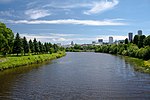
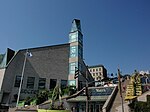
Beauport is a borough of Quebec City, Quebec, Canada on the Saint Lawrence River. Beauport is a northeastern suburb of Quebec City. Manufacturers include paint, construction materials, printers, and hospital supplies. Food transportation is important to the economy. Attractions include Parc de la Chute-Montmorency (Montmorency Falls Park), which contains a fortification built in 1759 by James Wolfe and Manoir Montmorency, the home from 1791 to 1794 of Prince Edward, Duke of Kent and Strathearn. The city's historic district contains many interesting churches and homes, including Bélanger-Girardin House, a National Historic Site of Canada where visitors can learn about Beauport's heritage. Annual events include the spring arts festival Salon de Mai and the summer Festival Folklorique des enfants du monde, a multicultural and international children's folklore festival.

Excerpt from the Wikipedia article Beauport, Quebec City (License: CC BY-SA 3.0, Authors, Images).

Beauport, Quebec City
Autoroute Dufferin-Montmorency, Quebec Beauport (Beauport)

Geographical coordinates (GPS) Address Nearby Places
placeShow on map

Wikipedia: Beauport, Quebec CityContinue reading on Wikipedia

Geographical coordinates (GPS)

Latitude Longitude
N 46.852 ° E -71.189 °
placeShow on map

Address

Autoroute Dufferin-Montmorency

Autoroute Dufferin-Montmorency
G1C 2H8 Quebec, Beauport (Beauport)
Quebec, Canada
mapOpen on Google Maps

Beauport QC
Beauport QC
Share experience

Nearby Places

Battle of Quebec (1775)

The Battle of Quebec (French: Bataille de Québec) was fought on December 31, 1775, between American Continental Army forces and the British defenders of Quebec City early in the American Revolutionary War. The battle was the first major defeat of the war for the Americans, and it came with heavy losses. General Richard Montgomery was killed, Benedict Arnold was wounded, and Daniel Morgan and more than 400 men were taken prisoner. The city's garrison, a motley assortment of regular troops and militia led by Quebec's provincial governor, General Guy Carleton, suffered a small number of casualties. Montgomery's army had captured Montreal on November 13, and early in December they became one force that was led by Arnold, whose men had made an arduous trek through the wilderness of northern New England. Governor Carleton had escaped from Montreal to Quebec, the Americans' next objective, and last-minute reinforcements arrived to bolster the city's limited defenses before the attacking force's arrival. Concerned that expiring enlistments would reduce his force, Montgomery made the end-of-year attack in a blinding snowstorm to conceal his army's movements. The plan was for separate forces led by Montgomery and Arnold to converge in the lower city before scaling the walls protecting the upper city. Montgomery's force turned back after he was killed by cannon fire early in the battle, but Arnold's force penetrated further into the lower city. Arnold was injured early in the attack, and Morgan led the assault in his place before he became trapped in the lower city and was forced to surrender. Arnold and the Americans maintained an ineffectual blockade of the city until spring, when British reinforcements arrived.