The city now known as Mexico City was founded as Mexico Tenochtitlan in 1325 and a century later became the dominant city-state of the Aztec Triple Alliance, formed in 1430 and composed of Tenochtitlan, Texcoco, and Tlacopan. At its height, Tenochtitlan had enormous temples and palaces, a huge ceremonial center, residences of political, religious, military, and merchants. Its population was estimated at least 100,000 and perhaps as high as 200,000 in 1519 when the Spaniards first saw it.
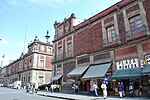
During the final stage of the Spanish conquest of the Aztecs, Spanish forces besieged and razed Tenochtitlan. Hernán Cortés understood the strategic and symbolic importance of the Aztec capital, founded the Spanish capital of Mexico City on the site, and in particular rebuilt the Aztec ceremonial and political center as the main square, the Plaza Mayor, usually called the Zócalo. Some of the oldest structures in Mexico City date from the early conquest era. Many colonial-era buildings remain standing and have been re-purposed as government buildings and museums. As the seats of the Viceroyalty of New Spain and the Archbishopric of New Spain, Mexico City was the center not only of political and religious institutions but also of Mexico's economic activity and the residence of social elites in colonial Mexico (1521–1821). Great merchant houses were located here, and the economic elites of the country also lived in the city, even if the sources of their wealth lay elsewhere. The concentration of mansions and palaces in what is now the Mexico City historic center led it to be nicknamed the "City of Palaces", a sobriquet often attributed, perhaps erroneously, to great savant Alexander von Humboldt. It was also a major educational center: the University of Mexico was founded in 1553 as part of the complex of the Plaza Mayor. The crown-approved attempt to train Nahua men to become Christian priests saw the establishment in 1536 of the Colegio de Santa Cruz de Tlatelolco in one of the two sections of the capital governed by a Nahua city council (cabildo). Many religious institutions for the education of the sons of Spanish elites were also based in the capital. Mexico City had the colony's largest concentration of those of Spanish heritage (both Iberian-born peninsulares and American-born criollos), as well as the largest concentration of mixed race casta population in the colony. Many Indians also lived outside the center of the capital.
Ever since independence in 1821, Mexico City remains the country's largest and most important city. Post-independence, U.S. forces captured Mexico City during the Mexican–American War, and the city saw violence during the Reform War and the French Intervention as well as the Mexican Revolution. At the beginning of the 20th century, the city's population stood at about 500,000. The city's history in the 20th and 21st centuries has been marked by explosive population growth and its accompanying problems. The city center deteriorated. The government has had problems keeping up with basic services, but the building of the Mexico City Metro has alleviated some major transportation problems. Smog became a serious problem as the shanty towns evolved, formed by the poor of the country migrating to the city. Since the 1985 Mexico City earthquake, which caused significant damage to the center of the city, efforts have been made to correct some of these problems. In the 2000s, businessman and philanthropist Carlos Slim created a foundation to revitalize the historic center as well as sites near the Basilica of the Virgin of Guadalupe.

 Continue reading on Wikipedia