place

Museo de la Secretaría de Hacienda y Crédito Público

1957 establishments in MexicoArt museums and galleries in MexicoArt museums established in 1957Aztec sitesColonial Mexico
Contemporary art galleries in MexicoHistoric center of Mexico CityHistoric house museums in MexicoHistory of Mexico CityHouses completed in 1530Landmarks in Mexico CityMexican cultureModern art museumsMuseums in Mexico CityPalaces in MexicoSpanish Colonial architecture in Mexico
MuseoSCPDF
MuseoSCPDF

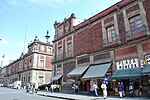
The Museo de la Secretaría de Hacienda y Crédito Público is an art museum located in the historic center of Mexico City. It is housed in what was the Palacio del Arzobispado (Palace of the Archbishopric), built in 1530 under Friar Juan de Zumárraga on the base of the destroyed pyramid dedicated to the Aztec god Tezcatlipoca. It remained the archbishphoric until 1867 when the Finance Ministry Accountancy Department was established there. The modern museum houses an exhibit dedicated to this god as well as a large art collection.

Excerpt from the Wikipedia article Museo de la Secretaría de Hacienda y Crédito Público (License: CC BY-SA 3.0, Authors, Images).

Museo de la Secretaría de Hacienda y Crédito Público
Moneda, Mexico City

Geographical coordinates (GPS) Address External links Nearby Places
placeShow on map

Wikipedia: Museo de la Secretaría de Hacienda y Crédito PúblicoContinue reading on Wikipedia

Geographical coordinates (GPS)

Latitude Longitude
N 19.433591666667 ° E -99.131291666667 °
placeShow on map

Address

Museo de la Secretaría de Hacienda y Crédito Público (Antiguo Palacio del Arzobispado)

Moneda 4
06010 Mexico City
Mexico
mapOpen on Google Maps

linkWikiData (Q1142398)
linkOpenStreetMap (6704744)

MuseoSCPDF
MuseoSCPDF
Share experience

Nearby Places

Massacre in the Great Temple of Tenochtitlan

The Massacre in the Great Temple, also called the Alvarado Massacre, was an event on May 22, 1520, in the Aztec capital Tenochtitlan during the Spanish conquest of Mexico, in which the celebration of the Feast of Toxcatl ended in a massacre of Aztec elites. While Hernán Cortés was in Tenochtitlan, he heard about other Spaniards arriving on the coast – Pánfilo de Narváez had come from Cuba with orders to arrest him – and Cortés was forced to leave the city to fight them. During his absence, Moctezuma asked deputy governor Pedro de Alvarado for permission to celebrate Toxcatl (an Aztec festivity in honor of Tezcatlipoca, one of their main gods, which, as popular in Aztec culture, included human sacrifice, in this case of a young man). But after the festivities had started, Alvarado interrupted the celebration, killing all the warriors and noblemen who were celebrating inside the Great Temple. The few who managed to escape the massacre by climbing over the walls informed the community of the Spaniards' atrocity.The Spanish version of the incident claims the conquistadors intervened to prevent a ritual of human sacrifice in the Templo Mayor; the Aztec version says the Spaniards were enticed into action by the gold the Aztecs were wearing, prompting an Aztec rebellion against the orders of Moctezuma. While differing so on Alvarado's specific motive, both accounts are in basic agreement that the celebrants were unarmed and that the massacre was without warning and unprovoked. The Aztecs were already antagonistic towards the Spaniards for being inside their city and for holding Moctezuma under house arrest. When Cortés and his men, including those who had come under Narváez, returned, the Aztecs began full scale hostilities against the Spaniards. The Spaniards had no choice but to retreat from the city, which they did on what is called the Sad Night (La Noche Triste), losing most of their men, who were either killed in the battle or were captured and sacrificed.

Zócalo
Zócalo

The Zócalo (Spanish pronunciation: [ˈsokalo]) is the common name of the main square in central Mexico City. Prior to the colonial period, it was the main ceremonial center in the Aztec city of Tenochtitlan. The plaza used to be known simply as the "Main Square" or "Arms Square", and today its formal name is Plaza de la Constitución (Constitution Square). This name does not come from any of the Mexican constitutions that have governed the country but rather from the Cádiz Constitution, which was signed in Spain in the year 1812. Even so, it is almost always called the Zócalo today. Plans were made to erect a column as a monument to Independence, but only the base, or zócalo (meaning "plinth"), was built. The plinth was buried long ago, but the name has lived on. Many other Mexican towns and cities, such as Oaxaca, Mérida, and Guadalajara, have adopted the word zócalo to refer to their main plazas, but not all.It has been a gathering place for Mexicans since Aztec times, having been the site of Mexican ceremonies, the swearing-in of viceroys, royal proclamations, military parades, Independence ceremonies, and modern religious events such as the festivals of Holy Week and Corpus Christi. It has received foreign heads of state and is the main venue for both national celebrations and national protests. The Zócalo and surrounding blocks have played a central role in the city's planning and geography for almost 700 years. The site is just one block southwest of the Templo Mayor, which, according to Aztec legend and mythology, was considered the center of the universe.