place

Nasdaq Riga

Economy of LatviaFinancial services companies established in 1993Nasdaq NordicNasdaq exchangesStock exchanges in Europe
Nasdaq Riga birojs
Nasdaq Riga birojs

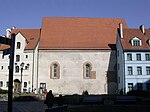
The Nasdaq Riga, formerly Riga Stock Exchange, is the sole stock exchange operating in Riga, Latvia. It is owned by Nasdaq, which also operates exchanges in the USA, Denmark, Sweden, Finland, Iceland, Armenia, Lithuania, and Estonia. Established in 1993. Riga Stock Exchange, together with Vilnius Stock Exchange and Tallinn Stock Exchange is part of the joint Baltic market that was established to minimize investing barriers between Latvian, Lithuanian and Estonian markets. OMX Riga (OMXRGI) is an all-share index consisting of all the shares listed on the Riga Stock Exchange.The exchange has a pre-market session from 08:30am to 10:00am, a normal trading session from 10:00am to 04:00pm, and a post-market session from 04:00pm to 04:30pm.

Excerpt from the Wikipedia article Nasdaq Riga (License: CC BY-SA 3.0, Authors, Images).

Nasdaq Riga
Vaļņu iela, Riga Old Riga

Geographical coordinates (GPS) Address Nearby Places
placeShow on map

Wikipedia: Nasdaq RigaContinue reading on Wikipedia

Geographical coordinates (GPS)

Latitude Longitude
N 56.9509 ° E 24.109 °
placeShow on map

Address

Vaļņu iela 1
LV-1050 Riga, Old Riga
Vidzeme, Latvia
mapOpen on Google Maps

Nasdaq Riga birojs
Nasdaq Riga birojs
Share experience

Nearby Places

Latvian War Museum
Latvian War Museum

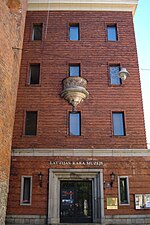
The Latvian War Museum (Latvian: Latvijas Kara muzejs) is a military museum in Riga, the capital of Latvia. The Latvian War Museum was established on 15 October 1916 as the Latvian Riflemen Battalion Museum. Initially the museum had its premises at Tērbatas Street 1/3. The museum collected material relating to the Latvian Riflemen and World War I. In 1917, when Riga was bombarded, the museum was evacuated. In June 1919 the museum restored operations at the Powder Tower in old town Riga. The museum opened to the public in June 1921. In 1936 the government acquired the neighbouring land lot. The erection of a new museum building was initiated in 1937, according to a project by architect Artūrs Galindoms. The interior works were additionally designed by architect R. Legzdiņš. All museum artifacts were temporarily stored at the museum workshop in Torņa Street. The new museum building was finished in the summer of 1940, but the museum did not manage to arrange *the exhibitions prior to the Soviet occupation of Latvia in 1940. The Latvian War Museum came under the jurisdiction of the Latvian People's Army's liquidation commission, which handed the museum artifacts over to the People's Commissariat of Education, and were stored at the previous Riga Stock Exchange building; and the museum premises were handed over to the Red Army. On 15 January 1941 the Latvian War Museum ceased to exist. Beginning in 1945, the building housed the Riga Nakhimov Naval School and continued to house it until 1953. From 1957 to 1990 the premises were occupied by the Latvian SSR Revolution Museum, which interpreted 20th century Latvian history through the point of view of Soviet ideology. However, the museum had during its existence gathered valuable, representative Soviet artifacts for its collections. On 11 June 1990 the Government of Latvia restored the Latvian War Museum.

Riga Russian Theatre

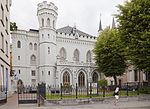
The Mikhail Chekhov Riga Russian Theatre (Latvian: Mihaila Čehova Rīgas Krievu teātris, Russian: Рижский русский театр имени Михаила Чехова), colloquially referred to as the Russian Theatre (Latvian: Krievu teātris, Russian: Русский театр) or the RRT, is a Russian-language theatre in Riga, Latvia. It is located on 16 Kaļķu iela, Riga. The Mikhail Chekhov Riga Russian Theatre (known before 2006 as Riga Russian Drama Theatre) was founded in 1883, making it the oldest Russian-language drama theatre outside Russia. The original troupe consisted of sixteen actors. The theatre grew during the 19th century and had something of a golden age during the leadership of K.N. Nezlobin, prior to the Russian Revolution. The theatre continued to operate after Latvia became an independent country following the Latvian War of Independence (1918–20). During the subsequent Soviet occupation of Latvia, the theatre continued to operate, but had to adapt to the political censorship of the day. It did not put on any performances during World War II. Following the dissolution of the Soviet Union and the re-establishment of Latvian independence, the theatre can once more offer a mix of classical plays and new, innovative plays. In 2006, it was named after Michael Chekhov, who spent two years in Riga (1932-1934) and influenced the Latvian theatre and performing arts. Since the 8 January 2018, the theatre has been led by Dana Bjorka, general manager and member of the board.