place

Small Guild, Riga

1866 establishments in the Russian EmpireBuildings and structures completed in 1866Buildings and structures in RigaLatvian building and structure stubsTourist attractions in Riga
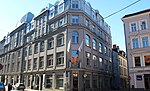
El Pequeño Gremio, Riga, Letonia, 2012 08 07, DD 03

The Small Guild (Latvian: Mazā ģilde) is a building situated in Riga, Latvia, at 3/5 Amatu Street. The building was erected in the years 1864—66 after a project by architect Johann Felsko in Neo-Gothic style.

Excerpt from the Wikipedia article Small Guild, Riga (License: CC BY-SA 3.0, Authors, Images).

Small Guild, Riga
Amatu iela, Riga Old Riga

Geographical coordinates (GPS) Address Website External links Nearby Places
placeShow on map

Wikipedia: Small Guild, RigaContinue reading on Wikipedia

Geographical coordinates (GPS)

Latitude Longitude
N 56.9494916 ° E 24.1080916 °
placeShow on map

Address

Mazā Ģilde

Amatu iela 5
LV-1050 Riga, Old Riga
Vidzeme, Latvia
mapOpen on Google Maps

Website
gilde.lv

linkVisit website

linkWikiData (Q2568596)
linkOpenStreetMap (173411375)

El Pequeño Gremio, Riga, Letonia, 2012 08 07, DD 03
Share experience

Nearby Places

Riga Russian Theatre

The Mikhail Chekhov Riga Russian Theatre (Latvian: Mihaila Čehova Rīgas Krievu teātris, Russian: Рижский русский театр имени Михаила Чехова), colloquially referred to as the Russian Theatre (Latvian: Krievu teātris, Russian: Русский театр) or the RRT, is a Russian-language theatre in Riga, Latvia. It is located on 16 Kaļķu iela, Riga. The Mikhail Chekhov Riga Russian Theatre (known before 2006 as Riga Russian Drama Theatre) was founded in 1883, making it the oldest Russian-language drama theatre outside Russia. The original troupe consisted of sixteen actors. The theatre grew during the 19th century and had something of a golden age during the leadership of K.N. Nezlobin, prior to the Russian Revolution. The theatre continued to operate after Latvia became an independent country following the Latvian War of Independence (1918–20). During the subsequent Soviet occupation of Latvia, the theatre continued to operate, but had to adapt to the political censorship of the day. It did not put on any performances during World War II. Following the dissolution of the Soviet Union and the re-establishment of Latvian independence, the theatre can once more offer a mix of classical plays and new, innovative plays. In 2006, it was named after Michael Chekhov, who spent two years in Riga (1932-1934) and influenced the Latvian theatre and performing arts. Since the 8 January 2018, the theatre has been led by Dana Bjorka, general manager and member of the board.

Siege of Riga (1656)

Siege of Riga by the Russian Army under Tsar Alexei Mikhailovich was the main event of the Russo-Swedish War. The fortifications of Riga consisted of a wall with ditch and 5 bastions around the old town. In 1652 Swedes had started construction of a new wall with 12 bastions around suburbs, but by 1656 the work had not been completed. The Russian vanguard consisting of the Vladimir v. Vizin reiters, Daniel Krafert infantry and Iunkmann dragoons approached Riga on August 20 and threw back the Swedes under count of Pärnu, Heinrich von Thurn into the city. Von Thurn was either killed, or captured in the action. The Swedes evacuated the suburbs and withdrew to the old town. A few days later, the main army under Tsar Alexei Mikhailovich arrived on the ships on the Duna River, and laid siege to Riga. The Russian army occupied three camps, two on the east bank of the Duna in Riga's suburbs, and a Corps under Ordyn-Nashokin on the west bank of the Duna, opposite the Kobrun entrenchment. As Russia had no full-fledged navy to intercept reinforcements coming to the Swedish garrison across the Baltic, Riga managed to hold out until October, when foreign officers commanding a small Russian flotilla defected to the other side and the Russians had to lift the siege. In the aftermath of this reverse, the Swedes recaptured much of Ingria, took the Pskov Monastery of the Caves and inflicted a heavy defeat on the Russian general Matvey Sheremetev in battle of Walk in 1657. The events of the siege were recorded in an engraving by Adam Perelli that was first published in 1697 in Samuel Puffendorf's work, Konung Carl X Gustafs Bragder.

Riga
Riga

Riga (; Latvian: Rīga [ˈriːɡa] (listen), Livonian: Rīgõ) is the capital and largest city of Latvia and is largest city in the Baltic states,and is home to 605,802 inhabitants which is a third of Latvia's population. The population of Rigas functional urban area, which stretches beyond the city limits, is estimated at 920,643 (as of 2023). The city lies on the Gulf of Riga at the mouth of the Daugava river where it meets the Baltic Sea. Riga's territory covers 307.17 km2 (118.60 sq mi) and lies 1–10 m (3.3–32.8 ft) above sea level, on a flat and sandy plain.Riga was founded in 1201 and is a former Hanseatic League member. Riga's historical centre is a UNESCO World Heritage Site, noted for its Art Nouveau/Jugendstil architecture and 19th century wooden architecture. Riga was the European Capital of Culture in 2014, along with Umeå in Sweden. Riga hosted the 2006 NATO Summit, the Eurovision Song Contest 2003, the 2006 IIHF Men's World Ice Hockey Championships, 2013 World Women's Curling Championship and the 2021 IIHF World Championship. It is home to the European Union's office of European Regulators for Electronic Communications (BEREC). In 2017, it was named the European Region of Gastronomy. In 2019, Riga received over 1.4 million foreign visitors. The city is served by Riga International Airport, the largest and busiest airport in the Baltic states. Riga is a member of Eurocities, the Union of the Baltic Cities (UBC) and Union of Capitals of the European Union (UCEU).