place

Latvian Museum of Decorative Arts and Design

1989 establishments in LatviaArt museums and galleries in LatviaArt museums established in 1989Decorative arts museumsEuropean museum stubs
Latvian building and structure stubsMuseums in Riga
Jura baznica
Jura baznica

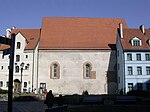
The Latvian Museum of Decorative Arts and Design is an arts museum in Riga, Latvia. The museum was established on 1 January 1989 and opened to the public on 6 July 1989. It is located in the former church St. George's Church, Riga, the oldest surviving stone building in Riga. The opening and closing plenary of the Northern Future Forum gathering of UK, Nordic, Baltic prime ministers was held here in 2013.

Excerpt from the Wikipedia article Latvian Museum of Decorative Arts and Design (License: CC BY-SA 3.0, Authors, Images).

Latvian Museum of Decorative Arts and Design
Skārņu iela, Riga Old Riga

Geographical coordinates (GPS) Address Nearby Places
placeShow on map

Wikipedia: Latvian Museum of Decorative Arts and DesignContinue reading on Wikipedia

Geographical coordinates (GPS)

Latitude Longitude
N 56.9481 ° E 24.1094 °
placeShow on map

Address

Skārņu iela 10
LV-1050 Riga, Old Riga
Vidzeme, Latvia
mapOpen on Google Maps

Jura baznica
Jura baznica
Share experience

Nearby Places

Riga Russian Theatre

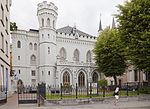
The Mikhail Chekhov Riga Russian Theatre (Latvian: Mihaila Čehova Rīgas Krievu teātris, Russian: Рижский русский театр имени Михаила Чехова), colloquially referred to as the Russian Theatre (Latvian: Krievu teātris, Russian: Русский театр) or the RRT, is a Russian-language theatre in Riga, Latvia. It is located on 16 Kaļķu iela, Riga. The Mikhail Chekhov Riga Russian Theatre (known before 2006 as Riga Russian Drama Theatre) was founded in 1883, making it the oldest Russian-language drama theatre outside Russia. The original troupe consisted of sixteen actors. The theatre grew during the 19th century and had something of a golden age during the leadership of K.N. Nezlobin, prior to the Russian Revolution. The theatre continued to operate after Latvia became an independent country following the Latvian War of Independence (1918–20). During the subsequent Soviet occupation of Latvia, the theatre continued to operate, but had to adapt to the political censorship of the day. It did not put on any performances during World War II. Following the dissolution of the Soviet Union and the re-establishment of Latvian independence, the theatre can once more offer a mix of classical plays and new, innovative plays. In 2006, it was named after Michael Chekhov, who spent two years in Riga (1932-1934) and influenced the Latvian theatre and performing arts. Since the 8 January 2018, the theatre has been led by Dana Bjorka, general manager and member of the board.