place

Ota, Ogun

Populated places in Ogun StateTowns in YorubalandUse Nigerian English from January 2023Yoruba history

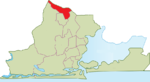
Ota (alternatively spelled Otta') is a town in Ogun State, Nigeria with an estimated 163,783 residents. Ota is the capital of the Ado–Odo/Ota Local Government Area. The traditional leader of Ota is the Olota of Ota, Oba Adeyemi AbdulKabir Obalanlege. Historically, Ota is the capital of the Awori Yoruba tribe.As of 1999, Ota has the third largest concentration of industries in Nigeria. It also possesses a large market and an important road junction, found just north of the tollgate on the Lagos – Abeokuta Expressway. Ota is well known because it is home to Obasanjo Farms Nigeria Limited belonging to the former Nigerian president, Olusegun Obasanjo. Ota is also the location of Canaanland which is the campus of the megachurch Winners' Chapel, as well as home to the Africa Leadership Forum.Otta is known as the home of some Yoruba ancient deities and festivals. Some of the festivals usually celebrated in Otta includes Egungun festival, Iganmode Cultural Festival, Gelede Festival, etc.

Excerpt from the Wikipedia article Ota, Ogun (License: CC BY-SA 3.0, Authors).

Geographical coordinates (GPS)

Latitude Longitude
N 6.6833333333333 ° E 3.2333333333333 °
placeShow on map

Address


Ogun State, Nigeria
mapOpen on Google Maps

Share experience

Nearby Places

Dana Air Flight 0992

Dana Air Flight 0992 was a scheduled Nigerian domestic passenger flight from Abuja to Lagos, Nigeria. On 3 June 2012, the McDonnell Douglas MD-83 aircraft serving the route suffered a dual-engine failure during its approach to Lagos. It failed to reach its intended destination and crashed onto buildings, killing all 153 people on board and six on the ground. With 159 deaths, it remains as the deadliest commercial airliner crash in Nigerian history since Kano air disaster in 1973. Nigerian Accident Investigation Bureau (AIB) concluded that both aircraft's engines had lost power during the approach to Lagos. Incorrect assembly had severed the engines' fuel line, causing fuel to not be delivered to both engines. During the initial sequence of the engine failure, the pilots opted not to declare an emergency until the second engine lost power during the flight's final approach. Lack of situational awareness and poor decision-making by the pilots eventually caused the aircraft to crash into buildings.: 94 The crash once again highlighted Nigeria's aviation safety record. It was the fifth major Nigerian aviation disaster in a decade, after EAS Airlines Flight 4226 in 2002, Bellview Airlines Flight 210 and Sosoliso Airlines Flight 1145 in 2005, and ADC Airlines Flight 053 in 2006. Consequently, it led to major overhaul of the nation's aviation sector. Since the crash of Flight 0992, Nigeria's aviation safety improved significantly and the country eventually retained the category 1 status of its aviation safety.