place

Club Hípico de Santiago

Horse racing venues in ChileMusic venues in ChileSports venues in Santiago

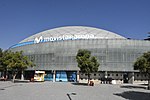
Club Hípico de Santiago is a thoroughbred horse race track in Santiago, Chile.

Excerpt from the Wikipedia article Club Hípico de Santiago (License: CC BY-SA 3.0, Authors).

Club Hípico de Santiago
El Mirador, Santiago

Geographical coordinates (GPS) Address External links Nearby Places
placeShow on map

Wikipedia: Club Hípico de SantiagoContinue reading on Wikipedia

Geographical coordinates (GPS)

Latitude Longitude
N -33.464166666667 ° E -70.668333333333 °
placeShow on map

Address

Club Hípico de Santiago

El Mirador
8370723 Santiago
Santiago Metropolitan Region, Chile
mapOpen on Google Maps

linkWikiData (Q5136270)
linkOpenStreetMap (15239307)

Share experience

Nearby Places

Fantasilandia
Fantasilandia

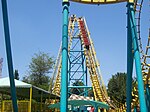
Fantasilandia is a Chilean amusement park. The park opened in 1978 and is located in a corner of the O'Higgins Park in Santiago, Chile.On January 28, 1978 the park opened for first time with only 8 attractions, including the "Galaxy" coaster, "Mansion Siniestra", "Ford T" and "Century 2000", among others. Over the years the park has replaced many of its classic rides with modern rides like "Top Spin", "Xtreme Fall", and "Boomerang". In late 2007, Fantasilandia opened a new ride to replace the old ride "Splash". Called "Tsunami" (Shoot the Chute) it was built in Chile under licence of Intamin A.G of Switzerland. With this milestone the park celebrated its 30-year anniversary. The ride "Villa Magica" also opened in the Kids Zone, located next to "Cine Magic 3D" and fast food locations. In 2008 Fantasilandia opened the second Vekoma SLC in South America. It is called "Raptor" and cost around US$10,000,000. In 2009 three new rides opened in the Kids Zone area. These were "Rockin' Tug", "Toing & Boing" and "Buggy Jump", all of them made in Italy by Zamperla. In late 2010 the Wave Swinger (a flying chairs ride) made by Zierer was opened and is called "Volare" A German built Condor ride was introduced in late 2011. It is called Ikarus. In December, 2012, Fantasilandia added an Air Race ride, built by Zamperla Rides, celebrating 35 years of the opening of the park A year later, the S.D.C Galaxy rollercoaster was closed due to an accident and the "Fun Karting" ride was removed. Also a restaurant with kiddie theme was added in front of the Air Race, and the construction for the new Mack Rides Twist 'n' Splash ride begun (which opened the 21st of December of that year) In December 2014, Fantasilandia started opening the "Moby Dick" ride, manufactured by Wisdom Rides, which opened officially to public in January 2015

Complex Engineering Systems Institute

The Complex Engineering Systems Institute (ISCI), housed at Universidad de Chile and having Pontificia Universidad Católica de Chile as an associate institution, brings together a group of top researchers from eight Chilean universities. Each of the researchers has been invited to join ISCI in view of their academic merit and for their existing or potential synergy with other ISCI members. This is the case with the 58 current ISCI members, who come from the Universidad de Chile, Pontificia Universidad Católica de Chile, Universidad de Santiago de Chile, Universidad Diego Portales, Universidad Adolfo Ibáñez, Universidad de los Andes, Universidad de Talca, and Universidad de Concepción. The researchers' group was formed on 24 January 2007 with two main goals. First, to define a solid set of engineering research areas that are both coherent and complementary, where all types of infrastructure interact with human behavior. Second, to establish a worldwide reference in Engineering research and education outside the USA and Europe, leading to a better understanding of relevant problems and attracting high-level, young researchers. This group has gained international recognition due to the quality of the research performed by its members. An important part of this work is performed jointly with researchers from other prestigious academic organizations abroad, through formal and personal collaboration networks. It prioritizes local synergy and nationwide impact, and the influence of its members has increased in relevant decision-making agents both in the industry and in public institutions.

Basílica de Nuestra Señora del Perpetuo Socorro

The Basílica de Nuestra Señora del Perpetuo Socorro is a Catholic Church located in the comuna of Santiago, in the capital of Chile. It was designed in the Gothic Revival style by the religious architects Gustave Knockaert —known as «Brother Gerardo»— and Huberto Boulangeot. They were members of the Redemptorists. The foundation stone was blessed and laid on 12 December 1904. The ownership of the land to build the church had been transferred from the Ugarte family by public deed on 26 April 1876. Gustave Knockaert (1845-1928), a Belgian priest who previously had designed church buildings for his congregation in Madrid, Paris, Mulhouse and Les Sables-d'Olonne, was appointed to form a team of 15 architects. Among those was Huberto Boulangeot, who was designated as construction manager for the church project. The construction of the church began in 1906, coinciding with the Valparaíso earthquake, which caused plans to be modified for additional structural reinforcement. The church was built with reinforced concrete, planned by the American engineer Juan Tonkin. Another collaborator was the brother Joaquín Chardin, a specialist in cement work, who contributed to the placing of the pointed arches, characteristic elements of the Gothic architecture. He also made the ornamental door of the sacristy, made from encina wood, and the coat of arms of the congregation that was carved on front entrance.Garden features of the basilica were commissioned to brother Constancio, which included the gardens, greenhouse and the pond.The blocks used for the interior columns of the church are from monolith formations and were carried from San José de Maipo using ox-drawn carts. These pieces were transported intact, between 1906 and 1907, to be carved and polished at the construction site. Stone was also extracted from San José de Maipo to make the bases, plinths and the steps. The importation of goods was limited by the saltpetre economic crisis and World War I. As a result, that 8 of the 28 originally planned stained glasses and a rose window were never purchased, leaving those openings with bare glass. The interior of the basilica includes confessionals made from roble americano wood and a French pipe organ made by Neuville Frères in 1897, which was, subsequently, declared a Monumento Histórico. The high altar was partially made in Belgium with marble and bronze, and was completed in Chile with lingue and American oak woods. Its centre includes an image of Our Lady of Perpetual Help, a replica of one found in the redemptorist church of Rome. The altars of Saint Alphonsus and of Our Lady of Mount Carmel were designed by the brother Huberto with bas-reliefs by the Spanish artist José Soria. The basilica is 68 metres (223 ft) long and 30 metres (98 ft) wide. The highest spire towers reach 55 and 65 metres (180 and 213 ft). The church has five naves, but only three of them were completed, the other two are closed and used as a hallway and a warehouse. The roof tiles were made from copper and lead. In 1919, the Basilica was blessed with a Pontifical Mass headed by the then archbishop of Santiago, Crescente Errázuriz. On that day and in an exceptional way, the Argentine musician Domingo Santa Cruz celebrated a Te Deum.The church was declared a Minor Basilica by the Holy See in 1926, being consecrated as such by the Papal ambassador Benedicto Marsella that same year.