place

Church of Saint Nicetas, Moscow

Churches completed in 1595Cultural heritage monuments of federal significance in MoscowMount AthosRussian Orthodox churches in Moscow
Church of Saint Nikita in Shvivaya Gorka 06

Church of St. Nicetas (Храм Никиты Мученика на Швивой горке) is one of the oldest parish churches in Moscow. It is known to have existed as early as 1476. Standing on Shvivova Gorka, the eastern slope of Taganka Hill, this small single-dome church once commanded a famous view of Zamoskvorechye (now blocked by the Kotelnicheskaya Embankment Building). The current church building, dating from 1595, stands on the older foundations. A tent-like belfry and large annex were added in 1685. The icon screen dates from the 1740s. The church has gone through more renovations in the 19th century but was restored to its original medieval appearance under the supervision of Leon David in the 1950s. The church forms the nucleus of the Athonite metochion, a Moscow mission of the Rossikon Monastery on Mount Athos. Future Athonite monks reside there. The entrance is flanked by two tower-like chapels of recent construction, dedicated to St. Pantaleon and Silouan the Athonite.

Excerpt from the Wikipedia article Church of Saint Nicetas, Moscow (License: CC BY-SA 3.0, Authors, Images).

Church of Saint Nicetas, Moscow
Goncharnaya St, Moscow Tagansky District

Geographical coordinates (GPS) Address External links Nearby Places
placeShow on map

Wikipedia: Church of Saint Nicetas, MoscowContinue reading on Wikipedia

Geographical coordinates (GPS)

Latitude Longitude
N 55.74575 ° E 37.644611 °
placeShow on map

Address

Храм Великомученика Никиты

Goncharnaya St 6
109240 Moscow, Tagansky District
Moscow, Russia
mapOpen on Google Maps

linkWikiData (Q1030117)
linkOpenStreetMap (151077511)

Church of Saint Nikita in Shvivaya Gorka 06
Share experience

Nearby Places

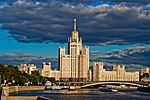
Kotelnicheskaya Embankment Building

Kotelnicheskaya Embankment Building is one of seven Stalinist skyscrapers laid down in September 1947 and completed in 1952, designed by Dmitry Chechulin (then Chief Architect of Moscow) and Andrei Rostkovsky. The main tower has 32 levels (including mechanical floors) and is 176 metres (577 ft) tall. At the time of construction it was the tallest building in Europe.The building also incorporates a 9-story apartment block facing Moskva River, designed by the same architects in 1938 and completed in 1940. Initially built in stern early Stalinist style, with wet stucco wall finishes, it was re-finished in terracotta panels in line with the central tower and acquired ornate pseudo-Gothic crowns over its 12-story raised corners and center tower. By the end of World War II, the side wing was converted to multi-family kommunalka housing, in contrast to the planned elite status of the central tower. The central tower, of a conventional steel frame structural type, has a hexagonal cross-section with three side wings (18 stories, including two mechanical floors). While it is not exceptionally tall or massive, the "upward surge" of five stepped-up layers, from a flat 9-story side wing to the spire, gives the impression of a more massive structure. The structure hides behind itself a so-called "Shvivaya Gorka," a hill with historical architecture and a maze of steeply inclined streets. Chechulin was initially criticized for complete disregard of this area, but his bureaucratic influence brushed off any criticisms.

Yauza (river)
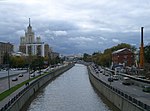
Yauza (river)

The Yauza (Russian: Я́уза) is a river in Moscow and Mytishchi, Russia, a tributary of the Moskva. It originates in the Losiny Ostrov National Park northeast of Moscow, flows through Mytishchi, enters Moscow in the Medvedkovo District and flows through the city in an irregular, meandering, generally north-south direction. The Yauza joins the Moskva River in Tagansky District just west of Tagansky Hill, now marked by the Kotelnicheskaya Embankment tower. Valleys of the Yauza, from the MKAD beltway in the north to the Moscow-Yaroslavl railway west of Sokolniki Park, are protected as natural reserves.The Yauza has been mentioned in Russian chronicles since 1156; the exact origin of the name is unknown. Moscow crossed its former natural eastern boundary (marked by the Yauza) in the beginning of the 16th century. The banks of the Yauza within the Garden Ring were densely urbanized by the middle of the 17th century; upstream valleys housed suburban residences of the House of Romanov, from Mikhail to Catherine II. Settlements along the Yauza (German Quarter, Lefortovo, Preobrazhenskoye) played a significant role in the history of Russia in the 17th and 18th centuries. Industrialization in the 19th and 20th centuries made the Yauza "the biggest gutter for waste in Moscow". In the 2000s the ecology improved, with the closing or conversion of old factories and cleanup efforts by the city government. In 2007 the Yauza waters were reclassified from "dirty" to "polluted" status, but in 2008 the trend reversed and pollution in the Yauza exceeded its 2006 levels. As of 2008, Yauza water passing the Moscow city boundary is rated as "polluted", and reaches a "very dirty" level at its inlet. Untreated surface runoff in the Central Administrative District remains the main source of pollution.

Taganskaya (Koltsevaya line)

Taganskaya (Russian: Тага́нская) is a station on the Koltsevaya line of the Moscow Metro. It opened on 1 January 1950 with the first segment of the fourth stage of the system. The station is named after the Taganka Square which is a major junction of the Sadovoye Koltso. Designed by architects K. Ryzhkov and A. Medvedev, this pylon station was built with the post-war flamboyance in mind, the overall design is based on the traditional Russian motives in decorations. The central feature of the station are 48 maiolica panels located on each face of the pylon. (works of Ye.Blinova, P. Kozhin, A. Sotnikov, A. Berzhitskaya and Z. Sokolova). These contain apart from floral elements, profile bas-reliefs of various World War II Red Army and Navy servicemen each dedicated to a group such as pilots, tank crews, sailors etc. The color gamma is balanced in such a way that the panels facing the central hall are on a blue majolica background, whilst the platform hall panels are monochromatic. Lighting comes from a set of 12 gilded chandeliers in the central hall with the same blue majolica center. The remaining decoration of the station include a cream-colored ceramic tile on the walls, powder colored marble on the lower pylons and also on the walls, and a checkerboard floor layout of black and gray granite. The end of the central hall once had a large sculptural group Stalin and youth, however this was replaced in 1961 by a new artwork of the same authors (P. Baladin and Ye. Blinova) depicting Vladimir Lenin, Coats of arms of the Soviet Republics and images of Hero-Cities Leningrad, Stalingrad, Sevastopol and Odessa. This was also taken down in late 1966 to make way for a transfer to the newly opened Taganskaya of the Zhdanovskaya line. Further transfer was opened in 1979 by adding a stairwell into the middle of the central hall for the new station Marksistskaya of the Kalininskaya line. Because the Taganka Square is located on the hill, in order to conveniently place the large vestibule, and also preserve a nearby heritage building, the escalator descent had to be broken, and an intermediate hall was added by placing a large cylinder and gradually lowering to the required depth. After a dome was added, the interior work on the new lobby began, the walls of which are faced with Altai marble Oroktoy with Syringa shade, and the pilasters from white marble. The dome contains a large ceiling fresco, Victory Fireworks by A. Shiryaeva. On 18 November 2005 the vestibule was closed for restoration, during which old escalators (installed in 1949) were replaced. All of the decoration features were renovated, and the upgrade included new turnstiles, ticket offices and security upgrade. The station was re-opened on 20 December 2006. It was the deepest station in Moscow Metro from 1950 until 1958.