place

Cine Latino

Buildings and structures in Mexico CityCinemas in MexicoMexican company stubsPaseo de la Reforma

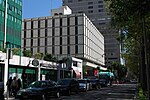
Cine Latino was one of the largest cinemas in Mexico City, located on the south side of Paseo de la Reforma, the city's signature boulevard, at #296, in the Zona Rosa district of the Colonia Juárez neighborhood. Construction began in 1942 and was inaugurated until April 20, 1960, the work was in charge of the architects Gabriel Romero, Carlos Vergara and Guillermo Salazar, he was one of the first to have its own parking, which was not very common in cinemas back then. In its heyday it featured D-150 technology for curved screen projections, in the 70-80s it was the first surround sound screen. It had two floors and a capacity of 1,850 spectators originally, and after remodelling could hold 2,500. It often hosted premieres such as "Lola la Trailera". The site is now occupied by the Torre Reforma Latino, one of Mexico's tallest buildings.

Excerpt from the Wikipedia article Cine Latino (License: CC BY-SA 3.0, Authors).

Cine Latino
Avenida Paseo de la Reforma, Mexico City

Geographical coordinates (GPS) Address Nearby Places
placeShow on map

Wikipedia: Cine LatinoContinue reading on Wikipedia

Geographical coordinates (GPS)

Latitude Longitude
N 19.4273891 ° E -99.1652374 °
placeShow on map

Address

Torre Reforma Latino

Avenida Paseo de la Reforma 296
06600 Mexico City
Mexico
mapOpen on Google Maps

Share experience

Nearby Places

Zona Rosa, Mexico City

Zona Rosa (English: "Pink Zone") is a neighborhood in Mexico City which is known for its shopping, nightlife, gay community and its recently established Korean community. The neighborhood is officially part of the Colonia Juárez colonia or official neighborhood, located just west of the historic center of Mexico City. The area's history as a community began when it was developed as a residential district for wealthy foreigners and Mexico City residents looking to move from the city center. The development of the area stalled during and after the Mexican Revolution. From the 1950s to 1980s the neighborhood was revitalized by artists, intellectuals and the city's elite who repopulated the area, gave it a bohemian reputation and attracted exclusive restaurants and clubs for visiting politicians and other notables. It was during this time that the area received the name of Zona Rosa, from José Luis Cuevas. The era ended in the 1980s, when many of the upscale businesses moved out and tourism, men's clubs, prostitution and other crime moved in. Although the area declined during the 1980s, it is still a major shopping and entertainment district and has also become a major tourist attraction for the city, one that the city has worked to preserve and rehabilitate since the 2000s, with mixed success. From the 1990s, the area has also become home to Mexico City's gay community, which is prominent around Amberes Street and sponsors an annual pride parade on Paseo de la Reforma.