place

The Flying Frenchman

1990s establishments in Hong Kong1992 worksBronze sculptures in ChinaHong Kong building and structure stubsKowloon stubs
Monuments and memorials in Hong KongOutdoor sculptures in Hong KongSculpture stubsStatues in Hong KongTsim Sha Tsui
HK TST Hong Kong Cultural Centre Flying Frenchman 7

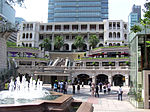
The Flying Frenchman is a bronze sculpture by César Baldaccini, installed outside the Hong Kong Cultural Centre along Tsim Sha Tsui's waterfront, in Kowloon, Hong Kong. The sculpture was gifted to Hong Kong by the Cartier Foundation in 1992. The name "Freedom Fighter" was rejected by Hong Kong's government, causing the artist not to attend the unveiling ceremony in 1993.

Excerpt from the Wikipedia article The Flying Frenchman (License: CC BY-SA 3.0, Authors, Images).

The Flying Frenchman
Salisbury Road, Kowloon Tsim Sha Tsui (Yau Tsim Mong District)

Geographical coordinates (GPS) Address Nearby Places
placeShow on map

Wikipedia: The Flying FrenchmanContinue reading on Wikipedia

Geographical coordinates (GPS)

Latitude Longitude
N 22.291666666667 ° E 114.16666666667 °
placeShow on map

Address

幻彩詠香江 Symphony of Lights

Salisbury Road
999077 Kowloon, Tsim Sha Tsui (Yau Tsim Mong District)
Hong Kong, China
mapOpen on Google Maps

HK TST Hong Kong Cultural Centre Flying Frenchman 7
Share experience

Nearby Places

Battle of Kowloon
Battle of Kowloon

The Battle of Kowloon (Chinese: 九龍海戰) was a skirmish between British and Chinese vessels off the Kowloon Peninsula, China, on 4 September 1839, located in Hong Kong, although Kowloon was then part of the Guangdong province. The skirmish was the first armed conflict of the First Opium War and occurred when British boats opened fire on Chinese war junks enforcing a food sales embargo on the British community. The ban was ordered after a Chinese man died in a drunken brawl with British sailors at Tsim Sha Tsui. The Chinese authorities did not consider the punishment to be sufficient as meted out by British officials, so they suspended food supplies in an attempt to force the British to turn over the culprit. Captain Charles Elliot was the chief superintendent of British trade in China, and he sailed to Kowloon in the cutter Louisa for food supplies during the embargo, accompanied by the schooner Pearl and a pinnace from HMS Volage. They encountered three Chinese junks, and Elliot sent interpreter Karl Gutzlaff with demands to allow the supply of provisions. He finally delivered an ultimatum after several hours of correspondence: the junks would be sunk if supplies were not received. The stated time period expired with no results, so the British opened fire on the junks, which returned fire with support from the on-shore fort. The larger junks pursued the British boats which were sailing away after running low on ammunition, but the British re-engaged the ships after replenishing their ammunition, and the Chinese retreated to their former position, ending the clash in a stalemate.