place

Beth Israel Cemetery (Quebec City)

Canadian building and structure stubsCemetery stubsJewish cemeteries in QuebecNational Historic Sites in QuebecQuebec City stubs
Religion in Quebec City
Cimetière juif de QuébecC

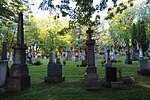
Beth Israel Cemetery is a 1-acre (0.40 ha) Jewish cemetery in the borough of Sainte-Foy–Sillery–Cap-Rouge, Quebec City, Quebec, Canada. It is designated a National Historic Site of Canada.

Excerpt from the Wikipedia article Beth Israel Cemetery (Quebec City) (License: CC BY-SA 3.0, Authors, Images).

Beth Israel Cemetery (Quebec City)
Boulevard René-Lévesque Ouest, Quebec Cité-Universitaire (Sainte-Foy–Sillery–Cap-Rouge)

Geographical coordinates (GPS) Address External links Nearby Places
placeShow on map

Wikipedia: Beth Israel Cemetery (Quebec City)Continue reading on Wikipedia

Geographical coordinates (GPS)

Latitude Longitude
N 46.7851 ° E -71.2606 °
placeShow on map

Address

Cimetière Beth Israël

Boulevard René-Lévesque Ouest 2052
G1V 0B6 Quebec, Cité-Universitaire (Sainte-Foy–Sillery–Cap-Rouge)
Quebec, Canada
mapOpen on Google Maps

linkWikiData (Q23303441)
linkOpenStreetMap (164475817)

Cimetière juif de QuébecC
Share experience

Nearby Places

Sillery, Quebec City

Sillery, a former independent city founded in 1637, is one of 35 administrative sectors (French: quartiers), which are unincorporated places, located in the post-expansion jurisdiction of the City of Quebec, Quebec, Canada. Sillery was one of multiple self-governing municipalities amalgamated into a vastly expanded Quebec City, that went into legal effect on January 1, 2002, as part of the province-wide 2000–06 municipal reorganization in Quebec. Located alongside in what pre-merger was the southwestern border of Quebec City, Sillery is a constituent district (French: quartier) of the borough (French: arrondissement) of Sainte-Foy–Sillery–Cap-Rouge. The territorially expanded City of Quebec consists of six boroughs. Four heritage sites are located within Quebec City, one of which is situated in Sillery. The neighbourhood of Sillery contains the Sillery Heritage Site, which was recognized as heritage district by the provincial government on 5 February 1964. On 22 June 2006, the federal government's Parks Canada included Sillery's historic district on its Canadian Register of Historic Places. In 2013, Quebec City changed the name of the historic district to Sillery Heritage Site (French: site patrimonial de Sillery), as part of its preparation for the provincial government's transfer of responsibility for the district's management to it.The City of Quebec has 27 neighbourhood councils (French: conseils de quartiers) spread across its territorial jurisdiction. Sillery has city representation and citizen participation through le conseil de quartier de Sillery. The council has public meetings, at Sillery's community centre, which on average are scheduled once a month. Sillery elects a total of 10 board members in staggered terms of office holding.

Mount Hermon Cemetery

Mount Hermon Cemetery is a garden (or rural) cemetery and National Historic Site of Canada. It is located in the Sillery district (French: quartier) of the Sainte-Foy–Sillery–Cap-Rouge borough (French: arrondissement) of Quebec City, Quebec, Canada. The cemetery was designated a National Historic Site of Canada in 2007.The impetus for the creation of the 11-hectare (26-acre) cemetery was the need for the provision of an Anglican burying ground for Quebec City's primarily English language speaking, Anglican community, in the mid–1800s.The cemetery is located at the corner of Saint-Louis Road (French: chemin Saint-Louis) and côte de Sillery (formerly côte de l'Église), on 109,010 m2 (0.042 sq mi) of land overlooking the Saint Lawrence River, in the southeastern direction.More than 17,000 people are buried at Mount Hermon. Mount Hermon Cemetery draws distinction as being the first garden cemetery (French: cimetière-jardin) established in Canada. Mount Hermon, and other garden cemeteries formed in North America, took inspiration from cimetière du Père-Lachaise of Paris.A memorial was dedicated to the victims of the sinking of the shipwrecked Empress of Ireland, in 1914, and other memorials were erected at later dates on the cemetery's grounds. The major loss of lives aboard the shipwrecked Empress of Ireland had significant impact upon Mount Hermon, along with its neighboring cemetery on chemin Saint-Louis: Saint-Patrick's Cemetery, which also relocated from the city of Quebec, in 1879. Both of the cemeteries took on responsibility for a significant number of the ship's passengers whom perished aboard or at sea. Separately, on the Mount Hermon grounds is the Treggett Bell, which was presented in gratitude to the Treggett family, who had members from four different generations of its family serve as Mount Hermon's Superintendents, encompassing the years 1865–2014.In addition, the cemetery contains sections dedicated for individuals of Greek (French: section de la communauté grecque orthodoxe), Chinese (French: section de la communauté chinoise), and Cambodian (French: lots des cambodgiens) descent.The main entrance is accessed at 1801 Saint-Louis Road, at the northern end of the cemetery. There is a pedestrian entrance located at the southwestern portion of the cemetery, accessed at the northern terminus of avenue des Voiliers, one-block east of côte de Sillery. The cemetery grounds contain both paved and gravel roads.