place

Sretensky Boulevard

Boulevards in MoscowMoscow geography stubs
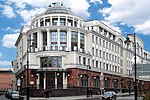
Moscow, Sretensky Boulevard, corner of Frolov Lane

Sretensky Boulevard (Russian: Сретенский Бульвар) is a major boulevard in central Moscow of important cultural significance, a part of the Boulevard Ring encircling the centre of the city. Sretensky Boulevard's northern end is at Lubyanka Street and Rozhdestvensky Boulevard, and its southern end is at Turgenevskaya Square, where it becomes Chistoprudny Boulevard. Sretensky Boulevard is a major thoroughfare, as it is a part of the Boulevard Ring. The Moscow Metro station called Sretensky Bulvar is a namesake of the boulevard.

Excerpt from the Wikipedia article Sretensky Boulevard (License: CC BY-SA 3.0, Authors, Images).

Sretensky Boulevard
Sretenskiy Blvd, Moscow Krasnoselsky District

Geographical coordinates (GPS) Address Nearby Places
placeShow on map

Wikipedia: Sretensky BoulevardContinue reading on Wikipedia

Geographical coordinates (GPS)

Latitude Longitude
N 55.766388888889 ° E 37.633611111111 °
placeShow on map

Address

Sretenskiy Blvd 6/1 с1
107045 Moscow, Krasnoselsky District
Moscow, Russia
mapOpen on Google Maps

Moscow, Sretensky Boulevard, corner of Frolov Lane
Share experience

Nearby Places

Vkhutemas
Vkhutemas

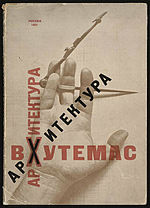
Vkhutemas (Russian: Вхутемас, IPA: [fxʊtʲɪˈmas], acronym for Высшие художественно-технические мастерские Vysshiye Khudozhestvenno-Tekhnicheskiye Masterskiye "Higher Art and Technical Studios") was the Russian state art and technical school founded in 1920 in Moscow, replacing the Moscow Svomas. The workshops were established by a decree from Vladimir Lenin with the intentions, in the words of the Soviet government, "to prepare master artists of the highest qualifications for industry, and builders and managers for professional-technical education". The school had 100 faculty members and an enrollment of 2,500 students. Vkhutemas was formed by a merger of two previous schools: the Moscow School of Painting, Sculpture and Architecture and the Stroganov School of Applied Arts. The workshops had artistic and industrial faculties; the art faculty taught courses in graphics, sculpture and architecture while the industrial faculty taught courses in printing, textiles, ceramics, woodworking, and metalworking. Vkhutemas was a center for three major movements in avant garde art and architecture: constructivism, rationalism, and suprematism. In the workshops, the faculty and students transformed attitudes to art and reality with the use of precise geometry with an emphasis on space, in one of the great revolutions in the history of art. In 1926, the school was reorganized under a new rector and its name was changed from "Studios" to "Institute" (Вхутеин, Высший художественно-технический институт, Vkhutein, Vysshiy Khudozhestvenno-Tekhnicheskii Institut), or Vkhutein. The school was dissolved in 1930 following political and internal pressures throughout its ten-year existence. Its faculty, students, and legacy were dispersed into as many as six other schools.

Higher School of Economics

HSE University (Russian: «Высшая школа экономики», ВШЭ), officially the National Research University Higher School of Economics (Russian: Национальный исследовательский университет «Высшая школа экономики») is a public research university founded in 1992 and headquartered in Moscow, Russia. Along with its main campus located in the capital, the university maintains three other regional campuses in Nizhny Novgorod, Perm and Saint Petersburg. There is also the Lyceum at HSE University in Moscow. Widely regarded among the most prestigious universities in Russia and the CIS, it acquired the status of "national research university" in 2009. HSE was the first educational institution in Russia to successfully introduce Bachelor's and Master's degrees, having also taken part in the development and implementation of the Unified State Exam to modernize education and health care systems of Russia. Starting from 2013, HSE University has also participated in the Project 5-100 (the project was initiated by the Ministry of Education and Science to promote at least five Russian universities to the top 100 universities according to Times Higher Education World University Rankings, QS World University Rankings, and Academic Ranking of World Universities). In 2022 it was ranked #568 in Best Global Universities by U.S. News & World Report, and #881 by Center for World University Rankings, and in 2020 it was ranked in the #801-900 group in the Academic Ranking of World Universities (ARWU), also known as the Shanghai Ranking. HSE offers education at all levels – from a lyceum for school students to post-graduate and MBA programmes. Students can pursue training in a number of fields, including the social sciences, economics, humanities, law, engineering, computer science, mathematics, physics, chemistry, biology and biotechnology, as well as in creative disciplines. HSE is the only university in Russia that is ranked in top 100 of the Times Higher Education Young University Rankings. Furthermore, university representatives are part of the Civic Chamber of the Russian Federation and the Expert Council under the Government of Russia.