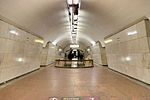
place

Bolshaya Lubyanka Street

Meshchansky DistrictStreets in MoscowTourist attractions in Moscow
Bolshaya Lubyanka1
Bolshaya Lubyanka1

Bolshaya Lubyanka Street is a radial street in Moscow's Central Administrative Okrug. The street runs north-east from Lubyanka Square to Sretenka Gates Square on the Boulevard Ring. The path of Bolshaya Lubyanka is continued by Sretenka Street (to Garden Ring), Mira Avenue and Yaroslavskoye Shosse and is the starting stretch of the route of M8 highway ("Kholmogory"), connecting Moscow to Sergiyev Posad, Yaroslavl, Vologda, and Arkhangelsk.

Excerpt from the Wikipedia article Bolshaya Lubyanka Street (License: CC BY-SA 3.0, Authors, Images).

Bolshaya Lubyanka Street
Bolshaya Lubyanka Street, Moscow Krasnoselsky District

Geographical coordinates (GPS) Address Nearby Places
placeShow on map

Wikipedia: Bolshaya Lubyanka StreetContinue reading on Wikipedia

Geographical coordinates (GPS)

Latitude Longitude
N 55.763611111111 ° E 37.629444444444 °
placeShow on map

Address

Bolshaya Lubyanka Street 20 с2
107045 Moscow, Krasnoselsky District
Moscow, Russia
mapOpen on Google Maps

Bolshaya Lubyanka1
Bolshaya Lubyanka1
Share experience

Nearby Places

NKVD

The People's Commissariat for Internal Affairs (Наро́дный комиссариа́т вну́тренних дел: Naródnyy komissariát vnútrennikh del; Russian pronunciation: [nɐˈrod.nɨj kə.mʲɪ.sə.rʲɪˈat ˈvnut.rʲɪ.nʲɪx̬ dʲel]), abbreviated NKVD (НКВД listen ), was the interior ministry of the Soviet Union. Established in 1917 as NKVD of the Russian Soviet Federative Socialist Republic, the agency was originally tasked with conducting regular police work and overseeing the country's prisons and labor camps. It was disbanded in 1930, with its functions being dispersed among other agencies, only to be reinstated as an all-union commissariat in 1934.The functions of the OGPU (the secret police organization) were transferred to the NKVD in 1934, giving it a monopoly over law enforcement activities that lasted until the end of World War II. During this period, the NKVD included both ordinary public order activities, as well as secret police activities. The NKVD is known for its role in political repression and for carrying out the Great Purge under Joseph Stalin. It was led by Genrikh Yagoda, Nikolai Yezhov and Lavrentiy Beria.The NKVD undertook mass extrajudicial executions of citizens, and conceived, populated and administered the Gulag system of forced labour camps. Their agents were responsible for the repression of the wealthier peasantry. They oversaw the protection of Soviet borders and espionage (which included political assassinations), and enforced Soviet policy in communist movements and puppet governments in other countries, most notably the repression and massacres in Poland.In March 1946 all People's Commissariats were renamed to Ministries, and the NKVD became the Ministry of Internal Affairs (MVD).

Federal Security Service

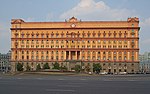
The Federal Security Service of the Russian Federation (FSB RF; Russian: Федеральная служба безопасности Российской Федерации (ФСБ РФ), tr. Federal'naya sluzhba bezopasnosti Rossiyskoy Federatsii, IPA: [fʲɪdʲɪˈralʲnəjə ˈsluʐbə bʲɪzɐˈpasnəstʲɪ rɐˈsʲijskəj fʲɪdʲɪˈratsɨɪ]) is the principal security agency of Russia and the main successor agency to the Soviet Union's KGB; its immediate predecessor was the Federal Counterintelligence Service (FSK) which was reorganized into the FSB in 1995. The three major structural successor components of the former KGB that remain administratively independent of the FSB are the Foreign Intelligence Service (SVR), the Federal Protective Service (FSO), and the Main Directorate of Special Programs of the President of the Russian Federation (GUSP). Its primary responsibilities are within the country and include counter-intelligence, internal and border security, counter-terrorism, and surveillance as well as investigating some other types of serious crimes and federal law violations. It is headquartered in Lubyanka Square, Moscow's center, in the main building of the former KGB. The director of the FSB is appointed by and directly answerable to the president of Russia.In 2003, the FSB's responsibilities were expanded by incorporating the Border Guard Service and a major part of the Federal Agency of Government Communication and Information (FAPSI); this would include intelligence activities in countries that were once members of the Soviet Union, work formerly done by the KGB's Fifth Service. The SVR had in 1992 signed an agreement not to spy on those countries; the FSB had made no such commitment.

Higher School of Economics

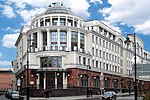
HSE University (Russian: «Высшая школа экономики», ВШЭ), officially the National Research University Higher School of Economics (Russian: Национальный исследовательский университет «Высшая школа экономики») is a public research university founded in 1992 and headquartered in Moscow, Russia. Along with its main campus located in the capital, the university maintains three other regional campuses in Nizhny Novgorod, Perm and Saint Petersburg. There is also the Lyceum at HSE University in Moscow. Widely regarded among the most prestigious universities in Russia and the CIS, it acquired the status of "national research university" in 2009. HSE was the first educational institution in Russia to successfully introduce Bachelor's and Master's degrees, having also taken part in the development and implementation of the Unified State Exam to modernize education and health care systems of Russia. Starting from 2013, HSE University has also participated in the Project 5-100 (the project was initiated by the Ministry of Education and Science to promote at least five Russian universities to the top 100 universities according to Times Higher Education World University Rankings, QS World University Rankings, and Academic Ranking of World Universities). In 2022 it was ranked #568 in Best Global Universities by U.S. News & World Report, and #881 by Center for World University Rankings, and in 2020 it was ranked in the #801-900 group in the Academic Ranking of World Universities (ARWU), also known as the Shanghai Ranking. HSE offers education at all levels – from a lyceum for school students to post-graduate and MBA programmes. Students can pursue training in a number of fields, including the social sciences, economics, humanities, law, engineering, computer science, mathematics, physics, chemistry, biology and biotechnology, as well as in creative disciplines. HSE is the only university in Russia that is ranked in top 100 of the Times Higher Education Young University Rankings. Furthermore, university representatives are part of the Civic Chamber of the Russian Federation and the Expert Council under the Government of Russia.

Ministry of Transport (Russia)

The Ministry of Transport of the Russian Federation (Russian: Министерство транспорта Российской Федерации) is a ministry of the Government of Russia responsible for transportation. The Ministry of Transport oversees road transport, railroads, commercial aviation, sea transport, inland waterway transport, and urban metro systems in Russia. The ministry develops public policies and legal regulations, and also oversees the surveying, mapping, and naming of geographic features. The Ministry of Transport is headquartered in Meshchansky District, Moscow. The Ministry of Transport was created in 1809 as the Ministry of Railway Transport of the Russian Empire and later became the People's Commissariat for Railways of the USSR. It was reformed into the Ministry of Railways in 1946 and later expanded its authority to become the Ministry of Transport of the USSR. It was re-established as the Ministry of Transport of the Russian Soviet Federative Socialist Republic after the collapse of the Soviet Union in 1991 and received its current name when the state was renamed to the Russian Federation on December 25, 1991. The Ministry of Transport was combined with the Ministry of Communications and Information for a brief period as short-lived Ministry of Transport and Communications from 9 March to 20 May 2004. Vitaly Savelyev has been the Minister of Transport since 10 November 2020.