place

Chistye Prudy (Moscow Metro)

Moscow Metro stationsRailway stations in Russia opened in 1935Railway stations located underground in RussiaSokolnicheskaya Line
MosMetro Chistye Prudy asv2018 01

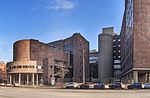
Chistye Prudy (Russian: Чи́стые пруды́, English: Clean Ponds) is a Moscow Metro station in the Basmanny District, Central Administrative Okrug, Moscow. It is on the Sokolnicheskaya Line, between Lubyanka and Krasnye Vorota stations. Chistye Prudy was opened on 15 May 1935 as a part of the first segment of the Metro. The station lies beneath Myasnitskaya Street, close to Turgenevskaya Square and the Clean Ponds, after which the station was named. It was the deepest station in Moscow Metro from 1935 until 1938.

Excerpt from the Wikipedia article Chistye Prudy (Moscow Metro) (License: CC BY-SA 3.0, Authors, Images).

Chistye Prudy (Moscow Metro)
Чистопрудный бульвар, Moscow Basmanny District

Geographical coordinates (GPS) Address Nearby Places
placeShow on map

Wikipedia: Chistye Prudy (Moscow Metro)Continue reading on Wikipedia

Geographical coordinates (GPS)

Latitude Longitude
N 55.7657 ° E 37.6388 °
placeShow on map

Address

Чистопрудный бульвар
101990 Moscow, Basmanny District
Moscow, Russia
mapOpen on Google Maps

MosMetro Chistye Prudy asv2018 01
Share experience

Nearby Places

Vkhutemas
Vkhutemas

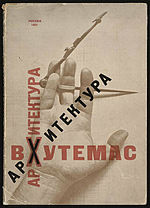
Vkhutemas (Russian: Вхутемас, IPA: [fxʊtʲɪˈmas], acronym for Высшие художественно-технические мастерские Vysshiye Khudozhestvenno-Tekhnicheskiye Masterskiye "Higher Art and Technical Studios") was the Russian state art and technical school founded in 1920 in Moscow, replacing the Moscow Svomas. The workshops were established by a decree from Vladimir Lenin with the intentions, in the words of the Soviet government, "to prepare master artists of the highest qualifications for industry, and builders and managers for professional-technical education". The school had 100 faculty members and an enrollment of 2,500 students. Vkhutemas was formed by a merger of two previous schools: the Moscow School of Painting, Sculpture and Architecture and the Stroganov School of Applied Arts. The workshops had artistic and industrial faculties; the art faculty taught courses in graphics, sculpture and architecture while the industrial faculty taught courses in printing, textiles, ceramics, woodworking, and metalworking. Vkhutemas was a center for three major movements in avant garde art and architecture: constructivism, rationalism, and suprematism. In the workshops, the faculty and students transformed attitudes to art and reality with the use of precise geometry with an emphasis on space, in one of the great revolutions in the history of art. In 1926, the school was reorganized under a new rector and its name was changed from "Studios" to "Institute" (Вхутеин, Высший художественно-технический институт, Vkhutein, Vysshiy Khudozhestvenno-Tekhnicheskii Institut), or Vkhutein. The school was dissolved in 1930 following political and internal pressures throughout its ten-year existence. Its faculty, students, and legacy were dispersed into as many as six other schools.