place

Maly Krasnokholmsky Bridge

Bridges completed in 1938Bridges in MoscowConcrete bridgesDeck arch bridges
Maly Krashokholmsky bridge 4exp Oloneo

Maly Krasnokholmsky Bridge (Russian: Малый Краснохолмский мост) is a bridge over the Vodootvodny Canal in Zamoskvorechye District in Moscow, Russia. This is one of the three bridges included into the Garden Ring, a ring road encircling the city center. The bridge connects Nizhnyaya Krasnokholmskaya Street (located between the canal and the Moskva River) and Zatsepsky Val Street. The length of the bridge is 70 metres (230 ft).The bridge was constructed in 1938 by V.A.Pashchenko (structural engineering) and Viktor Kokorin (architectural design)., at the same time as Bolshoy Krasnokholmsky Bridge over the Moskva River.There is public transportation over the bridge. In particular, as everywhere on the Garden Ring, there is passenger trolleybus traffic.

Excerpt from the Wikipedia article Maly Krasnokholmsky Bridge (License: CC BY-SA 3.0, Authors, Images).

Maly Krasnokholmsky Bridge
Sadovnicheskaya Embankment, Moscow Zamoskvorechye District

Geographical coordinates (GPS) Address External links Nearby Places
placeShow on map

Wikipedia: Maly Krasnokholmsky BridgeContinue reading on Wikipedia

Geographical coordinates (GPS)

Latitude Longitude
N 55.7335 ° E 37.642 °
placeShow on map

Address

Малый Краснохолмский мост

Sadovnicheskaya Embankment
115035 Moscow, Zamoskvorechye District
Moscow, Russia
mapOpen on Google Maps

linkWikiData (Q17898479)
linkOpenStreetMap (5365076)

Maly Krashokholmsky bridge 4exp Oloneo
Share experience

Nearby Places

Paveletskaya (Koltsevaya line)

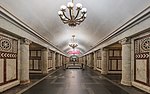
Paveletskaya (Russian: Павеле́цкая) is a station on the Koltsevaya line and Zamotskvoretskaya line of the Moscow Metro. Opened on 1 January 1950 as part of the first segment of the fourth stage, the station is a pylon-trivault built in the style of the late 1940/early 1950s Stalinist architecture to a design by architects Nikolai Kolli and I. Kasetl. The station's theme comes from the Paveletsky railway terminal from which trains depart towards the Volga Region. Thus agricultural influences are clearly seen, these include the square white koyelga marble columns decorated with red marble strips, flanked by marble columns with modern Ionic capitals. Bright bronze chandeliers provide lighting. The walls repeat the two tone marble, white on top, red on bottom, and the floor is laid with grey and white granite. The station's vestibule is built into the corner of the Garden Ring and Zemlyannoy Val, and occupies the ground floor of the building there. Inside above the escalator is a circular mosaic panel by Pavel Korin Red Square which depicts the Lenin's Mausoleum and the Saint Basil's Cathedral, framed by a bas-relief with typical soviet banners and floral arrangements with names of Volga cities on the sides. The vestibule has another artwork by Iosif Rabinovich, which is a mosaic on the dome of the vestibule on the theme of the permanent end to drought in the Volga. As the station was made to be a transfer point to Paveletskaya station of the Zamoskvoretskaya line, the vestibule was built as an entrance to both stations, however as the radial station of the Zamoskvoretskaya line was undergoing reconstruction the vestibule doubled as a transfer point. A direct corridor was opened only on 30 July 1955, which saw the addition of large staircases surrounded by marble balustrades in the centre of the platform. The other major change was that initially in the end of the station was a large medallion with image of Vladimir Lenin and Joseph Stalin, but during the 1961 de-Stalinization drive this was removed and instead replaced by the present artwork by Pavel Korin showing the Coat of Arms of the Soviet Union being held by a worker man and peasant woman amid floral backgrounds.

Moscow International House of Music

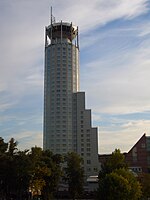
The Moscow International Performing Arts Centre was officially opened on September 28, 2003 with the debut of a new orchestra, the National Philharmonic of Russia under musical director Vladimir Spivakov. Also known as the Moscow International House of Music (Dom Muzyki), it is situated on the Kosmodamianskaya Embankment off the Garden Ring Road.The architects were Yury Gnedovsky, Vladilen Krasilnikov, Dmitry Solopov, Margarita Gavrilova, and Sergey Gnedovsky of Krasniye Kholmy Russian Cultural-business Centre and Tovarishestvo Teatralniy Arkhitekturov. The project won the Khrustalny Dedal architectural award at the XI All-Russian Zodchestvo festival. The first stone was laid on September 7, 2000 by Spivakov and Moscow Mayor Yury Luzhkov. The Turkish firm Enka Insaat ve Sanayi A.S. constructed the centre. The centre cost US$200 million to construct, and was financed entirely by the City of Moscow. It was the first classical music hall constructed in the city in over a century. It is part of a business and hotel complex called Riverside Towers, intended by the City to be its equivalent of Lincoln Center.The centre has a circular concert hall similar to the Philharmonie in Berlin. Seating is laid out on two principal levels, and arranged in various tiers that almost surround the stage. The hall is on the third storey, with promenade areas below. The auditorium seats 1,735, and is composed largely of Siberian larch wood, a blonde wood considered among the best for acoustics, with a light, airy look. The centre also houses a 575-seat chamber hall and a 532-seat theater. In addition to the three concert venues, it also has sound studio, a rehearsal hall, an audio-video complex, an exhibition hall, a hall of light, music rooms, the Allegro restaurant, a Bluthner music room, a summer patio called the Music Terrace and another concert hall that seats 120. The modernistic, cylindrical glass and steel centre is topped by an enormous, 9.5 metre-tall, 2 metric-ton treble clef covered in mozaic gold that rotates like a weathervane, designed by sculptor Zurab Tsereteli.It also has the largest organ in Russia, installed in Svetlanov hall in 2004. The organ was co-designed and built by the German firms of Glatter-Goetz and Johannes Klais. It has more than 5,500 pipes, ranging in size from 8 millimetres to 9.25 metres, and weighs 30 tons. It has 84 stops – three more than the second-largest Russian pipe organ, located at Moscow's Tchaikovsky Concert Hall.An early review in the newspaper Vedomosti questioned the "imperfect acoustics" of the main hall, although this review preceded installation of the organ, which was expected to alter the acoustics, and after which adjustments were anticipated.The centre was originally conceived as a home for the Russian National Orchestra. At the end of the 2002–2003 concert season, the Russian National decided not to renew Spivakov's contract as principal conductor and musical director, and he abruptly resigned. Spivakov lobbied government officials to conduct a new orchestra in Moscow. The National Philharmonic Orchestra was then formed under an executive order of Culture Minister Mikhail Shvydkoi, supported by President Vladimir Putin. Shortly after Spivakov became president of the Centre in May 2002, the Centre canceled the bookings for the Russian National, which rebooked some dates at higher fees and lost others.

Church of the Savior on Bolvany

Church of Transfiguration of Savior in Bolvanovka (Russian: Храм Спаса Преображения на Болвановке), also abbreviated to Saviour in Bolvanovka (Спас на Болвановке), is an Orthodox church in Zamoskvorechye District of Moscow. The neighborhood, Bolvanovka (rus. Болвановка), derives its name from Russian bolvan (болван), which could mean either a billet or, in obsolete sense, a non-Orthodox cult image. There have different Bolvanovka neighborhoods in medieval Moscow, a sign of wide Tatar presence (e.g. near Taganka Square). A legend says that the church stands on site of a Tatar bolvan, an artifact which symbolized submission of Moscow to Golden Horde. Ivan III of Russia destroyed this symbol (or broke ambassador symbol - basma (басма), that has the same name) and established an Orthodox church at this place in 1465. His refusal to pay tribute to the Horde resulted in the Great stand on the Ugra river of 1480. A wooden church had been mentioned in city records since 1465. The new baroque building was built in the 18th century; completion date is disputed (1722 or later); what is known definitely is that the church was consecrated in 1755. Alternative accounts assert that there was a succession of wooden churches built in 1708 and 1722; extant building that replaced them was built in 1749-1755. The church burnt down in the Fire of Moscow (1812) and was reopened to worshippers in 1815 with subsequent expansion in 1839. It was closed by Bolsheviks in 1922, partially destroyed, and returned to the worshippers in 1991. A temporary, standalone wooden belltower was added in the 1990s.