place

Katerina City Hotel

Hotels established in 1998Hotels in MoscowHouses completed in the 19th century
Katerina City Hotel
Katerina City Hotel

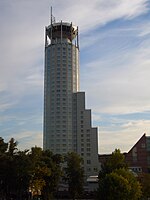
Katerina City (Russian: Гостиница Катерина Сити) is a hotel in the centre of Moscow, Russia. It is located not far from Paveletskaya metro station, Riverside Tower and Aurora business centers, 3 km away from Red Square and Kremlin. Katerina City is one of the Katerina chain hotels managed by UMACO company. The hotel consists of two interconnected buildings. The first building is a four-storey mansion built in the 19th century and fully renovated in 1998. The second building is an eight-storey modern one, was built in 2000. The hotel is noted as a Swedish-style hotel, designed by Sweco Avista FFNS AB. The hotel has 120 rooms; 66 small rooms, 44 medium and 10 large rooms. Meeting facilities include 8 conference halls for 2-120 guests.

Excerpt from the Wikipedia article Katerina City Hotel (License: CC BY-SA 3.0, Authors, Images).

Katerina City Hotel
Shlyuzovaya Embankment, Moscow Zamoskvorechye District

Geographical coordinates (GPS) Address Nearby Places
placeShow on map

Wikipedia: Katerina City HotelContinue reading on Wikipedia

Geographical coordinates (GPS)

Latitude Longitude
N 55.7311 ° E 37.6474 °
placeShow on map

Address

Shlyuzovaya Embankment 6 с1
115114 Moscow, Zamoskvorechye District
Moscow, Russia
mapOpen on Google Maps

Katerina City Hotel
Katerina City Hotel
Share experience

Nearby Places

Moscow International House of Music

The Moscow International Performing Arts Centre was officially opened on September 28, 2003 with the debut of a new orchestra, the National Philharmonic of Russia under musical director Vladimir Spivakov. Also known as the Moscow International House of Music (Dom Muzyki), it is situated on the Kosmodamianskaya Embankment off the Garden Ring Road.The architects were Yury Gnedovsky, Vladilen Krasilnikov, Dmitry Solopov, Margarita Gavrilova, and Sergey Gnedovsky of Krasniye Kholmy Russian Cultural-business Centre and Tovarishestvo Teatralniy Arkhitekturov. The project won the Khrustalny Dedal architectural award at the XI All-Russian Zodchestvo festival. The first stone was laid on September 7, 2000 by Spivakov and Moscow Mayor Yury Luzhkov. The Turkish firm Enka Insaat ve Sanayi A.S. constructed the centre. The centre cost US$200 million to construct, and was financed entirely by the City of Moscow. It was the first classical music hall constructed in the city in over a century. It is part of a business and hotel complex called Riverside Towers, intended by the City to be its equivalent of Lincoln Center.The centre has a circular concert hall similar to the Philharmonie in Berlin. Seating is laid out on two principal levels, and arranged in various tiers that almost surround the stage. The hall is on the third storey, with promenade areas below. The auditorium seats 1,735, and is composed largely of Siberian larch wood, a blonde wood considered among the best for acoustics, with a light, airy look. The centre also houses a 575-seat chamber hall and a 532-seat theater. In addition to the three concert venues, it also has sound studio, a rehearsal hall, an audio-video complex, an exhibition hall, a hall of light, music rooms, the Allegro restaurant, a Bluthner music room, a summer patio called the Music Terrace and another concert hall that seats 120. The modernistic, cylindrical glass and steel centre is topped by an enormous, 9.5 metre-tall, 2 metric-ton treble clef covered in mozaic gold that rotates like a weathervane, designed by sculptor Zurab Tsereteli.It also has the largest organ in Russia, installed in Svetlanov hall in 2004. The organ was co-designed and built by the German firms of Glatter-Goetz and Johannes Klais. It has more than 5,500 pipes, ranging in size from 8 millimetres to 9.25 metres, and weighs 30 tons. It has 84 stops – three more than the second-largest Russian pipe organ, located at Moscow's Tchaikovsky Concert Hall.An early review in the newspaper Vedomosti questioned the "imperfect acoustics" of the main hall, although this review preceded installation of the organ, which was expected to alter the acoustics, and after which adjustments were anticipated.The centre was originally conceived as a home for the Russian National Orchestra. At the end of the 2002–2003 concert season, the Russian National decided not to renew Spivakov's contract as principal conductor and musical director, and he abruptly resigned. Spivakov lobbied government officials to conduct a new orchestra in Moscow. The National Philharmonic Orchestra was then formed under an executive order of Culture Minister Mikhail Shvydkoi, supported by President Vladimir Putin. Shortly after Spivakov became president of the Centre in May 2002, the Centre canceled the bookings for the Russian National, which rebooked some dates at higher fees and lost others.

Novospassky Monastery

Novospassky Monastery (New Monastery of the Savior, Russian: Новоспасский монастырь) is one of the fortified monasteries surrounding Moscow from the south-east. Like all medieval Russian monasteries, it was built by the Russian Orthodox Church. The abbey traces its history back to Moscow's first monastery established in the early 14th century at the location where the Danilov Monastery now stands. The Church of the Savior in the Wood (Собор Спаса на Бору) of the Kremlin, the oldest church of Moscow, was its original katholikon. Upon its removal to the left bank of the Moskva River in 1491, the abbey was renamed Abbey of the New Savior, to distinguish it from the older one in the Kremlin.The monastery was patronized by Andrei Kobyla's descendants, including the Sheremetev and Romanov boyars, and served as their burial vault. Among the last Romanovs buried in the monastery were Xenia Shestova (the mother of the first Romanov Tsar), Princess Tarakanova (a pretender who claimed to have been the only daughter of Empress Elisabeth) and Grand Duke Sergei Alexandrovich of Russia. In 1571 and 1591, the wooden citadel withstood repeated attacks by Crimean Tatars. Upon the Romanovs' ascension to the Moscovy throne, Michael of Russia completely rebuilt their family shrine in the 1640s. Apart from the large 18th-century bell-tower (one of the tallest in Moscow) and the Sheremetev sepulcher in the Church of the Sign, all other buildings date from that period. They include: The Cathedral of the Transfiguration (Russian: Преображенский собор) (1645–49), a large five-domed katholikon with frescoes by the finest Muscovite painters of the 17th century The Intercession Church (Russian: Покровская церковь) or Church of the Veil of the Virgin (1673–1675) with a refectory The Church of the Sign or Church of the Znamenie Icon of the Virgin (1791–1795) The bell tower (1759–1785) The infirmary Church of St. Nicholas the Miracle Worker and monks' living quarters The house of Patriarch Filaret The House of Loaf-Giving.During the Soviet years, the monastery was converted into a prison, then into a police drunk tank. In the 1970s, it was assigned to an art restoration institute, and finally returned to the Russian Orthodox Church in 1991.

Paveletskaya (Koltsevaya line)

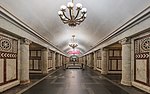
Paveletskaya (Russian: Павеле́цкая) is a station on the Koltsevaya line and Zamotskvoretskaya line of the Moscow Metro. Opened on 1 January 1950 as part of the first segment of the fourth stage, the station is a pylon-trivault built in the style of the late 1940/early 1950s Stalinist architecture to a design by architects Nikolai Kolli and I. Kasetl. The station's theme comes from the Paveletsky railway terminal from which trains depart towards the Volga Region. Thus agricultural influences are clearly seen, these include the square white koyelga marble columns decorated with red marble strips, flanked by marble columns with modern Ionic capitals. Bright bronze chandeliers provide lighting. The walls repeat the two tone marble, white on top, red on bottom, and the floor is laid with grey and white granite. The station's vestibule is built into the corner of the Garden Ring and Zemlyannoy Val, and occupies the ground floor of the building there. Inside above the escalator is a circular mosaic panel by Pavel Korin Red Square which depicts the Lenin's Mausoleum and the Saint Basil's Cathedral, framed by a bas-relief with typical soviet banners and floral arrangements with names of Volga cities on the sides. The vestibule has another artwork by Iosif Rabinovich, which is a mosaic on the dome of the vestibule on the theme of the permanent end to drought in the Volga. As the station was made to be a transfer point to Paveletskaya station of the Zamoskvoretskaya line, the vestibule was built as an entrance to both stations, however as the radial station of the Zamoskvoretskaya line was undergoing reconstruction the vestibule doubled as a transfer point. A direct corridor was opened only on 30 July 1955, which saw the addition of large staircases surrounded by marble balustrades in the centre of the platform. The other major change was that initially in the end of the station was a large medallion with image of Vladimir Lenin and Joseph Stalin, but during the 1961 de-Stalinization drive this was removed and instead replaced by the present artwork by Pavel Korin showing the Coat of Arms of the Soviet Union being held by a worker man and peasant woman amid floral backgrounds.