place

Dunedin Volcano

Extinct volcanoesGeography of DunedinLandforms of OtagoMiocene shield volcanoesPolygenetic shield volcanoes
Shield volcanoes of New ZealandVolcanoes of Otago
Organ pipes columnar joints Dunedin

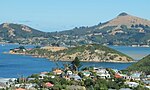
The Dunedin Volcano is an extensively eroded multi-vent shield volcano that was active between 16 and 10 million years ago. It originally extended from the modern city of Dunedin, New Zealand to Aramoana about 25 km away. Extensive erosion has occurred over the last 10 million years and Otago Harbour now fills the oldest parts of the volcano. The remnants of the volcano form the hills around Otago Harbour (including Mount Cargill, Flagstaff, Saddle Hill, Signal Hill, and Otago Peninsula).

Excerpt from the Wikipedia article Dunedin Volcano (License: CC BY-SA 3.0, Authors, Images).

Dunedin Volcano
Oxley Crescent, Dunedin Broad Bay

Geographical coordinates (GPS) Address Nearby Places
placeShow on map

Wikipedia: Dunedin VolcanoContinue reading on Wikipedia

Geographical coordinates (GPS)

Latitude Longitude
N -45.848 ° E 170.636 °
placeShow on map

Address

Oxley Crescent 81
9023 Dunedin, Broad Bay
Otago, New Zealand
mapOpen on Google Maps

Organ pipes columnar joints Dunedin
Share experience

Nearby Places

Broad Bay, New Zealand

The settlement of Broad Bay (Māori: Whaka Oho Rahi) is located on the Otago Harbour coast of Otago Peninsula, in the South Island of New Zealand. It is administered as part of the city of Dunedin, and is technically a suburb of that city, though its isolation and semi-rural nature make it appear as a settlement in its own right. Broad Bay is 13 kilometres (8.1 mi) to the east of the city centre, but due to the shape of the peninsula's coastline, the heart of the city cannot be seen from Broad Bay. A large bluff, Grassy Point, lies between Broad Bay and the harbourside settlements of Company Bay and Macandrew Bay to the west. The bluff is skirted by Portobello Road, the road which winds around the southeastern shore of the harbour between inner Dunedin and Portobello, 2 kilometres (1.2 mi) to the northeast of Broad Bay, and by the Otago Harbour Cycleway, which runs alongside it. The Camp Road walking track connects Broad Bay with Larnach Castle, close to the ridge of the peninsula. Broad Bay is situated on the shore of an aptly named wide bay (Broad Bay) and a smaller bay to the north east (Turnbulls Bay); between these lie a short peninsula (on which is sited the settlement's small historic cemetery), which terminates in the steep, finger-like headland of Yellowhead. The distinctive peak of Harbour Cone forms a backdrop to the settlement as seen from the harbour. The settlement is home to the heritage-listed Fletcher House, constructed in 1909 and restored in 1992, the first house by Fletcher Construction founder Sir James Fletcher. Like several settlements on the peninsula - including Portobello and Macandrew Bay, which lies 3 kilometres (1.9 mi) to the southwest - Broad Bay is a commuter settlement and a haven for alternative lifestylers. These settlements have a strong arts community, with many of their residents connected in some way with the visual or performing arts.

Portobello, New Zealand

Portobello is a village beside the Otago Harbour halfway along the Otago Peninsula in Dunedin City, New Zealand. It lies at the foot of a small peninsula (Portobello Peninsula) between Portobello Bay and Latham Bay. Like scores of Dunedin features, Portobello was named after a locality in Edinburgh, Scotland, also called Portobello. At the end of Portobello Peninsula sits a marine research station, the Portobello Marine Laboratory, which is part of the University of Otago. Close to the end of this peninsula lies Quarantine Island / Kamau Taurua. Portobello features a Historical Society Museum, the 1908 Restaurant, a local primary school (Portobello School, Years 1-8), the old Portobello Hotel (a pub), a cafe and several accommodation providers, including a camping ground, bed and breakfasts and motels. A local dairy acts as the community's grocers, though most of the village's retail needs are served by Dunedin, which is easily accessed via the winding but well-surfaced Portobello Road which runs along the edge of the harbour. A multi-year project to raise and widen this road and add a 19km shared-use pathway is nearing completion, safely connecting Portobello to Dunedin for cyclists and walkers. This pathway is part of the larger Otago Harbour Cycleway. A more convoluted but scenic route, Highcliff Road, connects Portobello with Dunedin city centre via the ridge of the peninsula. Boating is an historical focus for Portobello. In the past, Portobello residents caught the ferry to the city, before the Portobello Road along the foreshore was constructed. Today, scheduled ferry service to Kamau Taurua and Port Chalmers departs from the recently renovated ferry jetty, a short distance from the centre of the village. A boating club maintains a slipway and boat shed near the jetty. Portobello Community Inc. is the local community group, which works to improve Portobello for its community.