place

Institute of Biomedical Problems

1963 establishments in the Soviet UnionAsian organization stubsEuropean organization stubsInstitutes of the Russian Academy of SciencesMedical organization stubs
Medical research institutes in the Soviet UnionResearch institutes established in 1963Russia stubsSoviet and Russian space institutionsSpace medicineSpace technology research institutes

The Institute of Biomedical Problems (IMBP, also IBMP; Russian: Институт медико-биологических проблем РАН) is an institution of the Russian Academy of Sciences. The IMBP is the leading organization in Russia for conducting fundamental research in the field of space biology and medicine; medical and biological support of crewed space flights; development of methods and means of ensuring safety and life, preserving health and maintaining human performance in extreme conditions. Founded in 1963, it is based at 76a, Khoroshevskoe Shosse in Moscow. As of 2021, its director was Oleg Igorevich Orlov. It is known in the West particularly for the MARS-500 experiment simulating crewed flight to Mars.

Excerpt from the Wikipedia article Institute of Biomedical Problems (License: CC BY-SA 3.0, Authors).

Institute of Biomedical Problems
улица Генерала Колесника, Moscow Khoroshyovsky District

Geographical coordinates (GPS) Address Website Nearby Places
placeShow on map

Wikipedia: Institute of Biomedical ProblemsContinue reading on Wikipedia

Geographical coordinates (GPS)

Latitude Longitude
N 55.7795 ° E 37.5239 °
placeShow on map

Address

Институт медико-биологических проблем РАН

улица Генерала Колесника
123007 Moscow, Khoroshyovsky District
Moscow, Russia
mapOpen on Google Maps

Website
imbp.ru

linkVisit website

Share experience

Nearby Places

Polezhayevskaya
Polezhayevskaya

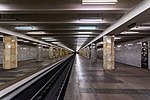
Polezhayevskaya (Russian: Полежаевская) is a station on the Moscow Metro's Tagansko-Krasnopresnenskaya line. It opened on 30 December 1972 as part of the original Krasnopresnenkiy radius and Krasnopresnenskaya line, and is unusual in having three through tracks (although it was not the first such station, see Partizanskaya). The station was initially intended to be at a junction to a branch toward Serebryanny Bor. However, the branch was scrapped after construction had already started, and the station was completed as originally planned. The station is named after Vasily Polezhayev, who was the head of Mosmetrostroy (The Moscow Metro building organisation) in 1958-1972. Its widened column tri-span design has a row of pillars in the centre of each of the two platforms, creating a wide space above the centre track. The octagonal pillars are coated with yellow marble of different tones and the walls covered with white ceramic tiles are accredited to the architects A. Fokina and L. Popov. Before 2015 only one of the platforms (and thus two of the tracks) is used by passengers. The second platform has been opened at 14 November 2015 (due to construction) and the third track (with the tunnel that goes another 340 metres before a siding) is used for the night-time standing of trains. Two vestibules (one with a closed escalator) are interlinked with subways under the Khoroshovo highway. The future prospects of the third track are dim, despite the construction of an adjoining station (Khoroshyovskaya) on the Bolshaya Koltsevaya line. Some plans for the interchange passages include switching the traffic from the central track to the unused one to fill it up and construct a staircase in its place. The station has a daily passenger traffic total of 73,700.