place

Battle of Chapultepec

1847 in Mexico19th century in Mexico CityBattles of the Texas Ranger DivisionChapultepecHistory of Mexico City
Mexican–American War fortsMexico City CampaignSeptember 1847 eventsUnited States Marine Corps in the 18th and 19th centuriesUnited States Marine Corps lore and symbols
Battle of Chapultepec

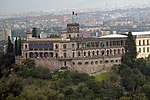
The Battle of Chapultepec was a battle between American forces and Mexican forces holding the strategically located Chapultepec Castle just outside Mexico City, fought 13 September 1847 during the Mexican–American War. The building, sitting atop a 200-foot (61 m) hill, was an important position for the defense of the city. The battle was part of the campaign to take Mexico City, for which General Winfield Scott's U.S. Army totaled 7,200 men. General Antonio López de Santa Anna, known for vicious attacks against Native Mexican American tribes, had formed an army of approximately 25,000 men. Mexican forces, including military cadets of the Military Academy, defended the position at Chapultepec against 2,000 U.S. forces. The Mexicans' loss opened the way for the Americans to take the center of Mexico City. In Mexican history, the battle is cast as the story of the brave deaths of six cadets, the Niños Héroes, who leapt to their deaths rather than be taken captive, with one wrapping himself in the Mexican flag. American sources also feature many depictions of the battle from the American point of view. Although it lasted only about 60–90 minutes, the battle has great importance in the histories of both countries.

Excerpt from the Wikipedia article Battle of Chapultepec (License: CC BY-SA 3.0, Authors, Images).

Battle of Chapultepec
Peatonal del Cerro, Mexico City

Geographical coordinates (GPS) Address Website Nearby Places
placeShow on map

Wikipedia: Battle of ChapultepecContinue reading on Wikipedia

Geographical coordinates (GPS)

Latitude Longitude
N 19.421 ° E -99.182 °
placeShow on map

Address

Museo Nacional de Historia Castillo de Chapultepec (Castillo de Chapultepec)

Peatonal del Cerro
11580 Mexico City
Mexico
mapOpen on Google Maps

Website
mnh.inah.gob.mx
linkVisit website

Battle of Chapultepec
Share experience

Nearby Places

Obelisco a los Niños Héroes

The Obelisco a los Niños Héroes is a monument installed in Chapultepec, Mexico City. The cenotaph was created in 1881 by architect Ramón Rodríguez Arangoity, one of the cadets captured in the Battle of Chapultepec. The marble cenotaph was a typical nineteenth-century monument. This one lists the names of the six cadets, the Niños Héroes, killed in the fierce fighting in the Mexican-American War as military cadets defended as well as the 40 who survived the attack. For his own political purposes, General Porfirio Díaz inaugurated the monument with a military and civilian audience of dignitaries. Subsequently, the obelisk became an annual site of remembrance for the Association of the Military College, a group of veterans who had been cadets. This modest-sized monument was superseded in 1952 by the massive Monumento a los Niños Héroes. The prisoners of the First Company were Captain Domingo Alvarado; Lieutenants José Espinosa, Agustín de la Peza; Cabo José T. de Cuellar; and Tambor Simón Álvarez; Cadets Francisco Molina, Mariano Covarrubias, Bartolomé Díaz León, Ignacio Molina, Antonio Sierra, Justino García, Lorenzo Pérez Castro, Agustín Camarena, Ignacio Ortiz, Manuel Ramírez de Arellano, Carlos Bejarano, Isidro Hernández, Esteban Zamora, Santiago Hernández, Ignacio Burgoa Lagos and Ramón Rodríguez Arangoity. Prisoners of Second Company were Lieutenant Joaquín Argaez; Sargeant Teófilo Noris; Corneta Antonio Rodríguez; Cadet alumni Joaquín Moreno, Pablo Banuet, Ignacio Valle, Francisco Leso, Antonio Sola, Sebastián Trejo, Luis Delgado, Ruperto Pérez de León, Cástulo García, Feliciano Contreras, Francisco Morelos, Miguel Miramón, Gabino Montesdedca, Luciano Becerra, Adolfo Unda, Manuel Díaz, Francisco Morel, Vicente Herrera, Onofre Capelo, Magdaleno Yta and Emilio Laurent.