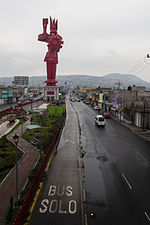
Huexotla or Huexotla is an archaeological site located 5 kilometers south of Texcoco, at the town of San Luis Huexotla, close to Chapingo, in the Mexico State.
Huexotla is considered to hold vestiges of the most important ancient Acolhuacan reign in the east of the Mexico highlands plateau.
Although a few buildings remain in Huexotla, it was a very large city that extended well beyond the perimeter wall, in fact, the only known structure of its kind in the region from the late postclassical. It is believed that the Huexotla main structure once existed at the place where the Franciscan convent and the Church of St. Louis were built.Huexotla, Coatlinchán and Texcoco were the main Acolhua culture cities and its development began in the 13th century.These cities more than likely had a common faith and destiny, from its founding throughout 1520; they formed part of the Aztec Triple Alliance. At the time of the Spanish conquest of the Aztec Empire, it was one of the largest and most prestigious cities in central Mexico, second only to the Aztec capital, Tenochtitlan. A survey of Mesoamerican cities estimated that pre-conquest Texcoco had a population of 24,000 and occupied an area of 450 hectares.Texcoco was founded in the 12th century, on the eastern shore of Lake Texcoco, probably by the Chichimecs. In or about 1336, the Acolhua, with Tepanec help, expelled Chichimecs from Texcoco and Texcoco became the Acolhua capital city, taking over that role from Coatlinchan.
In 1418, Ixtlilxochitl I, the tlatoani (ruler) of Texcoco, was dethroned by Tezozomoc of Azcapotzalco. Ten years later, in 1428, Ixtlilxochitl's son, Nezahualcoyotl allied with the Aztecs to defeat Tezozomoc's son and successor, Maxtla. Texcoco and the Aztecs of Tenochtitlan, with the Tepanecs of Tlacopan, subsequently formalized their association as the Triple Alliance.
Texcoco thereby became the second-most important city in the eventual Aztec empire, by agreement receiving two-fifths of the tribute collected.
Texcoco was known as a center of learning within the empire, and had a famed library including books from older Mesoamerican civilizations.
Around 1960 the site was explored by Eduardo Pareyón Moreno

 Continue reading on Wikipedia