place

Texcoco Cathedral

17th-century Roman Catholic church buildings in MexicoBuildings and structures in the State of MexicoMexican building and structure stubsNorth American church stubsReligion in the State of Mexico
Roman Catholic cathedrals in MexicoRoman Catholic churches completed in 1664Texcoco, State of Mexico
TexcocoCathFacade1
TexcocoCathFacade1

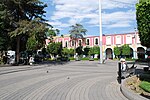
The Immaculate Conception Cathedral (Spanish: Catedral de la Inmaculada Concepción) Also Texcoco Cathedral is a Catholic cathedral that is located in the former convent that the Franciscans built in the 16th century in the town of Texcoco in Mexico. This is one of the first complex conventions that the Franciscan order built on lands of the new world, to carry out the process of evangelization. The Franciscan friars, with Pedro de Gante, erected the first monastery in the area, for the year 1526, with the help of the native labor of the area. The major church was not built until 40 years later, around 1576. Like all the conventual assemblages that were built in the sixteenth century, it had a fortified aspect, which are still preserves the high walls of the cathedral. This was changed during the works carried out towards the 17th century, when it was given its present appearance (1690-1700).It was made a cathedral in 1961, and Francisco Ferreira y Arreola was the first bishop.

Excerpt from the Wikipedia article Texcoco Cathedral (License: CC BY-SA 3.0, Authors, Images).

Texcoco Cathedral
Calle Fray Pedro de Gante, Texcoco de Mora

Geographical coordinates (GPS) Address Website Nearby Places
placeShow on map

Wikipedia: Texcoco CathedralContinue reading on Wikipedia

Geographical coordinates (GPS)

Latitude Longitude
N 19.5135 ° E -98.8838 °
placeShow on map

Address

Catedral de Texcoco

Calle Fray Pedro de Gante
56100 Texcoco de Mora
State of Mexico, Mexico
mapOpen on Google Maps

Website
diocesisdetexcoco.org
linkVisit website

TexcocoCathFacade1
TexcocoCathFacade1
Share experience

Nearby Places

Texcoco de Mora
Texcoco de Mora

Texcoco de Mora (, Otomi: Antamäwädehe) is a city located in the State of Mexico, 25 km northeast of Mexico City. Texcoco de Mora is the municipal seat of the municipality of Texcoco. In the pre-Hispanic era, this was a major Aztec city on the shores of Lake Texcoco. After the Conquest, the city was initially the second most important after Mexico City, but its importance faded over time, becoming more rural in character. Over the colonial and post-independence periods, most of Lake Texcoco was drained and the city is no longer on the shore and much of the municipality is on lakebed. Numerous Aztec archeological finds have been discovered here, including the 125 tonne stone statue of Tlaloc, which was found near San Miguel Coatlinchán and now resides at the Museum of Anthropology in Mexico City.Much of Texcoco's recent history involves the clash of the populace with local, state and federal authorities. The most serious of these is the continued attempts to develop an airport here, which despite the saturation of the current Mexico City airport, is opposed by local residents. The city and municipality is home to a number of archeological sites, such as the palace of Nezahualcoyotl, Texcotzingo (Baths of Nezahualcoyotl) and Huexotla. Other important sites include the Cathedral, the Juanino Monastery, and Chapingo Autonomous University. The most important annual festival is the Feria Internacional del Caballo (International Fair of the Horse), which showcases the area's mostly agricultural economic base.

Huejotla
Huejotla

Huexotla or Huexotla is an archaeological site located 5 kilometers south of Texcoco, at the town of San Luis Huexotla, close to Chapingo, in the Mexico State. Huexotla is considered to hold vestiges of the most important ancient Acolhuacan reign in the east of the Mexico highlands plateau. Although a few buildings remain in Huexotla, it was a very large city that extended well beyond the perimeter wall, in fact, the only known structure of its kind in the region from the late postclassical. It is believed that the Huexotla main structure once existed at the place where the Franciscan convent and the Church of St. Louis were built.Huexotla, Coatlinchán and Texcoco were the main Acolhua culture cities and its development began in the 13th century.These cities more than likely had a common faith and destiny, from its founding throughout 1520; they formed part of the Aztec Triple Alliance. At the time of the Spanish conquest of the Aztec Empire, it was one of the largest and most prestigious cities in central Mexico, second only to the Aztec capital, Tenochtitlan. A survey of Mesoamerican cities estimated that pre-conquest Texcoco had a population of 24,000 and occupied an area of 450 hectares.Texcoco was founded in the 12th century, on the eastern shore of Lake Texcoco, probably by the Chichimecs. In or about 1336, the Acolhua, with Tepanec help, expelled Chichimecs from Texcoco and Texcoco became the Acolhua capital city, taking over that role from Coatlinchan. In 1418, Ixtlilxochitl I, the tlatoani (ruler) of Texcoco, was dethroned by Tezozomoc of Azcapotzalco. Ten years later, in 1428, Ixtlilxochitl's son, Nezahualcoyotl allied with the Aztecs to defeat Tezozomoc's son and successor, Maxtla. Texcoco and the Aztecs of Tenochtitlan, with the Tepanecs of Tlacopan, subsequently formalized their association as the Triple Alliance. Texcoco thereby became the second-most important city in the eventual Aztec empire, by agreement receiving two-fifths of the tribute collected. Texcoco was known as a center of learning within the empire, and had a famed library including books from older Mesoamerican civilizations. Around 1960 the site was explored by Eduardo Pareyón Moreno