place

Morozova Mansion

1898 establishments in the Russian EmpireCultural heritage monuments of federal significance in MoscowHarv and Sfn no-target errorsHouses completed in 1898Houses in Moscow
Morozov family (merchants)Use British English from August 2025
Moscow SpiridonovkaStreet Morozova Palace 01 2017

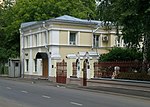
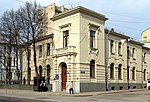
The Morozova Mansion or Zinaida Morozova's Mansion (Russian: Особняк Зинаиды Морозовой), also known as the Morozova Palace or the Spiridonovka Palace, is a neo-Gothic building in the Presnensky District of Moscow, which belonged to Zinaida Grigoryevna Morozova, who was married to industrialist Savva Morozov. Built to the design of the architect Fyodor Schechtel, it has been the Reception House of the Ministry of Foreign Affairs of Russia since 1938. The Morozovs bought the land on Spiridonovka Street in 1893; the mansion was completed by 1898, and Mikhail Vrubel was invited to decorate the interiors. After the death of Savva Morozov, Zinaida Morozova sold the estate to industrialist and philanthropist Mikhail Ryabushinsky, who was forced to emigrate in 1918. After the 1917 October Revolution, the state took over ownership of the mansion, and the building was transferred to the department of the People's Commissariat of Foreign Affairs, and later converted into the Reception House of the Ministry of Foreign Affairs of the Union of Soviet Socialist Republics. During the Second World War, the mansion hosted meetings of the foreign ministers of the United States, United Kingdom and the Soviet Union. In 1995, the mansion was seriously damaged by a major fire, but was restored using surviving drawings and photographs.

Excerpt from the Wikipedia article Morozova Mansion (License: CC BY-SA 3.0, Authors, Images).

Morozova Mansion
Spiridonovka Street, Moscow Presnensky District

Geographical coordinates (GPS) Address External links Nearby Places
placeShow on map

Wikipedia: Morozova MansionContinue reading on Wikipedia

Geographical coordinates (GPS)

Latitude Longitude
N 55.761388888889 ° E 37.591388888889 °
placeShow on map

Address

Особняк Зинаиды Морозовой (Дом приёмов Министерства иностранных дел)

Spiridonovka Street 17
123001 Moscow, Presnensky District
Moscow, Russia
mapOpen on Google Maps

linkWikiData (Q18524259)
linkOpenStreetMap (51049346)

Moscow SpiridonovkaStreet Morozova Palace 01 2017
Share experience

Nearby Places

Ponizovsky House
Ponizovsky House

The Embassy of Afghanistan in Moscow (Persian: سفارت کبرای جمهوری اسلامی افغانستان در مسكو/ Pashto:په مسکو کې د افغانستان د اسلامي جمهوریت لوی سفارت) is the diplomatic mission of the Islamic Emirate of Afghanistan to the Russian Federation. It is located at 42 Povarskaya Street (Russian: Поварская ул., 42) in the Arbat district of Moscow. Following the fall of the country to the Taliban in August 2021, the embassy remained in operation as a representative of the Islamic Republic, until the Russian Ministry of Foreign Affairs accredited Taliban appointee Jamal Nasir Gharwal as charge d'affaires on 9 April 2022.The mission is housed in historical Ponizovsky House, designed by Lev Kekushev, although its exterior was later radically altered and does not display signs of Kekushev's Art Nouveau style. In 1902 Jacob Reck's development company purchased a large Volchkov estate, split it in two lots, and invited Kekushev to design two luxury mansions for resale. The better known Mindovsky House (present-day Embassy of New Zealand) was set right on the street corner, with the main entrance facing the spacious inner courtyard. Ponizovsky House was set back from Povarskaya street line, allowing a narrow strip of garden between the wall and sidewalk; its main entrance faces the corner of Povarskaya Street and Skatertny Lane. Period photographs show that the building had a flattened yet prominent dome above the main entrance and a smaller curvilinear gable above Povarskaya street facade; overall styling was reserved, with clear vertical lines of windows cut through a tiled wall. In 1914, when Kekushev was already inactive, Ponizovsky House was rebuilt to a neoclassical design, losing the dome and all original exterior finishes.

Greater Church of the Ascension

The Greater Church of Christ's Ascension (Большое Вознесение) is one of the largest parish churches in downtown Moscow. It is a major landmark of Bolshaya Nikitskaya Street and Nikitskiye Vorota Square. It is named "greater" to prevent confusion with a nearby church of the same name. The church was commissioned by Prince Potemkin, the owner of a neighbouring messuage, shortly before his death. The yellow-colored Neoclassical building was erected between 1798 and 1816. The name of the architect is not known for certain. It has been attributed either to Matvey Kazakov, who built numerous Moscow churches in the reign of Catherine the Great, or Ivan Starov, who frequently worked for Potemkin. The edifice was overhauled to Osip Bove's designs after the 1812 Fire of Moscow. It stood unfinished for several decades and was not completed (under Afanasy Grigoriev's supervision) until 1848. The church holds historical significance for several reasons. It was in this church that Alexander Pushkin married Natalia Goncharova, a fact commemorated by their fountain statues on Nikitskie Vorota Square. It was also there that Patriarch Tikhon of Moscow held his last service; this is commemorated by a side-chapel dedicated in his name. The church was closed during the Soviet period, between 1931 and 1990. A 17th-century tent-like belfry, the sole remnant of an earlier church on the site, was demolished in 1937 and replaced by a statue of Aleksey Tolstoy, the "Red Count". The current belfry, freely based on Kazakov's designs and similar in style to the main church building, is of recent construction. There is a chapel of ease on Arbat Square.