place

St. John's, Newfoundland and Labrador

1497 establishments in North AmericaCapitals of former nationsCities in Newfoundland and LabradorFormer colonial capitals in CanadaPages with non-numeric formatnum arguments
Populated coastal places in CanadaPopulated places established in 1583Populated places established in the 1490sPort cities and towns on the Canadian Atlantic coastSt. John's, Newfoundland and LabradorUse Canadian English from November 2023
St John's Newfoundland Collage

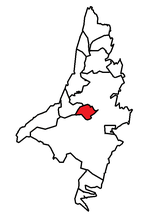
St. John's is the capital and largest city of the Canadian province of Newfoundland and Labrador. It is located on the eastern tip of the Avalon Peninsula on the island of Newfoundland. The city spans 446.04 km2 (172.22 sq mi) and is the easternmost city in North America (excluding Greenland).Its name has been attributed to the belief that John Cabot sailed into the harbour on the Nativity of John the Baptist in 1497, although it is most likely a legend that came with British settlement. A more realistic possibility is that a fishing village with the same name existed without a permanent settlement for most of the 16th century. Indicated as São João on a Portuguese map from 1519, it is one of the oldest cities in North America. It was officially incorporated as a city in 1888. With a metropolitan population of approximately 212,579 (as of 9 February 2022), the St. John's Metropolitan Area is Canada's 20th-largest metropolitan area and the second-largest Census Metropolitan Area (CMA) in Atlantic Canada, after Halifax.The city has a rich history, having played a role in the Seven Years' War, the American Revolutionary War, and the War of 1812. Italian inventor Guglielmo Marconi received the first transatlantic wireless signal in St. John's. Its history and culture have made it into an important tourist destination. St. John's was referred to as Baile Sheáin (Johnstown), in the poetry of Donnchadh Ruadh Mac Conmara (1715–1810), and among speakers of the Irish language in Newfoundland.

Excerpt from the Wikipedia article St. John's, Newfoundland and Labrador (License: CC BY-SA 3.0, Authors, Images).

St. John's, Newfoundland and Labrador
Königsplatz,

Geographical coordinates (GPS) Address Nearby Places
placeShow on map

Wikipedia: St. John's, Newfoundland and LabradorContinue reading on Wikipedia

Geographical coordinates (GPS)

Latitude Longitude
N 47.482222222222 ° E -52.796944444444 °
placeShow on map

Address

Tiefgarage "Königsplatz"

Königsplatz
91126 , Nasbach
Bayern, Deutschland
mapOpen on Google Maps

St John's Newfoundland Collage
Share experience

Nearby Places

Kenmount Road

Kenmount Road is a major road in St. John's, Newfoundland and Labrador. It begins at the intersection of Freshwater Road and Thorburn Road, just east of the Columbus Drive overpass. Originally passing through rural farmland, Kenmount Road is now a significant commercial area, with the Avalon Mall at its eastern end, followed by a series of car dealerships, restaurants, hotels, and other businesses. At its western end, Kenmount Road intersects Topsail Road and the Trans-Canada Highway, and has been extended into the Town of Paradise, where it runs into another road, McNamara Drive. O'Leary Industrial Park is located just north of Kenmount Road, with access via Pippy Place and Peet Street. Further west, past the intersection with the Team Gushue Highway, lies the Kelsey Drive big-box retail area. West of Kelsey Drive, the new Kenmount Terrace subdivision is currently under development. In the 2022 provincial budget it was announced that a school would be constructed in Kenmount Terrace, a first for the area.The Trans-Canada Highway originally continued down Kenmount Road, prior to the construction of the Outer Ring Road in the 1990s, which diverted the highway onto a new alignment across the north of the city. The overpass that carries Kenmount Road (originally the Trans-Canada Highway) over Topsail Road holds a special place in the province. One of the first highway interchanges constructed in the province, it has come to represent the boundary between the St. John's urban region and the remainder of the island. The phrase "beyond the overpass" is commonly used to refer collectively to all areas of Newfoundland that lie outside the boundaries of metro St. John's.