place

Museum of Literature and Theater Arts of Bosnia and Herzegovina

Art museums established in 1961Bosnia and Herzegovina literatureCultural history of Bosnia and HerzegovinaCultural organizations based in Bosnia and HerzegovinaCulture in Sarajevo
Culture of Bosnia and HerzegovinaHistory museums in Bosnia and HerzegovinaIvo AndrićLiterary museums in Bosnia and HerzegovinaMuseums in SarajevoNational Monuments of Bosnia and HerzegovinaTheatre in Bosnia and Herzegovina
Museum of literature BH logo

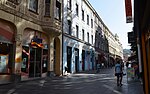
Museum of Literature and Theater Arts of Bosnia and Herzegovina (Serbo-Croatian: Muzej književnosti i pozorišnih umjetnosti Bosne i Hercegovine) is a literary art museum in Sarajevo, Bosnia and Herzegovina. It was established under the name Museum of Literature of Bosnia and Herzegovina in 1961 on the idea of then curator of literary collections in the Museum of Sarajevo, writer Razija Handžić, the future director. In 1970, the Theater Department was founded and added to the Museum of Literature. The idea was conceived around 1955, and gained traction when prominent writer and future Nobel Prize in literature laureate, Ivo Andrić, decided that the original manuscript of his novel The Bridge on the Drina be kept in Sarajevo. The museum is located in the Baščaršija neighborhood in the heart of Sarajevo, in the older of two Despić family house, built in the middle of the 19th century, and whose members donated it to City of Sarajevo.

Excerpt from the Wikipedia article Museum of Literature and Theater Arts of Bosnia and Herzegovina (License: CC BY-SA 3.0, Authors, Images).

Museum of Literature and Theater Arts of Bosnia and Herzegovina
Sime Milutinovića, Sarajevo MZ "Baščaršija" (Stari Grad Municipality)

Geographical coordinates (GPS) Address Nearby Places
placeShow on map

Wikipedia: Museum of Literature and Theater Arts of Bosnia and HerzegovinaContinue reading on Wikipedia

Geographical coordinates (GPS)

Latitude Longitude
N 43.8578 ° E 18.4266 °
placeShow on map

Address

Galerija Mak

Sime Milutinovića 7
71000 Sarajevo, MZ "Baščaršija" (Stari Grad Municipality)
Federation of Bosnia and Herzegovina, Bosnia and Herzegovina
mapOpen on Google Maps

Museum of literature BH logo
Share experience

Nearby Places

Hotel Central (Sarajevo)

Hotel Central is a historic hotel located in the center of the Bosnian capital, Sarajevo. It stands at the corner of Zelenih Beretki and Ćumurija streets. It was built in the 1880s, as part of the development of the Bosnian capital during Austro-Hungarian rule. The building was designed by Croatian architect Josip Vancaš. Unlike many other buildings constructed at that time in the emerging modern center of Sarajevo—buildings that referenced the architecture of Vienna and other cities of the monarchy, Vancaš drew inspiration from Oriental architecture, particularly Islamic design. For the two-story corner building, he designed windows in shapes typical of the Middle East with oriental motifs and horseshoe arches on the first floor. He emphasized the corner of the building with a first-floor balcony and a dome. The hotel was completed in 1889 and became the second hotel in the city, following Hotel Europe. The name Central was chosen because, at the time, Franz Joseph Street - today known as Zelenih beretki - served as the city’s main promenade. The hotel was completed in 1889 based on a design by architect Josip Vancaš and was financed by the city’s waqf (Islamic endowment). The building has three floors. Given its location on one of the most prominent sites in the city center, the Waqf Commission decided to lease out the entire building under the condition that a café would be established on the ground floor. The site where the hotel now stands was originally occupied by the Ajas Pasha Mosque, which was destroyed in 1697 when Eugene of Savoy set fire to Sarajevo. Although the mosque was rebuilt shortly thereafter, it was once again destroyed in a major fire that broke out in the Latinluk district in 1879. Following this second destruction, the mosque was not rebuilt. Instead, the waqf (Islamic endowment) decided to finance the construction of a hotel on the same site, which became known as Ajas Pasha’s Court (Ajas-pašin dvor). During the war in the 1990s, the hotel was largely destroyed and later completely reconstructed. During the restoration, only the outer walls were preserved, and the interior of the building was entirely rebuilt. The renovation of the façade aimed primarily to preserve the original architectural design of the decorative elements. The reconstruction was completed in 2008. The hotel is owned and managed by the Irish company Templeville Developments Ltd. and includes the Westwood Club & Spa within its facilities.

Ferhat Pasha Mosque (Sarajevo)

Ferhadija Mosque (Bosnian: Ferhat-pašina džamija, Turkish: Ferhad Paşa Camii), also known as Ferhat Pasha Mosque, is a central building in the city of Sarajevo built by Bosnian Sanjak-bey (governor) Ferhad-beg Vuković, a descendant of the famous mediaeval Vuković family. This mosque has one dome above the prayer area and three small domes at the cloister and is one of the greatest achievements of Bosnia and Herzegovina’s 16th century Ottoman and Islamic architecture. The Ferhadija mosque reflects the full maturity of the classical Ottoman style-domed mosque, portico with small domes, and beautiful built-on minaret. Research works on the painted decoration inside the mosque carried out in 1964–1965 revealed five painted layers dating from various periods. The oldest and extremely valuable decorations of the first layer date from the 16th century (in the dome, on the cornice and pendentives, the base of the corner calottes, the mihrab and the lunettes of the lower row of windows), belonging to the group known as Rumi ornament, which were also to be seen in the Aladža Mosque in Foča. The next layers (on the calottes, central part of the mihrab, and surface of the dome) consists of purely floral decorations with the features of 18th-century style. The third and fourth layers date from the late 19th century (1878), and the first quarter of the 20th. The mosque was damaged during the Bosnian War in 1992–1995.