place

Nomarhia station

European rapid transit stubsGreek railway station stubsThessaloniki Metro

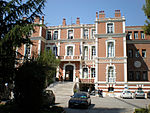
Nomarhia (Greek: Νομαρχία, literally Prefectural Administration) is an under-construction metro station serving Thessaloniki Metro's Line 2. The station is named after the nearby Villa Allatini, which housed the administrative headquarters of the Prefecture of Thessaloniki (Greek: Νομαρχία Θεσσαλονίκης, Nomarhia Thessalonikis). Prefectures were abolished in 2010 and the Villa now houses the regional administration of Central Macedonia, but the station name has remained. It is expected to enter service in 2023.

Excerpt from the Wikipedia article Nomarhia station (License: CC BY-SA 3.0, Authors).

Nomarhia station
Thessaloniki Kalamaria Municipality

Geographical coordinates (GPS) Address Nearby Places
placeShow on map

Wikipedia: Nomarhia stationContinue reading on Wikipedia

Geographical coordinates (GPS)

Latitude Longitude
N 40.591388888889 ° E 22.956944444444 °
placeShow on map

Address


541 10 Thessaloniki, Kalamaria Municipality
Macedonia and Thrace, Greece
mapOpen on Google Maps

Share experience

Nearby Places

Municipal Art Gallery (Thessaloniki)

The Municipal Art Gallery of the Municipality of Thessaloniki in Central Macedonia, Greece was founded in 1966 as an offshoot of the Municipal Library. Since 1986 it has been housed in the Villa Mordoch on Vassilissis Olgas Avenue, a mansion designed by the architect Xenophon Paionidis in the eclectic style in 1905 and owned by the Municipality of Thessaloniki. Since 2013 it is housed in Villa Bianca, also on Vassilissis Olgas Avenue. It also uses the Makridis Room near the Posidonio sports centre on the sea front and the old Archaeological Museum (Yeni Cami) as permanent exhibition spaces. The gallery has more than 1,000 works in its collection, and these are divided into the Thessalonian Artists Collection (3 generations: 1898–1922, 1923–40, 1941–67), the Modern Greek Engraving Collection, the Collection of Byzantine and Postbyzantine Icons, which covers a period of six centuries, the Modern Greek Art Collection, and the Sculpture Collection. The gallery organises regular (mainly retrospective) exhibitions of Greek artists, produces numerous publications, has a specialised library-cum-reading-room, and offers guided tours for the public (booked in advance). Since 1986 it has held 55 exhibitions of Greek and foreign artists. One of its aims is to jointly organise exhibitions with major visual arts institutions in Greece and abroad. Thus it has presented such artists as Max Ernst and Nikos Engonopoulos (in 1997), Theofilos Hatzimichail (in 1998), and, for the first time in Greece, the works of Nikolaos Gyzis owned by his family (in late 1999). The latter include drawings and oil paintings from Gyzis’’s travels in Greece, Asia Minor, and Germany, family portraits and scenes, allegorical subjects, genre paintings, and still lives. The immediate aims of the Municipal Gallery include converting the second and third floors of the Villa Bianca into permanent exhibition spaces for works by Thessalonian artists and its collection of Byzantine icons.

Campbell pogrom
Campbell pogrom

The Campbell pogrom, also known as the Campbell riot, was an antisemitic pogrom that took place on 29–30 June 1931 in the Campbell neighbourhood of Kalamaria in Thessaloniki, in the Macedonia region of northern Greece. Campbell was an impoverished Jewish settlement, set up in the aftermath of the Great Thessaloniki Fire of 1917 to house Jewish refugees. The fire severely damaged the economic position of Thessaloniki's traditionally strong Jewish community. During the 1920s, the Jews became politically isolated, and were held responsible by the Venizelist political faction for both the Venizelists' defeat in the 1920 Greek legislative election and the Greek defeat in the Greco-Turkish War of 1919–1922. In the mid-1920s, the first fascist organisations appeared in Thessaloniki, and engaged in antisemitic activities with tacit governmental approval. Venizelist newspapers, particularly Makedonia, ran articles characterising the Jews as a foreign population that sought the destruction of Greece. While antisemitism had little prominence in Greek national politics, it became an important force in Venizelist politics in northern Greece, and among Christian refugees from Asia Minor and Eastern Thrace. Encouraged by false accusations of Jewish collaboration with Bulgarians and communists to bring about the independence of Macedonia from Greece, refugees from Asia Minor, reservists of the Hellenic Army and members of nationalist organisations enacted a campaign of antisemitic violence and intimidation throughout June 1931. Following limited responses from the local authorities, including the governor-general of Macedonia, Stylianos Gonatas, nationalists attacked several Jewish neighbourhoods on the night of 29–30 June 1931. The greatest violence took place at Campbell, where the attacks resulted in the destruction of the neighbourhood, the deaths of a Christian resident, and dozens of injuries. Other attacks took place in other Jewish neighbourhoods, including one in the "151" camp in Kato Toumba, in which a Jewish resident, Leon Vidal, was fatally wounded. Local authorities largely failed to prevent violence, and hindered attempts by Jewish residents to resist the attacks. In the ensuing trial, the perpetrators of the attack were all acquitted, while members of the Hellenic Parliament defended the pogrom as an act of patriotism. The government of Eleftherios Venizelos stated that it would support the Jewish community, but provided minimal financial assistance towards its recovery, with the result that thousands of Jews permanently left Thessaloniki, particularly for France and Palestine. The city's Jewish community remained substantially alienated and weakened until the imposition of a dictatorship under Ioannis Metaxas in 1936.