place

Museo Antropologico y de Arte Contemporaneo

2003 establishments in EcuadorArt museum and gallery stubsArt museums established in 2003Buildings and structures completed in 2003Buildings and structures in Guayaquil
Ecuadorian building and structure stubsModern art museumsMuseums in EcuadorTourist attractions in Guayaquil
Guayaqil MuseoAntropologicoydeArteContemporaneo

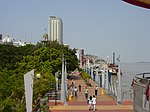
Museo Antropologico y de Arte Contemporaneo (English: "Anthropology and Contemporary Art Museum"), or MAAC is a state-of-the-art museum in Guayaquil, Ecuador celebrating Ecuadorian, Latin American and Pre-Columbian art and culture. MAAC is a welcome addition to Malecón 2000, the renovated riverwalk in Guayaquil. Inaugurated on 30 July 2003, MAAC aims to constitute itself in a catalyst for the development of the local, regional and national artistic culture. MAAC's mission is to harness the institutional cultural patrimony, by showcasing a valuable collection of 50,000 native Ecuadorian archaeological pieces and over 3,000 modern works of art. The MAAC offers many integrated programs that include exhibitions, conferences, round tables, factories, projections of cinema, scenic arts, through which it aims to fulfill the challenges of putting the cultural patrimony to the service of the development of the Country and to help in cultural education of the community, on the base of a permanent interchange, stimulating the critical conscience of a diverse community.

Excerpt from the Wikipedia article Museo Antropologico y de Arte Contemporaneo (License: CC BY-SA 3.0, Authors, Images).

Museo Antropologico y de Arte Contemporaneo
Simón Bolívar Promenade, Guayaquil Rocafuerte (Carbo-Concepción)

Geographical coordinates (GPS) Address Nearby Places
placeShow on map

Wikipedia: Museo Antropologico y de Arte ContemporaneoContinue reading on Wikipedia

Geographical coordinates (GPS)

Latitude Longitude
N -2.1855861111111 ° E -79.876052777778 °
placeShow on map

Address

Simón Bolívar Promenade

Simón Bolívar Promenade
090313 Guayaquil, Rocafuerte (Carbo-Concepción)
Guayas, Ecuador
mapOpen on Google Maps

Guayaqil MuseoAntropologicoydeArteContemporaneo
Share experience

Nearby Places

Guayaquil Municipal Museum

Guayaquil Municipal Museum (Spanish: Museo Municipal de Guayaquil) is a museum in Guayaquil, Ecuador. It contains artifacts, objects and historical items relating to the history of Guayaquil. It is considered the most important of the city and one of the best in the country. It is located in the center of the city of Guayaquil, in the same building as the Municipal Library. Admission is free, but passports are required.The museum has its origins in 1863 when an industrial museum was started by the politician and writer Pedro Carbo Noboa, making it the oldest in Ecuador, but it was not until 1908 that the museum was officially founded. The first director was Camilo Destruge Illingworth. The museum has gone through a variety of moves and renovations, acquiring its own building for the first time in 1916.The museum's website outlines the following rooms: Pre-Hispanic Room: ceramic, metal, and stone objects and handicrafts from the Valdivia, Machalilla and Chorrera cultures Colonial Room: includes Spanish firearms, a diorama from the old church of Santo Domingo, the layouts of Guayaquil traced between 1170 and 1772 by Francisco Requena and Ramon Garcia de Leon y Pizarro, and a scale model of the city made by architect Parsival Castro according to a sketch made in 1858 by Manuel Villavicencio" Religious Art Room: "an exhibition of mystic scenes comprised by religious paintings from the churches of Guayaquil; icons and archetypes of sacred art, and sculptures crafted by colonial artists like Diego Robles" Numismatic Room: coins, particularly the barter systemThe museum also has a collection of tsantsas, or shrunken heads.

Battle of Guayaquil
Battle of Guayaquil

The Battle of Guayaquil was the final and pivotal armed confrontation in a struggle for political control of Ecuador. The battle was fought on the outskirts of the city of Guayaquil, Ecuador on September 22–24, 1860, among several factions claiming control of the country in the wake of the abdication of president Francisco Robles, amidst continuous Peruvian military pressure due to the ongoing Ecuadorian–Peruvian territorial dispute. The battle brought an end to a series of skirmishes between the forces of Gabriel García Moreno's Provisional Government, backed by General Juan José Flores, and the government of General Guillermo Franco in Guayas, which was recognized by Peruvian president Ramón Castilla. After a series of internal problems and diplomatic issues with Peru, Ecuadorian president Francisco Robles resigned from his post on May 1, 1859, leaving control of the country split among a number of Jefaturas Supremas (Supreme Commands). Ecuadorian statesman Gabriel García Moreno created a provisional government seated in Quito, while General Franco declared himself Supreme Chief of Guayas. Peruvian President Castilla, intending to take advantage of the leadership crisis to broker a favorable territorial deal, commanded a Naval force that blockaded the Gulf of Guayaquil. Failing to reach an agreement with García Moreno, Castilla met with Franco and signed the Treaty of Mapasingue, recognizing all disputed territories as belonging to Peru. The expeditionary troops returned to Callao on February 19, 1860, after supplying Franco's army with boots, uniforms, and 3,000 rifles.Accusing Franco of treason for signing the treaty with the Peruvians, Gabriel García Moreno, allied with former enemy General Juan José Flores, attacked Franco's forces, setting off a civil war. After several battles, García Moreno's forces were able to force Franco's troops to retreat back to Guayaquil, the site of the final battle. García Moreno won the encounter, bringing an end to the factional war. The battle was the culmination of a period of instability, known as the terrible year of Ecuadorian history. With his side prevailing, García Moreno restored peace to the country, and ushered in what would later be looked on as the era of Conservatism, the establishment of authoritarian, if not frankly dictatorial, regime that outlived him by twenty years, until 1895.The Treaty of Mapasingue was annulled by the Ecuadorian Congress in 1861, and by the Peruvian Congress in 1863, during the presidency of Miguel de San Román.